Religulous

Bill Maher’s Religulous was almost exactly what I expected and worth seeing. He makes no attempt to be comprehensive, cherry picking from among the wealth of religious extremists in the Abrahamic traditions as well as some more mainstream folk. The movie is often hilarious and just as often makes you wonder how our species has survived. He presents an even balance between examples of all too scary reality and the “are you kidding me?” moments.

Maher asks most of the Atheist 101 questions that non-believers consider when either rejecting the religion of their childhood, or attempting to understand theist positions at all. Sometimes, he is just being Bill Maher, a snarky comedian poking fun at the fringes and speaking out against perceived hypocrisies and injustice. Other times, his questions strike at the heart of human need for what religion has to offer and how churches often pervert that desire to gain power and control. Engaging were his own autobiographical narratives, outlining his own religious journey.

For the most part, I agree with Maher’s conclusions. The only caveat I would add, which you loyal readers know from my previous posts on dis-organized religion, is that I believe that we can create a religion without the faults of organized religion but that provides people with the loving, covenanted community that can heal, sustain, and transform us into better people and toward a better society. Maher heads toward the conclusion that many atheists adopt, which I believe throws the baby out with the bath water.

Deconstructing Hymns

Yes, I am one of those Unitarian Universalists who reads ahead as we sing hymns to determine whether or not I agree with the lyrics. I believe that our commitment to reason, truth, and meaning demands this of us. Sometimes, of course, my love of a tune or certain lyrics can clash with my reticence regarding other words.

On a recent Sunday morning we sang one of my favorite hymns, “We’ll Build a Land,” a tune I find appealing and singable. The imagery of certain phrases stirs my imagination, such as “raising up devastations from old,” “restoring ruins of generations,” “mantle of praises resound,” and “oaks of righteousness.” At the same time, other phrases trouble me either linguistically, theologically, or both. I’m not sure what “oil of gladness” represents, for example, or whether giving the afflicted “garlands instead of ashes” has meaning beyond the poetic.

My greatest challenge, however, comes during the refrain, which reads, “Come build a land where sisters and brothers, anointed by God, may then create peace.” I am inspired by the commitment to peace. However, I cringe at the notion that we cannot create peace without the input of God (and am curious about the nature of this “anointing”). Over the years, however, I have allowed myself to compromise my qualms in order to enjoy great music shared with other voices in loving community.

Until the day comes that I have time to write The Atheist’s Hymnal, I will gladly embrace the spirit of such hymns.

The Religious Servant Leader in Dis-Organized Religion

Fleshing out this notion of dis-organized religion compels me to define the role I would see myself filling within an intentional community. I offer the following as a vision for that role that I would love to make happen.

Human beings need elements of religion to live in harmonious community. These include those parts of our lives that continue (re-) to bind us together (-ligio) as people. Historically, however, the negative impacts of organized religion outweighed the positive contributions to the health and welfare of human community. Therefore, communities are better served by a new kind of religion – a “dis-organized” religion. The essential tenets of such a religion entail a code of freedom:

  • from the construct of “god” in any of its manifestations, or of any “supernatural” or “spiritual” planes of existence (religious atheism is not anti-theist, but stresses the non-experience of a deity);
  • from the presumption that humanity is evil, sinful, or deserving of punishment;
  • from all religious creeds and dogma, or the belief that people must obey religious authority; and
  • from limitations to exploration of religious experience and understanding.

And, it is the freedom:

  • to believe as one wishes;
  • to “be” oneself fully, as an equal partner with and responsible for all existence;
  • to live with and to love others fully;
  • to think and to feel fully; and
  • to experience all within yourself and among others, as part of whatever constitutes our world.

Would there be ministers in this dis-organized religion? While this religion would invent its own reverent language, one may note that the Latin root of the word “minister” means “servant.” “Ministers” in dis-organized religion would be servant leaders, helping others explore their religious selves by serving them (for further reading on the concept of servant leadership, see the materials from the Greenleaf Center). For thousands of years in human communities, people have served the role of religious servant leader. This role possesses many names: shaman, prophet, guru, oracle, lama, rabbi, priest, imam, minister. Intentional community needs this role as well, although divested of much of the historical legacy of these examples. For that reason, this role requires a new name and not any of the traditional titles. For sake of simplicity, call this role the Voice.

What is the Voice not?

  • The Voice is not divine or saintly, seeking to be no more or less special than others in the community.
  • The Voice uses powers of reason and intuition, and is not in touch with any supernatural forces, spirits, or “god.”
  • The Voice has a unique focal emphasis within the community, but possesses no inherently unique talent, skill, or ability.
  • The Voice is not an authority over others or over the community; if anything the Voice eschews power or dominance.

What is the Voice?

  • Like a shaman, the Voice is “one who knows,” who can heal the ailing heart and mind.
  • Like an oracle, the Voice is a visionary, who observes and interprets forces and trends.
  • Like a guru, the Voice is a “destroyer of darkness,” who mentors in search of understanding and learning.
  • Like a lama or rabbi, the Voice is a teacher, who enlightens by offering the tools of learning and an objective perspective.
  • Like a prophet, the Voice is a guide, who seeks truth in service of others.
  • Like a priest or imam, the Voice is a celebrant, who builds community through worship and rites of passage.
  • Like a minister, the Voice is a religious servant leader.

What does the Voice do?

  • The Voice monitors the cultural health of the community and individuals within the community.
  • The Voice is a doctor of the community body.
  • The Voice provides expert advice in coordinating the multiple codes of the community’s belief system.
  • The Voice preserves community traditions and helps the community celebrate group and individual achievements and milestones.
  • The Voice mentors and teaches so that all may grow more mindful.

What are the attributes of the Voice?

  • The Voice offers a comprehensive view on all matters.
  • The Voice always looks to the long-term future while meeting the needs of today.
  • The Voice is in touch with the flow of the community.
  • The Voice seeks to be ever more wise, knowledgeable, and insightful.

I have participated in many Unitarian Universalist youth worship services, which in many ways epitomizes the experience I envision for everyone. Is it possible? If it was built, would anyone come? A large part of me wants to buy an old church or warehouse and convert it into a collage of studios, clinics, and other community activities and see what happens.

Ministry in Dis-Organized Religion

You, who are on the road,
Must have a code that you can live by.
And so, become yourself,
Because the past is just a good bye.

Teach your children well,
Their father’s hell did slowly go by.
And feed them on your dreams,
The one they picks,
the one you’ll know by.

Don’t you ever ask them why,
if they told you, you will cry,
So just look at them and sigh and know they love you.

And you, of tender years,
Can’t know the fears that your elders grew by.
And so please help them with your youth,
They seek the truth before they can die.

Teach your parents well,
Their children’s hell will slowly go by.
And feed them on your dreams,
The one they picks, the one you’ll know by.

— Graham Nash

When I was a teenager, I bought Crosby, Stills, Nash and Young’s live album Four-Way Street. I remember being enormously disappointed, because the songs did not sound the way I knew them. I traded the album to a friend (for Pink Floyd’s The Wall, which I’m sure has all kinds of deep meanings) and didn’t listen to CSNY for years.

A few years ago, I rediscovered CSNY and other music from those formative years. Some songs were like long lost friends. Others were new acquaintances. Some, I knew, but had never really heard or understood.

For the past year, I have been on a pilgrimage – a journey not of body, but of the heart and mind. It began over Thanksgiving, when I gave a short talk to several hundred Boy Scouts about Unitarian Universalism. I explained that the UU church is a home for all religious seekers, even atheists like myself. Even though I have been an atheist for many years, over the ensuing weeks I found myself thrust into a new public “outness,” when people approached and thanked me for my comments.

When my son was home for winter break, we had several long talks. As a result, I began blogging about disillusion in America and directions we can take to build intentional community together. I began to consider the shape of my future ministry as a religious atheist and what my “church” would look like in such an intentional community.

My son recently asked me to read Days of War, Nights of Love by the CrimethInc. Ex-Workers Collective (http://www.crimethinc.com/books/days.html). If you have read this post to this point, you should stop whatever you are doing and look into their writings. I don’t agree with all of their conclusions – yet – but I find their work inspiring and thought-provoking. The book nudged me further along my path toward ministry in dis-organized religion.

What is the role of religion in a community that rejects “organized” religion? For me, dis-organized religion is a code of freedom:

  • from the construct of god
  • from creeds and dogma
  • from limitations to spiritual exploration

and it is the freedom:

  • to believe
  • to be, to live and to love
  • to think and to feel
  • to experience all within yourself, among others, and as part of existence

What is my role as a minister in dis-organized religion? Well, for the CrimethInc folks, ministry is what I love. I have given up much to become a minister and now know that I would sacrifice almost anything for my ministry. The Latin root of the word “minister” means “servant.” I see ministers as servant leaders, who help others explore their spiritual selves by serving them. Service also includes celebrating rites of passage, nurturing through chaplaincy, and offering vision and insight with a prophetic voice to inspire, encourage, and imagine.

I fed my children on my dreams and now they are helping me find my truth in my elder years. I have a long road to go, but with their help, I will travel on.

Visual Displays

About 25 years ago, I attended a talk at a conference by a man named Edward Tufte. He had just written a book titled The Visual Display of Quantitative Information. His talk and the focus of his book was on what makes a good graph, or visual display of information, as well as what qualifies as a poor graphic.

I loved the presentation and immediately purchased the book (which I still recommend highly). One of the most memorable parts of the book is his presentation of a classic chart by Charles Joseph Minard (1781-1870), showing the fate of Napoleon’s army during its invasion of and subsequent retreat from Russia. Drawn in 1861, the plot displays six variables: the size of the army; its location on a two-dimensional surface; the direction of the army’s movement; and the temperature on various dates during the retreat. Tufte suggests that it may be the best statistical graphic ever drawn, and I agree.

I have had a copy of this graphic posted by my desk ever since, which has followed me from office to office. Minard’s map is a constant reminder to me of excellence. Every time I look at this graphic, I imagine how I can strive to work to produce something outstanding, either in its impact or in its effectiveness. This graph also reminds me daily that our lives are endless visual displays to those around us and to the world of what humans can accomplish if they put their minds and their hearts to a commitment.

Will I ever produce anything as elegant and memorable as Minard’s graphic? Who knows? Perhaps I already have and do not even realize it. Regardless, I find that a worthy goal every day, applied to my work, my interactions with people, or just how I live my life.

Peace and PTSD

I recently completed a unit of Clinical Pastoral Education (CPE), at the Veteran’s Administration Hospital here in Pittsburgh. During my time at the VA facility, I visited patients in various life and medical conditions, met some amazing people, and learned a great deal about myself and my ministry. Early in my time there, I met a Vietnam veteran. The visit shaped my entire time in CPE and, in one way has brought me close to the end of a road in my life.

First, I need to share with you the landmarks I have passed on this particular path. When I was 10 years old, my oldest brother, Jon, was my hero and, next to my father, my most important role model. He went to fight in Vietnam. It was 1968, the worst year of the war. The television news bombarded us nightly with images of death, reports of opposition to our involvement, and editorials questioning our core goals as a nation and as a people.

I saw and heard these reports. But, all I cared about was that Jon would come home safely. I did not care about falling dominoes. I did not care about the welfare of people halfway around the world. I wanted our armed forces to bomb our enemy into oblivion so that Jon, my brother, would not be harmed.

Jon finished his tour of duty and returned home. We celebrated in our dining room the night he got back. There he was, thinner and a little older, but still the brother I knew and loved. Almost the next day, however, the change started. Jon talked less and spent much more time alone. He stayed up all hours of the night, reading voraciously. He and his wife quarreled more often. Jon’s patience with his children grew shorter. I did not know what was happening, but sensed that some part of my brother was missing.

I entered junior high school and began a lifelong passion for history, particularly about Nazi Germany. I, too, read voraciously. One book, titled Treblinka, chronicled the events that occurred at the concentration camp of that name in Poland. The account introduced me to the Holocaust and engaged my curiosity and revulsion about the potential for humans to harm each other. My interest in that era of our past gradually shifted away from battles and military strategy, to the people of Germany…not the soldiers and fanatics, but nurses, store owners, professors, and ministers…everyday people. I still believed in war, at least that we needed to fight wars to protect ourselves, our way of life, and our basic principles of freedom and democracy.

One thing that did die in me during that time was my belief in God. Like many people who travel the path that leads to atheism, I could not imagine how the God that all of my friends believed in could ever allow a thing like the Holocaust to happen. Why would the father of Jesus condone war at all? As a result, I lived unchurched for many years, until I happened to discover Unitarian Universalism.

In Unitarian Universalism, I found a religious home that shared my revulsion for war, but still welcomed those who felt that sometimes war is necessary to defend freedom and democracy. Unitarian Universalism welcomed the lifelong learner in me who taught religious education classes and wrote curricula for other churches to use. While writing one of my curricula, Thinking the Web, I explored the theory of Just War. Just War is a doctrine of ethics asserting that a conflict can and ought to meet the criteria of philosophical, religious, or political justice, provided it follows certain conditions. An example of these conditions would be “Just cause,” which states that the reason for going to war needs to be just, such as recapturing things taken or punishing people who have done wrong. Another example is the condition of “Proportionality,” which states that the force used must be proportional to the wrong endured, and to the possible good that may come. The more disproportional the number of collateral civilian deaths, the more suspect will be the sincerity of a belligerent nation’s claim to justness of a war it fights.

Taken in it’s entirety, the conditions defining Just War made a good deal of sense to me. At the same time, however, I also wrote a class session on conscientious objection and began to explore the philosophy of pacifism. Honestly, I found unconditional pacifism untenable. I admired Gandhi’s vision of nonviolent resistance, but frankly felt that the position taken by the historic peace churches – the Quakers, the Church of the Brethren, and the Mennonites – simply avoided the challenges we face in a modern global society.

When I entered the seminary, I took a class on Unitarian Universalist History. I wrote a paper on the Unitarian response to Nazi Germany. My research revealed much division in the 1930’s on the issue of pacifism. Those advocating absolute pacifism, led by John Haynes Holmes of the Community Church in New York City, were challenged by ministers such as James Luther Adams, who had traveled in Nazi Germany and foresaw the horrors to come. Many Unitarians straddled the fence, eventually supporting the effort once the European conflict erupted, and more strongly after Pearl Harbor. I found myself sympathetic to what I called Realistic Pacifists, who abhored war, but recognized the necessity of the practice.

And yet, throughout this journey, my doubts grew. I lived through the Gulf War and then the invasion of Iraq. I saw Just War theory brutalized by those with financial motivations, or historic biases against the Muslim people. I read more history, now revealing even more complicity by the United States in the birth and growth of Nazism in Germany and the hatred of America by the Japanese. I began to see more clearly the attitude of Gandhi and Jesus, that violence only propagates more violence, continuing the cycle of humans harming one another.

Which brings back me to my latest landmark on this particular road. One day, I entered the room of a patient. We only shared 30 minutes or so together. Somehow, at that moment, this man decided to share with me his experiences in Vietnam. I believe in synchronicity – that sometimes two events or two people can come together in some larger meaning, but that there need not be any identifiable cause for the meeting. What this man had been feeling for 40 years came flowing out with me.

During CPE, students spend time in clinical sites, in small group processing exercises, and in more traditional learning sessions called didactics. Just the day before, my group learned about Post Traumatic Stress Disorder (PTSD) during a didactic. This man exhibited every symptom.

  • He had been exposed to traumatic events during the war;
  • He reexperienced these events over the years in flashbacks and nightmares;
  • He had never been able to talk about things even related to the experience that would trigger these memories;
  • He experienced persistent difficulty with sleep, anger, and being hypervigilant, that is, sensitive to things such as loud noises; and
  • He had experienced these symptoms for years and they significantly impaired his ability to function in social and work settings.

As we spoke, I shared my feelings about my brother and stories Jon had shared with me. He told his own stories, including one about a Vietnamese girl who used to come into the soldiers’ PX. He said that the soldiers bought her whatever she wanted because she was so pretty and innocent. He went on to tell me that, one day, he picked her up…and she exploded. She had been booby-trapped.

He began to cry and I joined him. He was frustrated by his tears, but I told him what I had learned the day before. You have been through a traumatic experience. Crying is the reaction any normal person should have when faced with such an abnormal experience. These tears have waited 40 years to come out of you.

Afterwards, I reflected on this visit and felt deep sadness for this man. I could only imagine the tragedy of his life for the past 40 years. I realized fully for the first time that the victims of war include not only the dead, the wounded, the imprisoned, and the displaced, but all of the soldiers engaged in the conflict, their families and friends, and everyone whose lives they touch. I realized that no cause, no reasons, no justification could warrant the destruction of war, the destruction that war caused this man for the past 40 years. And, I knew that we will continue to devastate the lives of men like this until we end war; until we disavow all violence toward one another; until we pledge once and for all not to harm each other.

Therefore, I have committed to live the rest of my life nonviolently. I will militantly defend the innocent with my own life if needed. But, I will strive never again to harm another person mentally, physically, or emotionally. I make the distinction set forth by John Haynes Holmes in his 1916 book New Wars for Old, in that I will lift my “militancy from the plane of the physical, to the plane of moral and spiritual force.” As a human being, I will struggle to maintain this pledge. As a human being, I recognize that I will harm others. But, as a human being, I know that we have the potential to end war; we have the potential to love each other; we have the duty to try to live nonviolently. The cycle of people harming one another cannot stop until enough of us pledge to end our violent behaviors.

Will I advocate that the Unitarian Universalist Association join with the Quakers, the Church of the Brethren, and the Mennonites, and become a peace church? Yes. But, I will also advocate that we understand that the path to pledging to nonviolence can be long and difficult. I will advocate patience and understanding as people struggle with the commitment. As a noncreedal peace church, Unitarian Universalism can become a home for people struggling to make this commitment where they will not be judged for their current position on the matter; a home for further discussion about both the practical and the theoretical issues of war and peace; and a home for people to share their feelings and experiences openly in loving community.

(this is the bulk of the text of a sermon I delived on Sunday, August 10, 2008 at the First Unitarian Church of Pittsburgh)

Mother’s Day

I know, I am early and there are 44 shopping days left until Mother’s Day. Sadly, that statistic tends to dominate our thinking regarding holidays. Hardly a celebration remains unsullied by the taint of consumerism.

As a father, I admit to appreciating a day devoted to my dedication as a parent. But, isn’t our reward knowing every day that we did our best to raise our children to face the world and, hopefully, make it a better place? Wasn’t my reward all of those years with my own children and the opportunities to coach, advise, and educate others’ children? Do I really need a card, or a grudgingly purchased gift to confirm the quality of my fatherhood?

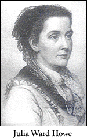
This wasn’t the original purpose of the holiday. Unitarian abolitionist Julia Ward Howe wrote the lyrics to The Battle Hymn of the Republic after reviewing Union troops in Washington, D.C. in 1861. However, the ensuing four years of death and destruction convinced her that peace was the only path for a sane society to pursue. With the outbreak of more madness in the Franco-Prussian War in 1870, Howe issued a proclamation calling for a congress of women to “promote the alliance of the different nationalities,the amicable settlement of international questions,the great and general interests of peace.”

After achieving her goal, Howe’s Mother’s Day for Peace was celebrated for several years, but never achieved national recognition. In 1914, President Woodrow Wilson declared the first national Mother’s Day with an intent to honor mothers, but commercialization of the holiday quickly became rampant. The original meaning of the holiday was soon lost.

Last summer, some colleagues in Kansas City initiated an effort to reclaim Mother’s Day. Julia’s Voice is a group of “mothers and others” joined together to return Mothers Day to its original intent. They are looking for people across the country to join with them on May 11 to speak out against war. I will be preaching on the subject on May 4 (the Sunday before Mother’s Day) at the First Unitarian Church of Pittsburgh and I encourage others to join them.

The best way to honor mothers is to incorporate the best qualities of motherhood into our social policies and governmental actions. The best way to honor mothers is never again to put them, their children, or their partners in harm’s way. The best way to honor mothers is to strive for a world where peace becomes the norm. As an aspiring Unitarian Universalist minister, I have always been frustrated at our lack of unique holidays. We have our rituals, such as Water Communion and Flower Communion, but our liturgical calendar seems filled with observances from other religious traditions. Let us work to reclaim this holiday created by a Unitarian and embodying an important principle of our denomination — the goal of world community, with peace, liberty and justice for all.

Illusions in America Today #8

The news last week that 1 in 100 Americans are currently in prison should shock every citizen of this nation. Our elected officials want desperately for us to feel “safe,” which really translates into being complacent and satisfied with the status quo. In fact, this trap of safety is what should appall us into action, as we watch another generation lose their futures and dreams in the bureaucracy of the criminal justice system.

No matter how one assesses this issue, a system that incarcerates 1% of your population for criminal activity is a failure. Every dollar spent on building prisons is a dollar not spent on education, health care and job creation. Every brick laid for prison walls is a 100 year commitment to maintaining a physical facility at a time when we are closing down mental hospitals, bridges are collapsing, and social service agencies scramble for dollars just to stay open.

If we agree that the current system is broken beyond repair, what is the answer? First, society must address the core basic needs of its people in order to prevent the roots of crime – economic injustice, hate, and lack of opportunities. Instead of mandatory sentencing, we should have mandatory funding for education and health care for every citizen. Every dollar spent on policing should be matched by at least a dollar on community development and economic improvements.

How would an intentional community handle this issue? Our intentional community is committed to nonviolence, so the top priority must be placed on dealing with crimes involving violence. But, what are the roots of violence? The best way to address violence is to live nonviolently in every aspect of life, which includes not only personal relationships, but economically as well. No one should earn money at the expense of another’s well being. Every citizen must receive equal treatment and access to services and freedoms. But, most importantly, every citizen should expect to contribute to the well-being of the communities and to their neighbors. These are expectations that should be taught from the youngest ages and accepted by everyone in the community regardless of age or ability.

Would we ever incarcerate anyone? Yes. But, only those whose repeated acts of violence show that they are presently incapable of normal social interaction. At that point, they give up their rights as equal citizens and enter into a mandatory program of treatment and training designed not to punish a criminal, but to truly reclaim a human being. For nonviolent offenders, there are many useful tasks that can be assigned as compensation to the community for their lawlessness. Forced labor is not cruel and unusual. Locking someone up in a tiny cell for years on end is cruel and unusual. Forced treatment and training is an infringement on absolute individual rights. But, it enforces the right of the community to survive and thrive which, in the end, best serves the rights of the individual as well.

Just as education is not solely the responsibility of professional teachers, the management of criminal acts is not solely the responsibility of trained law enforcement agents. We must reexamine our notions of justice and address every level of the system in order to better use our precious financial and human resources.

George Romero’s Diary of the Dead

George Romero’s latest film offering is getting limited distribution, and I recommend that you catch it quickly. As the latest in his Living Dead movies (following Night, Dawn, Day, and Land), Romero offers us yet another entertaining, yet meaningful glipse into horror. Here are a few comments without spoilers.

Night of the Living Dead is an American classic. Other directors have tried to copy it a hundred times, mostly failing miserably. In Diary, Romero returns to the events of the original Night and tries to copy his own masterpiece, updating to modern times and with a different perspective. I think he achieves this goal. He pays due homage to the original without simply xeroxing its formula, succeeding in creating a whole different story with different people that is engaging and meaningful.

As in most of his work, Romero succeeds in horrifying us not with a monster, but with the monster represented by humankind. In Diary, Romero is no longer subtle about this message, putting into the narrative “movie within the movie” the voice of judgment, ending with a powerful ultimate question. What other director indicts our society this forcefully while still entertaining and thrilling audiences?

Fans of horror films walk into a new Romero movie expecting excellence because he generally delivers it. That’s why, when he tries something new, we have to roll with the punches of a master at work and try to go with his flow. The vehicle of this film, of film students chronicling the events, succeeds where Cloverfield perhaps failed in that these are purpose-driven people acting in ways that even they have troubling articulating. Jason is not a cardboard hero. He has trouble at times explaining his muse and why he is doing what he is doing. The characters are conflicted, which is of course trademark Romero. He never gives you an easo hero or heroine and never hands it to you on a plate. You, the viewer, will be entertained, but he also wants you to think and to leave the theater mad and frustrated by the world.

And, of course, the fanboy in me wants great special effects and he delivers again. There are a couple of memorable dispatchings of zombies and some subtly creepy images. The video taping was effective without the jarring quality of other films (like Blair Witch Project) that have used this vehicle. So, my recommendation is “Don’t miss it.” Diary is an admirable addition to the Living Dead lexicon and deserves our praise. This is the work of a master craftsman in his prime, challenging us the way all great artists do.

Role of the Church in an Intentional Community

My premise has been that America suffers under debilitating illusions and that our best solution is the creation of intentional communities seeking to disillusion themselves. These communities would model for others more just and loving ways for humans to live together. What role would the church play in such a community?

My answer involves the creation of a pizza, with the following ingredients:

  • recognition of ceremonies of human rites of passage common to most religious traditions (birth, mariage/union, death, coming of age, etc.);
  • celebration of an inclusive liturgy that honors the wisdom found in all religious traditions;
  • promotion of the principles that are the bedrock of our moral code, which again are generally common to most religious traditions;
  • education for all ages on spiritual practices and ways of understanding core elements of life and human relationships; and
  • empowerment of all citizens to pursue their unique ministries within the community.

All of these ingredients would be laid on a foundation that is noncreedal, yet open to the reverent language and imagery of all theologies. Therefore, this church will not require a belief in any supernatural being or forces, but will recognize that human knowledge is limited and that a commitment to a free and responsible search for truth and meaning is essential.

Briefly, what do each of these ingredients of our religious pizza entail?

Rites of Passage – Every child is a holy child; love between people is our core principle; aging, life transitions, and death are natural processes.

Inclusive Liturgy – All religions derive in part from a shared foundational wisdom worthy of celebration; our church would honor all messages of universal redemption and commitment to a higher ideal.

Moral Code – Nontheism; the existence or nonexistence of a god or gods is not relevant to the creation of loving and just principles for living; as children of all universes, we are imbued with the ability to define a moral code and to live by it.

Religious Education – Science may never explain all that exists, certainly not in ways that help us here and now to deal with life’s challenges; we can educate (not indoctrinate) people about the art of living and train them to use tools to cope and to aspire to greater consciousness.

Ministry – Ministry is not the task of professionally trained individuals alone; all of us have the capacity to minister to each other; each of us has gifts worth sharing that should be encouraged to blossom and grow.

Peter Morales, candidate for the Presidency of the Unitarian Universalist Association has a short video on YouTube. While I have no position at this time on the election, I was moved by a sentiment he expressed relative to the need for this denomination to grow. He said that we must feed the spiritually hungry and house the religiously homeless if we are to heal and transform the world. I could not agree more. Our church, and the church I propose, would reach out to all people of every cultural and religious background – theist, atheist, deist, polytheist, pantheist, etc. – in recognition and celebration of our shared beliefs in principles affirming love, justice, and unity with all existence.