Nonbelievers Are Now at the Table

In his 2009 Inaugural speech today, President Barack Obama discussed the religious landscape of the United States. “For we know that our patchwork heritage is a strength, not a weakness. We are a nation of Christians and Muslims, Jews and Hindus — and nonbelievers.” When I heard this word, my heart leaped in my chest. For the first time in my recollection, an elected official welcomed me to the table of religious Americans.

A twinge in my mind wished he had chosen a more positive word — one that did not focus on the negative of our belief. But, the joy of being included at all quickly swept away any sense of disappointment or argument. For once, my President recognized me as a person. My President honored my journey and did not recoil in fear from fellow seekers on the path of truth and meaning. My President opened a space in the national dialogue for me to enter, not as a combatant or even an enemy, but as a colleague and as a friend.

In some ways, nonbelievers are one of the largest closeted minorities in this country. Public declaration of atheism is, in many venues, a killing blow. A 2006 study showed that atheists are the least trusted group of people in this nation. And, while my argumentative spirit always enjoys a good challenge, the prevailing attitude against my fellow atheists, agnostics, and other nonbelievers hurts on a deep personal level.

Last year, during my clinical pastoral education unit, I was dismissed by a hospital staff member after leading a worship service in the chapel. He asked me what I believed about Jesus. I did not even finish my first sentence before he held his hand up, told me he would pray for me, and walked away. I was not surprised — I have had the experience before no matter how respectfully I respond to the question. But, this one hurt.

I made it down to the car to return to chaplain’s office at the main hospital site. Then, I broke down in tears. That hand thrust in my face could not have hurt more had it wielded a knife. Once again, I had been rejected, refused entry into the discourse, and reviled as someone unworthy of breath to hold a conversation.

But, today, my President opened his arms to me and welcomed me into the conversation. I may have my doubts about Barack Obama’s ability to lead us through the myriad of challenges we face as a nation. At least now, however, I feel that my contributions to the effort will be warmly accepted and appreciated.

Religion Without God

In 1961-62, Samuel H. Miller delivered a series of talks as part of the Lyman Beecher Lectures at Yale Divinity School (published in 1963 as The Dilemma of Modern Belief). One of these lectures, titled “The Point of Religious Atheism,” argues that atheism exists merely because humankind can no longer “see” God in our modern times. Nearly 50 years later, I reject such an apologist view of religious atheism.

Miller begins his lecture quoting Dietrich Bonhoeffer, who wrote in his Letters from Prison, “our coming of age forces us to a true recognition of our situation vis-a-vis God, in the God is teaching us that we must live as men [sic] who can get along very well without him.” Adding to the list the names of Buber, Nietzsche, and Dostoyevski, Miller lays the groundwork for an era of godforsakeness, in which God has simply vacated the premises, or in which the modern lenses of human vision are too sophisticated to view the subtle presence of the divine.

Miller cites Joseph Wood Krutch, who in the Preface to his 1929 book The Modern Temper wrote of that age, “one of its most distinguishing features is just its inability to achieve either religious belief on the one hand, or exultant atheism, on the other.” Miller builds upon this and other writers to conclude that modern religious atheism as practiced by skeptics, unbelievers, and others indifferent to sacred presences means merely the religious experience of the death of God.

In the next section of his lecture, Miller begins with the assertion moving to its potential requires that modern religious atheism move beyond “staring blinding at the shocking idea of rejecting God” and merely criticizing predominant opinions about God. I could not agree more. The New Atheist authors, such as Hitchens, Dawkins, and Harris do masterful jobs of shocking their readers with a preponderance of evidence why a belief in God is unfounded and why organized religion threatens human society. Perhaps such scare tactics fit the era of the Holocaust and nuclear nightmares. But, I believe that many of today’s seekers wants more than non-belief and validation for the rejection of the faith of their childhood or of the dominant social paradigm.

For me, the simple paradigm is this. Every child is born an atheist. We are taught to believe in God; we are taught to believe that morality derives from faith in a deity who prescribes rules for our behavior; we are taught that our natural human imperfections somehow require us to fill the gaps in our understanding of and experiencing of the universe with some sacred spirit or presence whose existence is unproven and unprovable.

We are taught, at least in Western traditions, that theism and religion are inseparable. Therein lies the future of religious atheism for me. I believe in the value of living in religious covenant with my fellow humans and with the world about me. I believe in courageously using the force of our human reason toward compassionate purpose. I believe in religion without god.

Religulous

Bill Maher’s Religulous was almost exactly what I expected and worth seeing. He makes no attempt to be comprehensive, cherry picking from among the wealth of religious extremists in the Abrahamic traditions as well as some more mainstream folk. The movie is often hilarious and just as often makes you wonder how our species has survived. He presents an even balance between examples of all too scary reality and the “are you kidding me?” moments.

Maher asks most of the Atheist 101 questions that non-believers consider when either rejecting the religion of their childhood, or attempting to understand theist positions at all. Sometimes, he is just being Bill Maher, a snarky comedian poking fun at the fringes and speaking out against perceived hypocrisies and injustice. Other times, his questions strike at the heart of human need for what religion has to offer and how churches often pervert that desire to gain power and control. Engaging were his own autobiographical narratives, outlining his own religious journey.

For the most part, I agree with Maher’s conclusions. The only caveat I would add, which you loyal readers know from my previous posts on dis-organized religion, is that I believe that we can create a religion without the faults of organized religion but that provides people with the loving, covenanted community that can heal, sustain, and transform us into better people and toward a better society. Maher heads toward the conclusion that many atheists adopt, which I believe throws the baby out with the bath water.

Deconstructing Hymns

Yes, I am one of those Unitarian Universalists who reads ahead as we sing hymns to determine whether or not I agree with the lyrics. I believe that our commitment to reason, truth, and meaning demands this of us. Sometimes, of course, my love of a tune or certain lyrics can clash with my reticence regarding other words.

On a recent Sunday morning we sang one of my favorite hymns, “We’ll Build a Land,” a tune I find appealing and singable. The imagery of certain phrases stirs my imagination, such as “raising up devastations from old,” “restoring ruins of generations,” “mantle of praises resound,” and “oaks of righteousness.” At the same time, other phrases trouble me either linguistically, theologically, or both. I’m not sure what “oil of gladness” represents, for example, or whether giving the afflicted “garlands instead of ashes” has meaning beyond the poetic.

My greatest challenge, however, comes during the refrain, which reads, “Come build a land where sisters and brothers, anointed by God, may then create peace.” I am inspired by the commitment to peace. However, I cringe at the notion that we cannot create peace without the input of God (and am curious about the nature of this “anointing”). Over the years, however, I have allowed myself to compromise my qualms in order to enjoy great music shared with other voices in loving community.

Until the day comes that I have time to write The Atheist’s Hymnal, I will gladly embrace the spirit of such hymns.

The Religious Servant Leader in Dis-Organized Religion

Fleshing out this notion of dis-organized religion compels me to define the role I would see myself filling within an intentional community. I offer the following as a vision for that role that I would love to make happen.

Human beings need elements of religion to live in harmonious community. These include those parts of our lives that continue (re-) to bind us together (-ligio) as people. Historically, however, the negative impacts of organized religion outweighed the positive contributions to the health and welfare of human community. Therefore, communities are better served by a new kind of religion – a “dis-organized” religion. The essential tenets of such a religion entail a code of freedom:

  • from the construct of “god” in any of its manifestations, or of any “supernatural” or “spiritual” planes of existence (religious atheism is not anti-theist, but stresses the non-experience of a deity);
  • from the presumption that humanity is evil, sinful, or deserving of punishment;
  • from all religious creeds and dogma, or the belief that people must obey religious authority; and
  • from limitations to exploration of religious experience and understanding.

And, it is the freedom:

  • to believe as one wishes;
  • to “be” oneself fully, as an equal partner with and responsible for all existence;
  • to live with and to love others fully;
  • to think and to feel fully; and
  • to experience all within yourself and among others, as part of whatever constitutes our world.

Would there be ministers in this dis-organized religion? While this religion would invent its own reverent language, one may note that the Latin root of the word “minister” means “servant.” “Ministers” in dis-organized religion would be servant leaders, helping others explore their religious selves by serving them (for further reading on the concept of servant leadership, see the materials from the Greenleaf Center). For thousands of years in human communities, people have served the role of religious servant leader. This role possesses many names: shaman, prophet, guru, oracle, lama, rabbi, priest, imam, minister. Intentional community needs this role as well, although divested of much of the historical legacy of these examples. For that reason, this role requires a new name and not any of the traditional titles. For sake of simplicity, call this role the Voice.

What is the Voice not?

  • The Voice is not divine or saintly, seeking to be no more or less special than others in the community.
  • The Voice uses powers of reason and intuition, and is not in touch with any supernatural forces, spirits, or “god.”
  • The Voice has a unique focal emphasis within the community, but possesses no inherently unique talent, skill, or ability.
  • The Voice is not an authority over others or over the community; if anything the Voice eschews power or dominance.

What is the Voice?

  • Like a shaman, the Voice is “one who knows,” who can heal the ailing heart and mind.
  • Like an oracle, the Voice is a visionary, who observes and interprets forces and trends.
  • Like a guru, the Voice is a “destroyer of darkness,” who mentors in search of understanding and learning.
  • Like a lama or rabbi, the Voice is a teacher, who enlightens by offering the tools of learning and an objective perspective.
  • Like a prophet, the Voice is a guide, who seeks truth in service of others.
  • Like a priest or imam, the Voice is a celebrant, who builds community through worship and rites of passage.
  • Like a minister, the Voice is a religious servant leader.

What does the Voice do?

  • The Voice monitors the cultural health of the community and individuals within the community.
  • The Voice is a doctor of the community body.
  • The Voice provides expert advice in coordinating the multiple codes of the community’s belief system.
  • The Voice preserves community traditions and helps the community celebrate group and individual achievements and milestones.
  • The Voice mentors and teaches so that all may grow more mindful.

What are the attributes of the Voice?

  • The Voice offers a comprehensive view on all matters.
  • The Voice always looks to the long-term future while meeting the needs of today.
  • The Voice is in touch with the flow of the community.
  • The Voice seeks to be ever more wise, knowledgeable, and insightful.

I have participated in many Unitarian Universalist youth worship services, which in many ways epitomizes the experience I envision for everyone. Is it possible? If it was built, would anyone come? A large part of me wants to buy an old church or warehouse and convert it into a collage of studios, clinics, and other community activities and see what happens.

Ministry in Dis-Organized Religion

You, who are on the road,
Must have a code that you can live by.
And so, become yourself,
Because the past is just a good bye.

Teach your children well,
Their father’s hell did slowly go by.
And feed them on your dreams,
The one they picks,
the one you’ll know by.

Don’t you ever ask them why,
if they told you, you will cry,
So just look at them and sigh and know they love you.

And you, of tender years,
Can’t know the fears that your elders grew by.
And so please help them with your youth,
They seek the truth before they can die.

Teach your parents well,
Their children’s hell will slowly go by.
And feed them on your dreams,
The one they picks, the one you’ll know by.

— Graham Nash

When I was a teenager, I bought Crosby, Stills, Nash and Young’s live album Four-Way Street. I remember being enormously disappointed, because the songs did not sound the way I knew them. I traded the album to a friend (for Pink Floyd’s The Wall, which I’m sure has all kinds of deep meanings) and didn’t listen to CSNY for years.

A few years ago, I rediscovered CSNY and other music from those formative years. Some songs were like long lost friends. Others were new acquaintances. Some, I knew, but had never really heard or understood.

For the past year, I have been on a pilgrimage – a journey not of body, but of the heart and mind. It began over Thanksgiving, when I gave a short talk to several hundred Boy Scouts about Unitarian Universalism. I explained that the UU church is a home for all religious seekers, even atheists like myself. Even though I have been an atheist for many years, over the ensuing weeks I found myself thrust into a new public “outness,” when people approached and thanked me for my comments.

When my son was home for winter break, we had several long talks. As a result, I began blogging about disillusion in America and directions we can take to build intentional community together. I began to consider the shape of my future ministry as a religious atheist and what my “church” would look like in such an intentional community.

My son recently asked me to read Days of War, Nights of Love by the CrimethInc. Ex-Workers Collective (http://www.crimethinc.com/books/days.html). If you have read this post to this point, you should stop whatever you are doing and look into their writings. I don’t agree with all of their conclusions – yet – but I find their work inspiring and thought-provoking. The book nudged me further along my path toward ministry in dis-organized religion.

What is the role of religion in a community that rejects “organized” religion? For me, dis-organized religion is a code of freedom:

  • from the construct of god
  • from creeds and dogma
  • from limitations to spiritual exploration

and it is the freedom:

  • to believe
  • to be, to live and to love
  • to think and to feel
  • to experience all within yourself, among others, and as part of existence

What is my role as a minister in dis-organized religion? Well, for the CrimethInc folks, ministry is what I love. I have given up much to become a minister and now know that I would sacrifice almost anything for my ministry. The Latin root of the word “minister” means “servant.” I see ministers as servant leaders, who help others explore their spiritual selves by serving them. Service also includes celebrating rites of passage, nurturing through chaplaincy, and offering vision and insight with a prophetic voice to inspire, encourage, and imagine.

I fed my children on my dreams and now they are helping me find my truth in my elder years. I have a long road to go, but with their help, I will travel on.

Peace and PTSD

I recently completed a unit of Clinical Pastoral Education (CPE), at the Veteran’s Administration Hospital here in Pittsburgh. During my time at the VA facility, I visited patients in various life and medical conditions, met some amazing people, and learned a great deal about myself and my ministry. Early in my time there, I met a Vietnam veteran. The visit shaped my entire time in CPE and, in one way has brought me close to the end of a road in my life.

First, I need to share with you the landmarks I have passed on this particular path. When I was 10 years old, my oldest brother, Jon, was my hero and, next to my father, my most important role model. He went to fight in Vietnam. It was 1968, the worst year of the war. The television news bombarded us nightly with images of death, reports of opposition to our involvement, and editorials questioning our core goals as a nation and as a people.

I saw and heard these reports. But, all I cared about was that Jon would come home safely. I did not care about falling dominoes. I did not care about the welfare of people halfway around the world. I wanted our armed forces to bomb our enemy into oblivion so that Jon, my brother, would not be harmed.

Jon finished his tour of duty and returned home. We celebrated in our dining room the night he got back. There he was, thinner and a little older, but still the brother I knew and loved. Almost the next day, however, the change started. Jon talked less and spent much more time alone. He stayed up all hours of the night, reading voraciously. He and his wife quarreled more often. Jon’s patience with his children grew shorter. I did not know what was happening, but sensed that some part of my brother was missing.

I entered junior high school and began a lifelong passion for history, particularly about Nazi Germany. I, too, read voraciously. One book, titled Treblinka, chronicled the events that occurred at the concentration camp of that name in Poland. The account introduced me to the Holocaust and engaged my curiosity and revulsion about the potential for humans to harm each other. My interest in that era of our past gradually shifted away from battles and military strategy, to the people of Germany…not the soldiers and fanatics, but nurses, store owners, professors, and ministers…everyday people. I still believed in war, at least that we needed to fight wars to protect ourselves, our way of life, and our basic principles of freedom and democracy.

One thing that did die in me during that time was my belief in God. Like many people who travel the path that leads to atheism, I could not imagine how the God that all of my friends believed in could ever allow a thing like the Holocaust to happen. Why would the father of Jesus condone war at all? As a result, I lived unchurched for many years, until I happened to discover Unitarian Universalism.

In Unitarian Universalism, I found a religious home that shared my revulsion for war, but still welcomed those who felt that sometimes war is necessary to defend freedom and democracy. Unitarian Universalism welcomed the lifelong learner in me who taught religious education classes and wrote curricula for other churches to use. While writing one of my curricula, Thinking the Web, I explored the theory of Just War. Just War is a doctrine of ethics asserting that a conflict can and ought to meet the criteria of philosophical, religious, or political justice, provided it follows certain conditions. An example of these conditions would be “Just cause,” which states that the reason for going to war needs to be just, such as recapturing things taken or punishing people who have done wrong. Another example is the condition of “Proportionality,” which states that the force used must be proportional to the wrong endured, and to the possible good that may come. The more disproportional the number of collateral civilian deaths, the more suspect will be the sincerity of a belligerent nation’s claim to justness of a war it fights.

Taken in it’s entirety, the conditions defining Just War made a good deal of sense to me. At the same time, however, I also wrote a class session on conscientious objection and began to explore the philosophy of pacifism. Honestly, I found unconditional pacifism untenable. I admired Gandhi’s vision of nonviolent resistance, but frankly felt that the position taken by the historic peace churches – the Quakers, the Church of the Brethren, and the Mennonites – simply avoided the challenges we face in a modern global society.

When I entered the seminary, I took a class on Unitarian Universalist History. I wrote a paper on the Unitarian response to Nazi Germany. My research revealed much division in the 1930’s on the issue of pacifism. Those advocating absolute pacifism, led by John Haynes Holmes of the Community Church in New York City, were challenged by ministers such as James Luther Adams, who had traveled in Nazi Germany and foresaw the horrors to come. Many Unitarians straddled the fence, eventually supporting the effort once the European conflict erupted, and more strongly after Pearl Harbor. I found myself sympathetic to what I called Realistic Pacifists, who abhored war, but recognized the necessity of the practice.

And yet, throughout this journey, my doubts grew. I lived through the Gulf War and then the invasion of Iraq. I saw Just War theory brutalized by those with financial motivations, or historic biases against the Muslim people. I read more history, now revealing even more complicity by the United States in the birth and growth of Nazism in Germany and the hatred of America by the Japanese. I began to see more clearly the attitude of Gandhi and Jesus, that violence only propagates more violence, continuing the cycle of humans harming one another.

Which brings back me to my latest landmark on this particular road. One day, I entered the room of a patient. We only shared 30 minutes or so together. Somehow, at that moment, this man decided to share with me his experiences in Vietnam. I believe in synchronicity – that sometimes two events or two people can come together in some larger meaning, but that there need not be any identifiable cause for the meeting. What this man had been feeling for 40 years came flowing out with me.

During CPE, students spend time in clinical sites, in small group processing exercises, and in more traditional learning sessions called didactics. Just the day before, my group learned about Post Traumatic Stress Disorder (PTSD) during a didactic. This man exhibited every symptom.

  • He had been exposed to traumatic events during the war;
  • He reexperienced these events over the years in flashbacks and nightmares;
  • He had never been able to talk about things even related to the experience that would trigger these memories;
  • He experienced persistent difficulty with sleep, anger, and being hypervigilant, that is, sensitive to things such as loud noises; and
  • He had experienced these symptoms for years and they significantly impaired his ability to function in social and work settings.

As we spoke, I shared my feelings about my brother and stories Jon had shared with me. He told his own stories, including one about a Vietnamese girl who used to come into the soldiers’ PX. He said that the soldiers bought her whatever she wanted because she was so pretty and innocent. He went on to tell me that, one day, he picked her up…and she exploded. She had been booby-trapped.

He began to cry and I joined him. He was frustrated by his tears, but I told him what I had learned the day before. You have been through a traumatic experience. Crying is the reaction any normal person should have when faced with such an abnormal experience. These tears have waited 40 years to come out of you.

Afterwards, I reflected on this visit and felt deep sadness for this man. I could only imagine the tragedy of his life for the past 40 years. I realized fully for the first time that the victims of war include not only the dead, the wounded, the imprisoned, and the displaced, but all of the soldiers engaged in the conflict, their families and friends, and everyone whose lives they touch. I realized that no cause, no reasons, no justification could warrant the destruction of war, the destruction that war caused this man for the past 40 years. And, I knew that we will continue to devastate the lives of men like this until we end war; until we disavow all violence toward one another; until we pledge once and for all not to harm each other.

Therefore, I have committed to live the rest of my life nonviolently. I will militantly defend the innocent with my own life if needed. But, I will strive never again to harm another person mentally, physically, or emotionally. I make the distinction set forth by John Haynes Holmes in his 1916 book New Wars for Old, in that I will lift my “militancy from the plane of the physical, to the plane of moral and spiritual force.” As a human being, I will struggle to maintain this pledge. As a human being, I recognize that I will harm others. But, as a human being, I know that we have the potential to end war; we have the potential to love each other; we have the duty to try to live nonviolently. The cycle of people harming one another cannot stop until enough of us pledge to end our violent behaviors.

Will I advocate that the Unitarian Universalist Association join with the Quakers, the Church of the Brethren, and the Mennonites, and become a peace church? Yes. But, I will also advocate that we understand that the path to pledging to nonviolence can be long and difficult. I will advocate patience and understanding as people struggle with the commitment. As a noncreedal peace church, Unitarian Universalism can become a home for people struggling to make this commitment where they will not be judged for their current position on the matter; a home for further discussion about both the practical and the theoretical issues of war and peace; and a home for people to share their feelings and experiences openly in loving community.

(this is the bulk of the text of a sermon I delived on Sunday, August 10, 2008 at the First Unitarian Church of Pittsburgh)
Reclaiming Words

Exploring my religious philosophy with friends recently, I have engaged in the ongoing debate over groups of people reclaiming words once deemed pejorative. For instance, “Unitarian” was originally meant as an insult, yet our religious forebears took ownership of the word. Addressing the Boy Scouts, I commented that the song “Yankee Doodle” was written and sung by the British to mock the bumpkin colonists. In my opinion, if African Americans want to reclaim the n-word, and gays want to reclaim the q-word and women want to reclaim the b-word, then I am all for it. I have always loved the quote from the movie 1776, when Stephen Hopkins from Rhode Island breaks the tie vote allowing the Continental Congress to debate independence by saying, “I’ve never seen, heard, nor smelled an issue that was so dangerous it couldn’t be talked about. Hell yes, I’m for debating anything!” Well, I have never found a word so inherently harmful that it couldn’t be used during intelligent discourse. That does not mean that we must use it, but I reserve for myself and others the right to use it should we choose to do so.

I feel especially possessive about the word “atheist.” According to Wikipedia, atheism “originated as a pejorative epithet applied to any person or belief in conflict with established religion.” The following citation is used to support this statement.

Drachmann, A. B. (1977 (“an unchanged reprint of the 1922 edition”)). Atheism in Pagan Antiquity. Chicago: Ares Publishers. ISBN 0-89005-201-8. “Atheism and atheist are words formed from Greek roots and with Greek derivative endings. Nevertheless they are not Greek; their formation is not consonant with Greek usage. In Greek they said atheos and atheotēs; to these the English words ungodly and ungodliness correspond rather closely. In exactly the same way as ungodly, atheos was used as an expression of severe censure and moral condemnation; this use is an old one, and the oldest that can be traced. Not till later do we find it employed to denote a certain philosophical creed.”

I believe it imperative that atheists fully reclaim this word and refute the long held association with amorality, which I would contend is still held by many today.

For me, reclaiming “atheist” looms especially large because I seek to become a Unitarian Universalist minister. I feel a duty to provide other atheists (as well as agnostics or others questioning their theology) with a role model of an atheist who is also religious — even devoutly religious. I feel an equal duty to help theists understand how someone can live a religious life (and perhaps lead their religious community) whose theology lacks theistic underpinnings. It is important, for instance, for an atheist minister to model respect for and reasonable analysis of others’ sacred texts, interpreting the wisdom of those texts removed from the assumption of an anthropomorphic motive force in the universe.

And, I feel an especially enormous duty to our children and youth, growing up in a predominantly theistic cultural paradigm. If you are an adult, do you remember those early teen years when you began to question the wisdom passed on to you from parents and other elders? Imagine being 13 today in America, questioning the existence of God in a community where nearly everyone you know is Christian and in a world where nearly every major religious movement begins with the premise of an omniscient being that will, in most cases, punish you for such thoughts. Young minds need to know that such thoughts are healthy and reasonable. Young people need to know that giving up the notion of god does not mean giving up meaning in life, or the joy of human community. Children and youth need to hear the voices of adults – theist and atheist – unafraid to worship together, focusing the power and love of the human spirit on their thoughts and feelings and actions.

Boy Scouts and the Press

I had my first encounter with the press as a budding minister and, so far, I have to say I’m am very satisfied. Our local scouts hosted their second annual Ten Commandments hike the day after Thanksgiving. A group of 350 scouts, parents, and leaders walked to a number of churches in the local area, stopping at each to hear presentations by representatives of different religious traditions. Presenters included Jews, Catholics, Byzantine Catholics, Baptists, Episcopals, Lutherans, Christian Scientists, Hindus, and Buddhists. At each stop, we were asked to address one of the 10 Commandments and how our religion interpreted that particular rule, as well as briefly discuss our religion.

I was assigned the commandment against taking the Lord’s name in vain — which is enormously ironic since I am particularly fond of swearing. But, I explained that my interpretation of the commandment is that we should not judge or disrespect others vainly in the name of whatever we consider of ultimate importance (referring to Tillich’s concept of Ultimate Concern). As an example, I asked the scouts to look at our principles in the hymnal and pointed out our commitment to the democratic process. I said that it would be wrong for me in the name of Democracy to disrespect another person’s religion just because its structure was hierarchical.

In describing Unitarian Universalism, I told the scouts that the people they meet in one of our congregations might display a wide range of religious beliefs. I explained that they might find Christians, Jews and Muslims; atheists and agnostics; pagans, wiccans and pantheists; humanists and folks with many other views on the nature of god. Then, I told them that I am an atheist and that I do not believe that atheism and religion are mutually exclusive. That definitely raised a few eyebrows.

Funny, though, was that when the boys asked questions, they were mostly about the church building and our organ. One young man asked if Unitarian Universalists could also belong to another church. I explained that it was common for our families to have one UU parent and one parent of another faith tradition, and that these families often attend services at both churches.

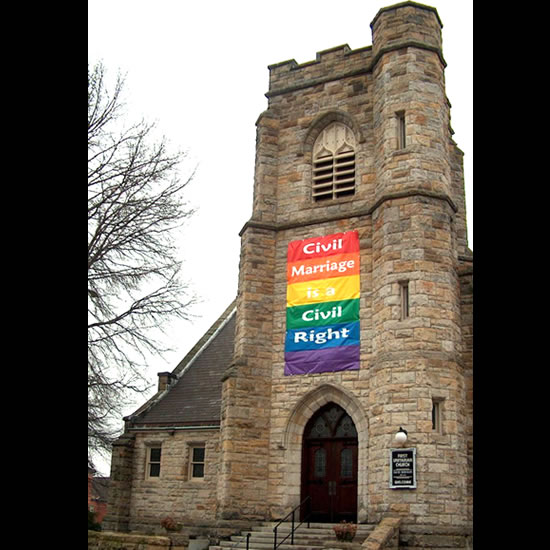
A reporter for the Pittsburgh Post-Gazette attended the event. She asked me about the conflict between the Unitarian Universalist Association and the Boy Scouts. I explained my understanding of the situation and added that that conflict at the national level has not yet hurt our relationship with local scouting groups. Needless to say, I was amazed when the article came out the next day how much focused on what I had said. I was even more amazed at how well she quoted me and represented my comments. She not only mentioned my comments on atheism extensively, but also mentioned prominently our church’s banner, “Civil Marriage is a Civil Right.” So, I was able to address both of the major issues of contention with the Boy Scouts in, I believe, a constructive way.

Of course, it remains to be seen if there will be any follow up on the article or comments from readers. I really hope that some folks will read it and try us out. I particularly hope that some teens who are questioning their religious beliefs will read it and realize that we are there as a noncreedal alternative as they search for truth and meaning in their lives. I know that as a teenager, I would have loved to know an adult I could talk to on these issues.

Atheism and the Destruction of Religion

I recently listened to the latest podcast of the Institute for Humanist Studies’ Network News. Noteworthy were several brief interviews with the notable “New Atheists,” such as Richard Dawkins, Daniel Dennett, and Sam Harris (http://humaniststudies.org/podcast/). The broadcast focused on comments made by Sam Harris at the Atheist Alliance International annual conference in September, where he told the crowd that they should not identify with the atheist label.

The rationale was perfectly logical (and frankly not a new argument), and reflected my own thoughts about the term for many years. “Atheist” as a word carries an immensely negative connotation, and is really not a particularly valuable label. As Harris pointed out, atheism is not a world view, as is a belief in rationality. Atheism is simply a rejection of an unsubstantiated notion.

What troubled me, however, was not the comments made in response to this argument, but rather a question asked of all three figures and their answers. The interviewer asked whether atheists should pursue the reform of religion or its destruction. Now, obviously, as someone pursuing the life of a minister, the question is at best problematic. My more visceral reaction, though, is one of offense at its simple mindedness and nastiness. My reasons for such a reaction are these:

  1. Contemplating the destruction of organized religion is a waste of time, given that billions of people on this planet support the concept and many of them are willing to kill themselves and others to defend it. As a long-term evolutionary goal of human society, perhaps I would be willing to consider the idea, but it’s priority would lag far behind a multitude of more pressing human needs.
  2. Simply discussing the desire to eliminate religion as a “yes/no” question ignores the many positive contributions of religion. One might just as logically argue for the elimination of all government because some politicians are corrupt, all families because of instances of abuse or divorce, and all other forms of human interaction and organization because they produce some negative as well as positive outcomes.
  3. The question assumes that atheism and organized religion are mutually exclusive (an assumption which all three of the speakers appeared to share). This assumption is unwarranted even under the current dominant paradigm of our modern view of the cosmos. There are at least hundreds of thousands of American atheists (many Unitarian Universalists, for instance) who belong to and participate regularly in churches, fellowships, societies, etc.
  4. The assumption is particularly erroneous if one is open to new quantum views of the universe, in which one acknowledges that many fields and forces exist that we do not yet understand, cannot yet quantify, and may well have wide ranging effects on our lives in biological and perhaps spiritual ways (however one chooses to define the term).

Obviously, I have no desire to take on these giants of the movement, who are far more adept at verbal repartee and public debate. I do, however, think it matters when public figures present their views in a cavalier manner that divides potential members of a movement. Atheism has faced this problem for decades, as have humanists. I find this paradox fascinating, given that two billion people are comfortable labeling themselves Christian and another 1.5 billion are comfortable with the term Muslim. Until atheists and humanists even come close to 1% of any nation’s populations, how can they ever hope to become the dominant paradigm of thought?