Truth and Meaning: Respect

In an editorial earlier this week titled “We should respect our police officers,” the Midland Daily News asserted that “Police actions have been scrutinized to the point in which many law enforcement officials believe that they can no longer do their jobs effectively because of public pressure.” The editorial concluded, “Law enforcement officers have a demanding, difficult and sometimes dangerous job to do. And because of that, they deserve our respect.”

There are two ways for the reader to take editorial sentiments such as these. First, they can be viewed as the innocuous kind of flag-waving we see on Memorial Day and Veteran’s Day. However, on the other 363 days of the year, our veterans go without adequate treatment of the mental and physical afflictions they suffered performing the dangerous work of imposing American foreign policy around the world. On each of the other 363 days of the year, according to the Veteran’s Administration, 22 veterans commit suicide. On the other 363 days of the year, our best patriots must live with the knowledge that their dedicated service has contributed to innocent civilian deaths, torture, and the ongoing destabilization of sovereign foreign governments.

So this editorial could simply be rhetorical pleasantry, a pat on the back to men and women who do perform a truly demanding, difficult, and sometimes dangerous job in our society. No one taking to the streets in Ferguson, New York City, Washington, D.C., or elsewhere is questioning the courage of law enforcement officials. They would join in commending police for taking dangerous criminals off our streets, for protecting and serving the citizens within their jurisdictions.

But, the second interpretation of this editorial reveals a far more insidious agenda. In citing the findings of the statistics compiled by the National Law Enforcement Officers Memorial Fund, the editorial fails to offer the details of the 50 firearms-related fatalities of police officers in 2014. Only 15 of those 50 resulted from ambushes, including the two recent heinous murders of Wenjian Liu and Rafael Ramos in New York City. Most of the firearm-related deaths of police officers in 2014 came from the regular performance of their duties, including traffic stops, routine investigations of suspicious behavior or disturbances, and others including accidental shootings. A logical conclusion one might draw from these statistics is that too many people own and carry guns who should not have them and that our society should improve efforts to better manage the sale of deadly firearms.

The claim that “many law enforcement officials believe that they can no longer do their jobs effectively because of public pressure” is dangerous hyperbole. If our police must exact unquestioning loyalty in order to perform their function, then something is wrong with our law enforcement system. If we are unable to hold people accountable for the negligent acts of violence committed behind the shield of a uniform and badge, then something is wrong with our criminal justice system. And if we continue to allow unfettered access to deadly firearms without adequate controls, then we should hardly be surprised at the toll such a policy exacts on our citizens and on our police.

The concern being expressed about the recent deaths of unarmed African-American boys and men at the hands of police officers has nothing to do with being pro- or anti-police. Dismissing recent “public pressure” as anti-police sentiment is misleading and factually incorrect. Recent public pressure has focused on our inability to objectively follow our system of prosecutorial due process in order to find justice. It is about needless deaths and what must occur to prevent such waste from ever happening again.

Should we respect the police? Absolutely. But respect does not mean turning a blind eye when police abuse their authority or use lethal force inappropriately or unevenly. Respecting the police means not only honoring their contributions, but also holding them accountable when their actions result in the death of innocents.

Truth and Meaning: Christmas Spirit

When my father was a boy, he considered an orange a special Christmas present. And while he grew up in relative poverty, he never considered his family poor. My grandfather was always able to find work that paid a fair wage. My grandmother was a stay-at-home mother. And my father was able to work during the summer and save up enough for college.

http://www.educatingwomen.org/poverty-in-the-us/But, times have changed. People like my grandfather – unskilled or skilled in outdated technologies – have few full-time job opportunities that pay enough to support a family. Fathers and mothers often work several jobs and then have to pay for child care. And young people today routinely graduate from college with massive student loan debt.

Like most of you that read David DeForest’s letter to the editor in the December 12 issue of the Midland Daily News (“No Reason to Work”), I was deeply saddened that such attitudes still exist in our community. Especially now, as we celebrate the birth of a man who loved all people and cared about the well being of everyone, the public expression of such sentiments reminds us of the pain that many feel in this country. The pain of hunger and homelessness; the pain of hate and discrimination; the pain of hopelessness that nothing we do can improve our lives.

My grandfather came to this country penniless, skilled in a trade that no longer existed. And yet, his children grew up healthy and went on to successful lives. Such is no longer the case for many of today’s immigrants. The path to citizenship is prohibitively expensive and takes as long as 10 years to complete. In the meantime, they perform the menial tasks beneath most Americans, living in constant fear that federal agents will burst into their homes and ship family members to undisclosed locations for uncertain deportation.

Especially painful was reading Mr. DeForest’s depiction of Americans living in poverty today. Jesus never asked for any justification when helping the poor or the sick. He simply helped them. Jesus never asked a hungry person, “Why don’t you just get a job?” He simply fed them. And Jesus did not tower over the poor in judgment, condemning them for their need. He simply gave them hope.

Mr. DeForest’s misplaced anger should be directed at the true parasites in this country – privileged rich people who contribute little and consume much; corporate CEO’s who are paid more in one day than a minimum wage employee can earn in a year; bankers who gamble with this nation’s economy with impunity. These leeches cost America billions of dollars each year. Every social welfare program combined does not come close to any such amount.

So, to Mr. DeForest, and to anyone who shares his sentiments, now is the time to re-examine your attitudes. Now is the time to walk among the poor and show them the respect they deserve by learning about the ravages of racism, xenophobia, sexism, homophobia, and institutionalized poverty. At Christmas time, let us all walk the path of Jesus – the path of sympathy, compassion, understanding and love.

Address Opposing the Religious Freedom Restoration Act

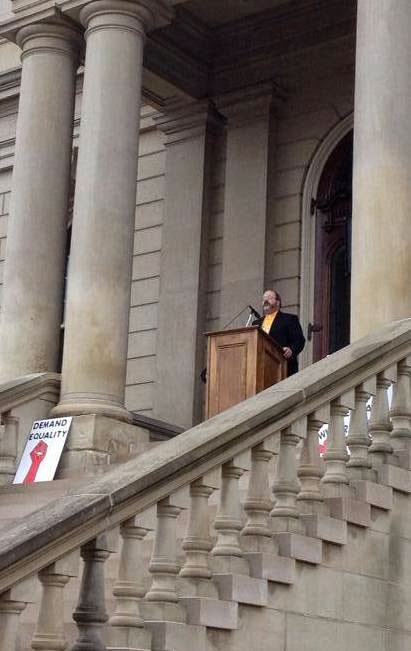
At the request of students from Adrian College, I was asked to speak at a protest on the Capitol steps in Lansing in opposition to the proposed Religious Freedom Restoration Act (HB 5958) on December 16, 2014 during the waning days of the lame duck session of the Michigan legislature.  The following are my comments (you may also see a video here, or listen to an mp3 version here).
————————-


Everywhere we turn today, politicians seek to justify the unjustifiable. “Corporations are people,” they tell us. “We need more bombs and so we must cut school lunch programs.” “The best way to fix our faltering economy is to double down our investment into the banks that got us here in the first place.”

And now we hear a new claim. With House Bill 5958, our legislators tell us, “Government must not burden people and businesses when choosing to exercise their religious beliefs, regardless of the consequences of that action on others.” Convincing us of the sincerity of such statements, especially given their inherent contradictions and the tremendous potential for and mischief by those taking advantage of such claims as these, presents a daunting challenge.

And because the task raises such difficulties, they must call on the greatest authorities to lend credence to their arguments. So, you hear many politicians today referring to the founders of this great nation. They quote Thomas Jefferson, John Adams, Thomas Paine, and others as proof of the righteousness of their cause.

They carefully sift through mountains of books to find just the right quote – even if they must take that quote completely out of context. When the founders stood mute on a subject, they tell us what the founders were really thinking. When those tactics fall short, they shout words like “Freedom!” and “Liberty!” confident that they can rely on our patriotism and our trust in the democratic process that they act in our best interests.

And when all else fails, they wait until the dead of night. They skulk in the shadows of the halls of government until after the electorate has spoken. They wait until the time when everyone looks forward to family gatherings and singing joyous praises.

Then, they slink from behind their desks. They quietly announce a hearing – or bypass the process of a public hearing altogether – and pass whatever laws please them. They do this because they know, were it not for the distractions of the holidays and our everyday lives, we might hold up our hands and say, “Wait a minute…I don’t understand what purpose this proposed bill serves.” After months of hibernation, they race through the lame duck session because they are afraid that we might have the time to read proposed bills and share our opinions. They feverishly plunge through this window because it is too late for us to voice our discontent at the ballot box with politicians whose terms will end shortly.

Perhaps the legislatures populated by our founders operated with a similar lack of transparency. But, I doubt it. It was Thomas Paine, who wrote in his landmark work Common Sense that the faithfulness of those elected to serve in public office “will be secured by the prudent reflection of not making a rod for themselves.” In other words, our elected officials should not rule over us like tyrants, but should engage with us in dialogue and informed debate.

Later, Paine specifically talks about the nature of America. “This new world,” he writes, “hath been the asylum for the persecuted lovers of civil and religious liberty from every part of Europe. Hither have they fled, not from the tender embraces of the mother, but from the cruelty of the monster…” So clearly, Paine would not have dreamed of a legislature using the tactics of a tyrant to pass laws abridging the rights of those who fear religious persecution.

Our ancestors came to this land because people used religious beliefs to hurt, to imprison, and even to kill them. I understand the corruption of religion by those who wield it as a rod to punish others. My grandmother Theresa fled her home in Europe for committing the sin of divorcing her abusive husband. For this act of self-preservation, the church deemed her unworthy and excommunicated her – a punishment that meant death; for she was now shunned by employers, shop owners, and landlords. Staying meant homelessness and starvation because she believed in her right to live free.

My grandmother met the man who became my grandfather here in America. He, too, had fled Europe because the Serbian army would routinely cross the river into his hometown and conscript young men to fight the never-ending religious conflict in the Balkans. No matter how many times the military dragged him to kill people who believed in God differently, he defected and returned home.

A century later, people still die in that region because of their religious beliefs. Governments that claim to fight for independence, for self-rule, for self-determination, use that fight as an excuse to rape and murder those who are different. A simple carpenter, my grandfather understood the corruption of freedom by those wielding it as a rod to kill others. So, he made the perilous journey here to America, where he could believe freely.

After years of struggle, my grandparents raised a family. My father honored his parents and cared for them in their later years. After my grandmother died, my grandfather’s life became simple again. He would sit at the kitchen table drinking coffee and playing solitaire all day. He believed he would soon rejoin his beloved Theresa in Heaven and was content to await his death patiently.

One night, my parents hosted a prayer meeting. The minister of our church spoke about the evils of card playing. Finally, my father asked our minister if he believed that my grandfather would spend eternity in Hell for the sin of playing solitaire. When our minister answered “yes,” my father threw him out of the house and we never returned to that church.

My father, an engineer, had designed our church building. He literally helped build that congregation. He raised his children in its Sunday School. I remember singing “Wonderful Grace of Jesus” during Sunday night services. But that same church used its religious belief to damn my grandfather.  So my father understood the corruption of restoration. He saw firsthand how a church could roll back the clock to a time when religion was routinely used as a rod to condemn others to perpetual flames and torment.

By the time I became a dad, I chose not to believe in the God of my father or my grandfather. My children went unbaptized. And I raised them in a Unitarian Universalist church, where they learned to respect all religious beliefs and to honor the spiritual path they would choose for themselves.

As a Sunday School teacher, I learned the history and heritage of famous Unitarians, like John Adams, who once wrote to his friend Thomas Jefferson:

We have…a National Bible Society, to propagate King James’s Bible, through all Nations. Would it not be better to apply these pious Subscriptions, to purify Christendom from the Corruptions of Christianity…[Some say] I have renounced the Christian religion…Far from it. I see in every Page, Something to recommend Christianity in its Purity and Something to discredit its Corruptions…The Ten Commandments and the Sermon on the Mount contain my Religion.

Don’t kill. Don’t cheat. Don’t steal. Don’t lie. Don’t envy your neighbor. In fact, love your neighbor. Love your neighbor as you would have your neighbor love you. Nearly every religion preaches this basic golden rule. Love everyone. Do not love only those who believe as you do. Do not withhold love from those who do not meet your approval. Everyone. No exceptions.

So I understand the corruption of laws that claim to restore religious freedom. Laws like HB 5958 are not an act of religion, bringing us together in common purpose and principle, but an act of division. The Religious Freedom Restoration Act is not an act of freedom, relieving us of governmental intrusion into our souls, but an act of invasion. This proposed travesty of a law is not an act of restoration, renewing hope for a people suffering daily oppression, but an act of destruction.  This so-called Religious Freedom Restoration Act is a corruption of religious freedom; a corruption of our democratic principles; a corruption of the core tenets of our human community; and a corruption of the very soul of our state.

I have the great good fortune to be married to a wonderful woman. Jody serves as advocate for victims of sexual assault at the Underground Railroad, a women’s shelter in Saginaw. She wanted to be here with me today. But her commitment to serving others, and my commitment to support her work, superseded our personal desires. John Adams, my Unitarian ancestor, spent many years apart from his love. To our great good fortune, they left behind a collection of correspondence exhibiting not only their devotion to each other, but also their shared commitment to justice, equality, and freedom.

Abigail and John wrote often of this new nation and of the true meaning of words like “freedom.” In one letter, Abigail wrote:

How difficult the task to quench the fire and the pride of private ambition, and to sacrifice ourselves and all our hopes and expectations to the public [welfare]! How few have souls capable of so noble an undertaking! How often are the laurels worn by those who have had no share in earning them! But there is a future… reward, to which the upright [person] looks, and which will most assuredly be obtained, provided [that person] perseveres unto the end.

You here today know about sacrifice. You have given up your time and energy to be here and to have your voices heard by your elected officials. You here today understand working toward the common good and the noble undertaking of guaranteeing freedom to all people. You here today see too clearly how those charged with guaranteeing our freedoms wear the shriveled laurels earned by catering to special interests, by pursuing power over others, and through the self-righteous delusion that they know the one truth.

Because Abigail Adams was right – there is a future reward. Moreover, we need not wait patiently until we die to receive that reward. We can unite as one people. White or black – whatever our skin color – we can unite. Woman or man – whatever our sexual orientation or gender identity – we can unite; Catholic, Protestant, or Orthodox…Muslim, Jew, or Sikh…Buddhist, Hindu, or Jain…Agnostic or Atheist – whatever our religious beliefs – we can unite; Americans all, regardless of our documentation or ethnic heritage – we can unite.

We can unite to fight for equal justice under the law. We can unite to provide affordable access to health care for all. We can unite to protect our decisions on when to have children, when not to have children, and how to parent the children we have in safe and healthy communities. We can unite to ensure that every person has equal access to a quality education and a job paying a fair and living wage. We can unite to protect our planet from those who would plunder its resources and from practices that threaten our existence as a species through global climate change.

And by standing united against the corruption of the Religious Freedom Restoration Act, we guard our right to believe or not to believe what we want in regards to religion. We oppose the sanctioning of discrimination against people on the basis of religious beliefs. We support the freedom of religious practice, so long as that practice does not harm others.

And we stand united to defend the wall of separation between Church and State described by Thomas Jefferson. For he acknowledged that the supreme will of the nation in behalf of the rights of conscience was that no legislature should pass laws respecting an establishment of religion, or prohibiting the free exercise of religion. Jefferson wrote that “our civil rights have no dependence on our religious opinions,” and that depriving people of their civil rights on the basis of religious beliefs will “corrupt the principles of that very religion it is meant to encourage.”

A people united will never be divided.

Truth and Meaning: One Question

A crisis looms on our horizon. How we cope with that crisis will depend on your answer to a simple question.

Ignore the media hype. Disregard the irrelevant facts. Set aside unrelated events that may sway your judgment. Look at the evidence yourself and answer one simple question.

  • Tamir Rice, a 12-year-old boy, is playing alone in a park with a toy gun. Someone calls 911 to report seeing Tamir and even says it is probably just a toy gun. Minutes later, a police car roars up to within just feet of Tamir and two seconds later he is dead. Did Tamir Rice deserve to die?
  • Eric Gardner is selling single cigarettes for 50 cents — a petty crime. A few minutes later, he is surrounded by police. One puts Eric in an illegal choke hold. Eric gasps time and again that he cannot breathe. In just minutes, he lies on the sidewalk dead. Did Eric Gardner deserve to die?
  • Michael Brown fits the description of a person reported to have stolen some cigarettes and scuffled with a clerk. Michael is walking down the street with a friend. An altercation ensues with a police officer, the exact facts of which are disputed. Even assuming the worst case scenario, Michael grabbed unsuccessfully for the officer’s gun and then ran away. A minute later Michael is 30 feet away, hands visible with no weapon. The autopsy reports show bullet wounds in his arm, two to the chest that indicate he was falling forward, and the kill shot to the head at an angle indicating that he was nearly on the ground. Did Michael Brown deserve to die?
I have skewed no evidence. I have included nothing in these scenarios about the neighborhoods, the police officers themselves, community relations with the police, national media coverage or subsequent investigations. In the case of Tamir Rice and Eric Gardner, video records reveal the events in real time for anyone to watch. Disregarding all of the irrelevant noise surrounding these tragedies, did Tamir, Eric and Michael deserve to die?
 
Whether you are white or black does not matter. Whether you are Republican or Democrat does not matter. Whether you are young or old, straight or gay, man or woman, rich or poor — none of that matters. Did Tamir, Eric and Michael deserve to die?
 
If you ask yourself that question, and your answer is no, then you are ready to explore the coming crisis in our nation. You are ready to objectively examine the research and data. You are ready to set aside the punditry and editorializing and look at the reality in America for yourself. And when you do, you will see our deeply embedded systems of structured poverty, institutionalized racism and the impacts of privilege in our society.
 
This is painful work. If you are white, male, straight, middle class, you will be tempted to feel shamed — your initial reaction will be that you are being accused of something you did not do. That is a natural reaction, but I encourage you to move through it quickly. Privilege is not the problem. The problem is that too many people with privilege do not acknowledge its benefits and do too little to level the playing field for all.
 
Once you have answered the question and read the research, imagine how you would feel if you were a black man in America today, 50 years after the Civil Right Act supposedly launched us into a post-racial society. Imagine that you are the mother or father of Tamir or Michael, or the wife and children of Eric. If you can put on those shoes and walk in them for just a short time, then your feelings of shame and guilt will quickly evaporate. They will disappear because you will want to do something. You will want to change things so that the senseless ending of young lives stops.
 
Yes or no?
 

Guide to Holiday Conversations


You find yourself at a family gathering. On your right sits Uncle Harold, who voted twice for Nixon, Reagan and Bush (senior and junior). On your left sits your Cousin Gloria, the Prius-driving, recycling, public school teacher. You uncomfortably count the seconds before someone raises a contentious topic. In anticipation of that moment, here is your holiday guide to surviving inevitable conflicts, and to build bridges of love and understanding.

Immigration
Uncle Harold starts. “We need to ship those illegals back where they came from. Emperor Obama should wait for Congress to protect American jobs and keep our borders safe from terrorists, drug dealers and freeloaders.”
Cousin Gloria retorts. “Our ancestors were undocumented aliens who came here and slaughtered the indigenous peoples. No one made them go through years of red tape and expenses. No one broke up our families and deported people without due process.”
You: “We are a nation of immigrants, and people around the world have long viewed America as a land of freedom and opportunity. We can find a way to provide a more efficient path to citizenship while still providing reasonable security at our nation’s borders.

Abortion
Cousin Gloria: “This is my body and the government has no business invading my privacy and interfering with my health care. My body, my choice.”
Uncle Harold: “You are murdering tens of thousands of babies every year and I don’t want my tax dollars supporting godless groups like Planned Parenthood.”
You: “Everyone wants to reduce the number of unwanted pregnancies. But being pro-life also means educating our children about sex, and providing them with contraception. We should care about every child by supporting loving families that need help. Every child should receive an equal shot at the American Dream.”

Gay and transgender equality
Harold: “God condemns these abominations. I love the person, but homosexuality and the choices people make to tamper with God’s creation are sins.”
Gloria: “You hate LGBT people. You have no right legislating our bedrooms. Your bigotry just encourages bullying and violence against gays.”
You: “As Americans, we believe in freedom and equality. The research seems to show that sexual orientation is determined at birth. So while I respect people’s religious beliefs, I also support equal rights for all people on the basis of differences that we cannot control.”

Health care
Gloria: “Insurance companies are heartless and greedy. Because of them, thousands of people die from lack of adequate insurance. And now you want to take away the safety net of the Affordable Care Act.”
Harold: “Obamacare is fiscally irresponsible and forces people to pay more for their insurance, and to change doctors with which they have developed long relationships. We should let the free market do its job.”
You: “I know families who cannot afford medical insurance. If we can’t fix Obamacare, then we need to come up with a program that serves everyone, because all Americans deserve access to quality health care.”

Religious freedom
Harold: “America is a Christian nation and no one should be forced to do anything that violates their beliefs.”
Gloria: “Employers have no business discriminating against people who don’t share their religious beliefs. These so-called ‘religious freedom’ bills are nothing but legalized bigotry.”
You: “No one has the right to infringe on another’s religious beliefs. But government determines who needs protection from unlawful discrimination. Religious freedom should be a protective shield, not be a sword used to hurt others.”

Gun control
Gloria: “How many more children need to die to support your right to buy machine guns and to carry rifles into my grocery store?”
Harold: “The founders wrote the Second Amendment to protect us from tyranny and it is my duty to protect our nation, as well as to protect my family from harm, whatever the cost.”
You: “Everyone has a right to defend themselves from harm. Everyone also has the right to walk the streets free from the fear that some deranged gunman won’t open fire on them. We need to sit down and find common sense solutions to protect all Americans’ rights and to reduce the gun violence in our country.”

Gloria: “Fascist!”
Harold: “Communist!”
You: “Both of you stop it! Name calling will get you nowhere. Jesus taught us to love our neighbors, to feed the hungry, clothe the naked, heal the sick and free the prisoners. Can’t we set aside our partisan differences and agree on these noble goals — not just as Christian goals, but goals that all Americans can agree upon?”

I hope this helps you survive the holidays, as well as what is sure to be another new year of social, economic and political turmoil that will not end until the great mass of centrist thinkers takes back the moral middle of America.

Ferguson

I am overwhelmed with sadness as yet another young black man’s life is snuffed out and the killer excused by a system determined to maintain a status quo of injustice. After the first few sentences of the press conference last night, I sat in front of the television saying, “oh no, here it comes again.”

Absolutely nothing sounds right about this case. If Michael Brown was a suspect of a crime, how does he reach the car before the police officer emerges? Why would a man suspected of shoplifting wrestle for a gun, get shot, run away, and then come back towards the police officer? Why was deadly force ever on the table once there was separation between the two? After shots have been fired in the car, how can eyewitness accounts of the fatal shot be so conflicting as to be completely ignored? Why does a prosecutor spend months creating reasonable doubt (the job of the defense in a trial), and then do everything possible to prevent a grand jury from finding probable cause for even an indictment? If Michael Brown was standing accused of shooting a police officer, how long would it have taken for the grand jury to return an indictment for murder?

If this were an isolated incident, I could be tempted to dismiss it as inconclusive and to give a law enforcement officer the benefit of the doubt. But this is no isolated incident. Given the way this society systematically imprisons black men and given the quickly growing numbers of people of color shot dead by police under questionable circumstances, any reasonable person must start asking questions. How would this event have changed if Michael Brown had been white? Would events have been different if the officer were wearing a camera? Whatever other evidence exists, if two credible witnesses testified that the shooting was questionable, why is the officer not being charged at least with involuntary manslaughter?

Yesterday, after the killing of Tamir Rice in Cleveland, Police Chief Calvin Williams said, “Guns are not toys, and we need to teach our kids that. Our community needs to understand that.” No, Chief Williams, our police need to be taught that using deadly force against a 12-year old playing in a park is never acceptable. Instead of constantly blaming victims – especially those of color – our society needs to make radical changes to its out-of-control gun culture.

Fifty years ago, I was a blissfully ignorant eight-year old boy who played “soldier” with toy guns. Andy Griffith was the town sheriff in Mayberry. I watched Dragnet and Highway Patrol and knew the police were my friends. But I didn’t grow up in Selma. I paid little attention to Huntley and Brinkley reporting about dogs and fire hoses, burning churches, and murdered civil rights activists. Negroes lived in a different part of town – a part of town I never saw.

But now, my eyes see the world through the lens of centuries of oppression. I have tried to put my feet in the shoes of the people of Ferguson and of countless other towns and cities where police violence against people of color takes place. I have held hands – hands of all colors and ages – and tried to change our broken system. Last summer, I stood in solidarity with thousands of others in the 50th anniversary of the March on Washington.

The frightening specter of the 50th anniversary of the events in Selma, Alabama loom heavily on my mind. Fifty years later, African Americans are still dying at the hands of white authorities who aren’t even indicted and brought to trial. Poor communities are in deep pain and feeling enormous frustration at the continuing legacy of racial injustice in this country. As Unitarian Universalists and other people of faith, we must condemn the racist practices displayed by law enforcement agencies that mainly targets young people of color in our society, which negates their inherent worth and dignity, and continues the mass practice of institutional racism in our society.

It is time again for us to stand on the side of love to actively demonstrate alongside others who are fighting to change the laws that allow police harassment, which results in violence against communities of color. Every American deserves equal treatment in the eyes of the law. Every American deserves an equal chance to succeed in the most prosperous nation in the history of humankind. Every American should feel confident that police are there to protect them and not to execute them.

Truth and Meaning: The Root of the Problem

As more cases of police violence emerge in our media, we find ourselves repulsed by the violence, by the unprovoked viciousness exhibited by those chosen to protect and to serve. For many of us, our immediate reaction is to call for punishing those using excessive force. We want justice for Michael Brown and so many others brutally abused, beaten and murdered by police officers. We want to stand with the citizens of Ferguson demanding change.

But, the root of the problem is not the police. Our police are only a symptom of the underlying disease. This nation has engaged in one illegal military action after another, fighting one former ally after another that we armed to fight some other supposed enemy. And many brave and patriotic young men and women have felt duty bound to defend the principles of this nation by serving in the armed forces. But after their traumatic experiences, they return home physically wounded, emotionally bruised, and desperately in need of help. And we turn our backs on them.

The way we treat our combat veterans should be a matter of national disgrace. The rates of suicide and homelessness among our veteran population should be a top priority in Washington. The failure to provide these courageous men and women with the physical and mental health treatment they need is beyond appalling. I worked in the hospice unit of a VA hospital and saw the remnants of our fiasco in Vietnam and it grieves me beyond belief than we will be treating thousands more like them for the next 50 years.

Our police are no different. These brave men and women put their lives on the line every day to protect our manicured lawns and allow us to sleep soundly on our posturepedic mattresses. But, we raise our children in a world that still condones racism, sexism and homophobia. Our boys and girls grow up learning that violence is a solution and that a gun conveys power and authority. Our youth learn quickly that intimidation is the American way and that force trumps diplomacy.

So, is it any surprise that a handful of our police are bullies? Should we be shocked when an officer goes quickly to deadly force when facing a person who is the “other?” In a world of political extremists and religious fundamentalists, why should the violent reflexes of a police officer baffle us?

The root of the problem is not bad cops. The root of the problem is our tolerance of hate, our acceptance of prejudice and our parenting that teaches a child that other children are somehow less human because of their social status, skin color or identity.

So, for now, we should punish anyone who abuses their authority. But, we must start treating the disease underlying the symptoms. We must heal the sickness of bigotry; we must refute our gun culture and rape culture; we must start loving each other unconditionally until the death of one is felt equally by all.

Truth and Meaning: Occupy 2.0?

 
Sept. 17 was the three-year anniversary of the Occupy Wall Street movement. Whatever you thought of the movement’s strategies or success, its wondrous and flawed idealism, ask yourself this question: Has anything Occupiers protested improved in the past three years?
  • The bankers, lawyers and other white collar criminals responsible for our economic collapse have not been charged, let alone convicted of crimes. 
  • Income disparity continues to rise, with the average corporate head earning hundreds, even thousands times more than their average worker. 
  • Racism, sexism, homophobia, xenophobia and other oppressions continue unabated and largely unregulated. 
  • Our diet has become more genetically modified and our environment more polluted. 
  • Labor unions continue to be assaulted, no living wage is in sight and health insurance remains a target of the “haves.” 
  • Jobs remain scarce, and students continue to graduate from college with decreasing hope and increasing debt. 
  • Corporations are being treated more like people, and people are being treated more like disposable commodities.
  • Our reckless policies regarding campaign financing have created a government owned by the tiny elite they are supposed to be regulating. 
  • Our blind pursuit of war abroad has now expanded onto our city streets as paramilitary police gun down unarmed, innocent civilians. 
  • It has become increasingly easier to buy a gun than to vote in some states.
As the original statement of the Occupy Wall Street movement said, we as one people united must acknowledge that the future of humanity requires that our system must protect our rights, and upon corruption of that system, it is up to us to protect our own rights; that a democratic government derives its just power from the people, but corporations do not seek consent to extract wealth from the people and the Earth; and that no true democracy is attainable when the process is determined by economic power. We continue to live in a time when corporations, which place profit over people, self-interest over justice, and oppression over equality, run our governments.
 
The embers of the Occupy movement still glow. Perhaps the time has come to reignite the flame. While we wordsmith and squabble over pennies to aid the poor, the wealth of this great nation is being drained by a new monarchy as trickle down economics has become flood upwards economics. A people united cannot be divided. North Carolina is showing us the way with its Moral Monday movement. Perhaps the time has come for every state and for all people to unite and exercise their rights and responsibilities as Americans to reclaim the moral center of our country.
 

Truth and Meaning: Normal

Normal. I am hard pressed to think of a word I dislike more in the English language. Whatever definition one uses, I believe the word creates confusion and prevents us from engaging in useful and productive dialogue.

For instance, one may say that a society is “normal,” because it functions by the laws or norms that it has established. Should we consider normal the fact that nearly 50 million people in the richest country in the world live in poverty? Should we consider normal that there are as many guns as people in this country — and we have the gun death rates to back it up? Should it ever be normal that most of our elected officials could not pass the simplest tests on women’s anatomy, the environment, or our national banking system?

One may also say that something is normal if it is the “usual” state or condition. But tens of millions of Americans have untreated physical and mental illnesses. For them, the “usual” state consists of pain and anxiety, disability and depression. Tens of millions of people of color in America are “usually” treated as inferior by so-called white people. Should that situation ever be accepted as normal? On the average, 430 young people injure themselves and 13 succeed in committing suicide every day. How could a society ever consider such a “usual” state to be normal?

We routinely say that someone is “normal” if they are free from illness or sickness. Well, if that is the case, then there are no normal people on the face of the earth. We learn more each day about the nature of physical and mental disease, about neuroscience and addiction, about the impact of stereotypes on our levels of stress, and about the long-term impacts of trauma and abuse. Normal health does not exist and we delude ourselves believing that it does.

The word “normal” always carries with it an inherent stigma. When a teacher calls Johnny a normal student, the implication is that he does not really excel at anything but fits some arbitrary average. He may be the next Rembrandt or Albert Einstein, but we might never know because he is dyslexic. When friends call Katrina a normal-looking girl, the implication is that she is not beautiful. She may be the next Amelia Earhart or Sally Ride, but we might never know because she suffers from bulimia. And when we say that the Smiths are a normal family, we imply that the Smiths are heterosexual, have children, and pursue goals that match those of their neighbors. We don’t notice the bruises on Mrs. Smith’s arms, or the way the children flinch from the slightest touch. And the “abnormal” Joneses next door may be an amazing gay couple who could revitalize the neighborhood, but they just got evicted from their apartment and fired from their jobs for being gay.

“Normal” should be an aspiration — not the average or worse yet, the least common denominator. Wouldn’t it be nice if a normal day consisted of the United States not bombing some other country in the name of democracy and freedom? Wouldn’t it be nice if a normal day consisted of not one gay teenager being beaten and bullied, and not one woman assaulted or raped? Wouldn’t it be nice if a normal day consisted of not one single instance of wanton police brutality against unarmed and innocent civilians? Wouldn’t it be nice if a normal day consisted of every person in the world being fed, clothed, sheltered, safe, and happy?

Unfortunately, we live in the real world, and our leaders insist that those aspirations are currently beyond our reach. So, in the meantime, I will revel in being abnormal. Because the only way we can make those aspiration real is if we all excel in whatever makes us not normal — that is what makes us who we are.

Truth and Meaning: What is Racist?

Regular readers of this blog know that I have several enthusiastic contributors to the comments section. One of them openly supports the Ku Klux Klan and some Midland residents may remember his 2008 demonstration in full Klan regalia at the corner of Eastman Avenue and Saginaw Road here in Midland Michigan. Sometimes, people advise me to ignore his postings because of their extremist slant. I believe, however, that people of faith must try to engage anyone, at anytime, and at any place where the opportunity for spiritual growth presents itself.

I was rewarded for my diligence when, in response to my blog posting last week, this individual asked me several important questions on the subject of race. He posted the questions as they were written in an article titled “The Answer to Crime Among Young Black Males” by Tim Wildmon. I will quote Mr. Wildmon’s words exactly and then provide answers to each. Perhaps you will hear your own voice somewhere in the text.

He began by asking, “For example, without knowing skin color, when someone tells me they saw an awesome basketball player I immediately think he is Black. Why is that? Because most awesome basketball players in America are indeed Black. Does that make me a racist?”

Yes, it does! Most basketball players in high school are White and there are awesome White high school basketball players. At the college level, according to the latest NCAA Student-Athlete ethnicity report, there are still more White players than any other racial/ethnic group, and there are awesome White college basketball players. Only at the NBA level does one see a marked dominance of African-American players. And of the NBA’s 49 majority owners, only Michael Jordan of the Charlotte Bobcats is a person of color. And that is because of PRIVILEGE. Predominately White public schools generally get more funding than predominately Black schools. White families can usually afford college more easily than Black families. Blacks have far fewer opportunities than Whites to escape systemic poverty. And Blacks have far fewer opportunities open to them in other occupational sectors. So, yes, assuming that an awesome basketball player is Black is a racist observation.

He continued, “In the same way, when I hear of a convenience store robbery, without knowing the skin color, I immediately think it was a young Black male who committed the crime. Why is that? Because night after night I see the faces of young Black males on the news arrested for crimes. Does that make me a racist?”

Yes, it does! In 2010, the National Institutes of Health published a definitive article on the portrayal of lawbreakers and victims in crime news (http://www.ncbi.nlm.nih.gov/pmc/articles/PMC2904566/). In their conclusion they wrote, “Starting with the results for portrayals of offenders, we would expect Whites to have a higher likelihood of being reported on if reporting reflects offending incidents, because they are the most populous group. We did not find evidence of a significant difference in the number of portrayals of White perpetrators relative to Blacks in our base models. To us, this suggests a relative over-reporting of Blacks compared to Whites. We also found under-reporting of Hispanic perpetrators relative to Whites. We interpret the results for Blacks as consistent with power structure, racial threat and racial privileging arguments.” People are led to believe that Blacks commit more crimes because our media highlight the race of suspects far more frequently when he/she is a person of color. When that presentation is not challenged, we cooperate with the racist portrayals in our media. In 2011, White people committed nearly 250,000 violent crimes in this country, but just because the news shows more Black suspects than White does not make them more prone to violent crimes. So, yes, immediately assuming that a criminal is Black is racist.

He concluded with this question. “Which begs another question: does a stereotype only become racist when it is negative? Or can one have a positive stereotype based on race? What about the idea that “White men can’t jump”? Is that racist?”

Yes, it is! Saying that “all Asians are good at math” is a negative stereotype of what a racist would consider a positive observation. Research shows that perceived positive stereotypes, when brought into the forefront of an individual’s mind, can actually make them do worse at the thing they are supposed to be able to do better. One such study discovered that when Asian-American women were made explicitly aware of their ethnicity (and the expectations attached to it) right before testing their math skills, they were more likely to collapse under the pressure and do poorly in the test (http://pss.sagepub.com/content/11/5/399.short). ANY stereotype reduces the complex humanity of individuals, making it easier to dismiss each person’s inherent worth and dignity. And ‘White men can’t jump’ derives from an evil and ignorant stereotype that somehow Blacks are more closely tied to jungle animals than Whites. So, yes, attempts to compliment a group of people through stereotyping of any kind is racist.

The comments and questions posted by this individual represent classic examples of privilege — of how White, or straight, or male, or American-born people are often oblivious to their privilege and in complete denial of their prejudice. Systemic racism oppresses people of color, just as systemic sexism oppresses women, systemic hated of LGBT folk oppresses gays and lesbians, and systemic anti-immigration laws and opinions oppress undocumented immigrants. And those with privilege benefit ONLY by accident of birth. Those who possess privilege did absolutely nothing on their own to earn that privilege. Therefore, those who choose to take advantage of their privilege and do nothing to level the playing field, ARE racist, or sexist, or homophobic, or xenophobic.

But, here is the most important point. HAVING privilege is nothing to be ashamed of. No one is trying to lay a guilt trip on you for being White, or straight, or male, or a native-born American citizen. But those who accept the advantages of privilege do so at a cost to those who do not have privilege. Thus, those who accept the benefits — and do not work toward eliminating privilege — do so from the suffering of others. I am a White, straight, male, American, too. But I fight to eliminate privilege. I defend the poor, the hopeless, the oppressed, the exiled. As long as privilege exists, there will be oppression. And so long as the oppressors do nothing to stop it, then they are complicit in the resulting discrimination and suffering.