Truth and Meaning: The Infallibility of Fallibility

Most of our problems today boil down to one root cause. Far too many people consider themselves, their ideas, their beliefs, their faith to be the one and only Truth. This fundamentalist way of thinking creates in our social discourse a false dualism – I am right and you are wrong. The middle ground gets obliterated and compromise means catastrophic failure.

Sadly, this disease is spreading. Some oppose anything a president does because he or she is from the wrong party. Any attempt to impose limits on access to guns is labeled by some as violating the core tenets of our Constitution. Some seek to ban all abortion, even when the fetus is brain dead and threatening the life of the mother.
American poet and artist Ezra Pound once said, “The technique of infamy is to invent two lies and get people arguing heatedly over which one of them is true.” Two of the largest infamous lies facing this nation today are White supremacy and religious infallibility.
White supremacy is insidious because it preys upon our passive acceptance of privilege granted merely because of skin color. White supremacy whispers in your ear that Black and Latino cultures are inferior; that Jews are Untermenschen (subhuman); that social engineers have orchestrated the demise of White people; and that the history of North America began when White Europeans arrived to clear the land of savages. Cloaked in the disguise of love of family, White supremacy today still wears the hood and sheet that made yesterday’s murderers anonymous. Embracing discredited science and social paranoia, White supremacy proclaims that those artificially forcing the different races together are the true enemy.
Religious infallibility is the doctrine that nothing you do in life matters unless you meet some precondition of faith. Salvation rests on accepting without question the literal words of some ancient document, regardless of its context or linguistic devices. Religious infallibility preaches from the rooftops that all Muslims are engaged in a holy war against you; Jews killed Jesus so they deserve any punishment God doles out to them; and Christians sit in judgment damning all others to eternal hell fire. Cloaked in the perceived purity of self-righteousness, religious infallibility brands gay people abominations unworthy of marriage equality or the ability to adopt children. Religious infallibility clings to political control like a bloated leech, seeking to turn every nation into a theocracy of injustice and intolerance.
Both of these lies are the product of small fanatical groups. Most people with light skin color do not hate those with darker skin. Most religious people are open to learning about other religions and participating in interfaith dialogue and works of charity. But the strength of these fanatics derives from an irrational conviction that they are incapable of error, and that anyone who views the world through a different lens is blinding themselves to their Truth.
That is why I am a Unitarian Universalist. We embrace fallibility. We acknowledge fallibility as a human trait. By affirming the infallibility of our fallibility, we are free to question, to search for truth and meaning wherever that search leads us. By believing that no one group has a monopoly on the Truth, we find value in all religions and philosophies. And by using our gifts of reason and compassion, we separate the freedom to believe from the freedom to oppress. By applying our gifts to the cause of justice and equality, we challenge those who would use their beliefs to discriminate, to cause harm to others.
Affirming the inherent worth and dignity of every person, and respecting the spiritual growth of others requires that we label White supremacy and religious infallibility as the lies they truly are. For the only infallible attribute of humankind is its fallibility – its susceptibility to the lies of the infamous.

Truth and Meaning: An Open Letter to Lansing

Once again, our Michigan Legislature is spending its valuable time seeking to punish gay and transgender people for who they are. Bigots have resurrected a bill to allow agencies to turn away gay couples seeking to adopt one of the tens thousands of children in need of a home in our state. Perhaps you think bigot is too strong a word. But what else would you call it?

There is absolutely zero evidence that straight couples parent any better than gay couples. Medical authorities affirm that being gay or transgender is not a choice. So why would Michigan lawmakers seek to deny a child a loving home?

Since there is no factual basis for such discrimination, the only answer remaining is irrational bigotry. Then, let’s make two things abundantly clear. First, if you consider yourself a Christian, you have no scriptural basis for approving of such a law. There is nothing in the Bible condemning the union of a loving couple who happen to be of the same sex. Nothing. The verses that you are being told condemn homosexuality in fact prohibit deviant sexual practices, such as rape, prostitution and sex without a loving commitment. And unless you are willing to pass similar laws against people who are divorced or adulterers, what right do you have to support discrimination against gays?

Second, judgment is not up to you. Those who support this splinter legislation are blinded by the logs of hate in their own eyes. Since when have you so little faith in your god that you feel you must be his agent of punishment? Who says that you get to pick and choose who is worthy? If you feel so righteous, where is your judgment for domestic abusers, for racists, for polluters, and for usurers?

So, I request — in fact, I demand — that our legislators offer the proof that any organization acting as an agent of public service should be allowed to discriminate on the basis of their religious beliefs. Religious freedom does not equate to religious discrimination. Those who make this argument have allowed the seed of enmity to take root and blossom in their hearts.

Our state is becoming a national embarrassment. We used to make fun of “backwards,” “unenlightened” states. Now, we lie in the mud among them. Whether you are Republican or Democrat, conservative or liberal, Michigan’s war on sexual orientation and gender identity is morally abhorrent and will not stop until compassionate and loving people stand up for equal rights.

Truth and Meaning: Real Love

So, another Valentine’s Day is upon us. My message today is simple. You are loved.

Even if you get no cards in the mail, you are loved. If no one buys you chocolates or flowers, you are loved.

Whether you are Christian or Muslim, Atheist or Jew, you are loved. Whether you are conservative or liberal, rich or poor, you are loved. Whether you are gay or straight, you are loved.

I know this because I love you. As a Unitarian Universalist, I affirm and promote the inherent worth and dignity of every person, and compassion in human relations. Because I love you, I fight for your civil rights and for your freedom from discrimination. Because I love all of you, I advocate for a living wage, better public school funding, and clean air and water. Because I love every person, I dedicate my life to being my brother’s and my sister’s keeper, to justice for all, and for an end to violence and war.

And because you are loved, you do not need the roses or the heart-shaped boxes of sweets. You do not need to buy love at the store. And you do not need to buy the lies sold by the hate mongers and fear peddlers.

Despite the awful tragedies happening every day, the world is a pretty terrific place. In spite of our failures and heartaches, there is much to be said for living. But our lives are only as good as we make them, and we can all try harder to help those who are less fortunate to have a voice and a vote about things that affect them.

The best way to do this is to express your unconditional love proudly and publicly, without any expectation of any benefit in return. Love without judgment. Love with no strings attached. Love simply for the sake of loving.

Do I believe human nature causes us to be hurtful, distrustful and prejudiced? Not for a second. Am I a doe-eyed, naive Utopian? You bet. Love will do that for you. Love helps you see the innocent child in every person before life teaches them to be afraid and angry.

I am blessed to be married to a woman who reminds me every day of the power of love. And I am fortunate to be part of a religious community whose cornerstone is human beings caring for each other and welcoming all spiritual seekers regardless of their identities. May you feel that power within you on this Valentine’s Day, and every other day of the year.

Truth and Meaning: Not Only Once a Year

Let’s be honest — America has a problem with sex. On one hand, we prudishly dance around the subject and never really share our innermost feelings and desires with our partners. We freak out over public breast feeding. We blame rape victims for provoking their attackers because of what they wore or how much they drank. Bold men are considered forceful and strong. Bold women are seen as pushy and brash.

On the other hand, we surround ourselves with objectified images of women. The media defines feminine beauty as being young and thin, submissive yet sexy, revealing just enough to titillate, but hiding reality under make-up, hair products, tight clothes and high heels. From winged Victoria Secret models to breast-enhanced pseudo celebrities on so-called reality shows, women get identified as angel or whore and not as human beings.

The common thread among all of these attributes is a fundamental disrespect of women. Our society routinely discriminates against women by paying them less than men, constantly attacking their rights and access to medical care, and minimizing their personhood. Almost a century after earning the right to vote, women still struggle for equal treatment in the workplace, the halls of government, the media and our schools.

In a few days, we celebrate the national holiday of women’s oppression in this country — Valentine’s Day. For too many people, this becomes the day that reveals our worth as a partner, as a spouse, as a lover. We reduce our emotions to the amount of cash spent on commodities — products conveniently highlighted in our stores just for the occasion. Candy and card makers give us a wide variety of inexpensive ways to display our affection. Florists tell us that only roses will show her that we really love her. Jewelers tell us that only diamonds demonstrate a true sense of commitment. Girls are conditioned to believe that buying such gifts is how boys should show affection. Boys are conditioned to believe that girls want these things as proof of their devotion.

How did we allow ourselves to become so manipulated? History reveals millennia of repression of women. From Eve to Mary Magdalene, women have been reduced to weaker versions of men incapable of anything but betrayal, fickleness and irrationality. History writers routinely ignore the accomplishments of women, often writing women’s names from the narrative entirely.

Nowhere is this more apparent than in our religious history. Women still cannot be priests despite the fact that the Christian church in Rome was founded by a woman. Unless you are a midwife, prostitute or property of a man, women are hard pressed to find their way into our sacred texts. Even in the essential unique role as child bearer and nurturer, women have been methodically reduced from the Goddess from whom all life derives to something to be feared and controlled by men. Over the years, men have converted the deities of fertility, peace and love to the supporting cast of male dominance and violence.

We have made much progress in recent centuries, but we still have a long way to go. Going further will require than men take up the responsibility of being strong allies for women’s equality. A simple first opportunity is Valentine’s Day.

Don’t measure your love for someone by how much money you spend. Don’t try to purchase affection or sexual gratification through chocolate, flowers or bracelets. Ask the women in your lives what they want. Many women don’t want sparkly trinkets — they want real commitment to their dreams and well being. They want to be heard. They want their accomplishments acknowledged. They want to know that you consider them special and important in your life.

You won’t find love at the mall. Give the person you love a long message. Cook their favorite meal and watch their favorite movie. Write them a letter and bare your soul. Look deep into their eyes and say “I love you.”

That simple “I love you” means more than any store-bought present. And you don’t need the excuse of a manufactured holiday to share that gift. You can give that gift every single day of the year.

Truth and Meaning: Names of God

My door bell rang unexpectedly. I found three young women standing there. As they introduced themselves, I saw their name badges and recognized them as Mormons on their mission. I explained that I was a Unitarian Universalist minister, assuming that they would wish me a nice day and move on to the next house. But they showed interest and we began to talk.

After a few minutes, I invited them in. We had a delightful conversation for an hour or so. We respected and listened to each other. We discussed the Bible and the history of the Abrahamic faiths. We talked about the commonalities shared by most of the world’s religions. Then, one of them expressed her opinion about people uniting in religious belief. She spoke of the “one true god” (by which she of course meant the god of her religion) as the way for all people to come together in salvation. When she finished, I told her that I could agree with most of what she had just said, except for that phrase.

I explained that as long as people cling to the notion that their god is the one (and only) true god, or that their faith is the one true faith, then humanity is doomed to perpetual war and violence. Soon afterwards, they were on their way. I think I had done much to personalize my religious tradition for them, just as they worked to dispel some of the unfair stereotypes assigned to their faith.

Whatever your beliefs – even if you don’t believe in god at all – there are forces currently beyond our understanding. And while we continue to make great strides grasping the birth of the universe and the nature of the cosmos, I do not believe that we will ever completely know everything about everything. That is not a justification for the existence of god – it is merely acceptance that there are things that exist beyond human comprehension. Homo sapiens is not perfect and never will be. So, one can reasonably presume that our species will never have a perfect understanding of all existence.

If you grant that argument, then what do you call the mystery, the unknowable, the incomprehensible? Some people do not feel the need to call it “god,” or to name it in any way. But many people do find comfort in naming the wonder of the universe. In particular, people take solace thinking that behind the unknown lies a force of inherent goodness or order.

For Hindus, there are millions of manifestations of the Oversoul, and adherents are free to worship through whichever god most helps them make that connection. For Muslims, their one god goes by 99 different names, from the Compassionate and Merciful to the Giver of Life and Bringer of Death. Trinitarian Christians believe that god can only be understood as three persons that are distinct, yet one essence.

Over the centuries, far too many people have died because they did not share the same opinion regarding the nature of god or the manner in which we should hold god in regard. Hasn’t humankind reached a point where we can live together with people who do not share our particular belief about the wonder and mystery of the universe? Can we make peace with the notion that we have many names of god and that our differing practices do not justify prejudice and hate, violence and murder? Can we latch onto the common denominators of all religions to respect the inherent worth and dignity of every person?

Address Opposing the Religious Freedom Restoration Act

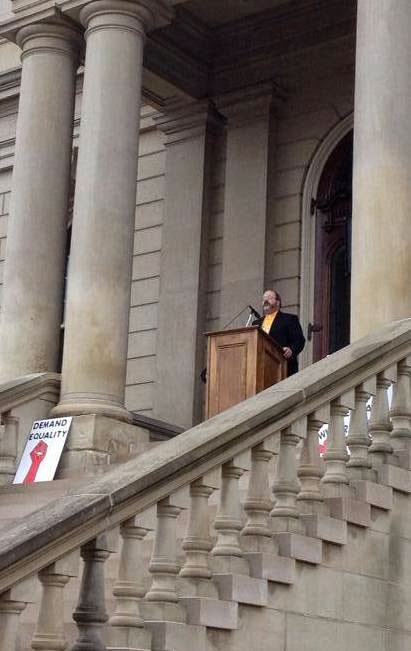
At the request of students from Adrian College, I was asked to speak at a protest on the Capitol steps in Lansing in opposition to the proposed Religious Freedom Restoration Act (HB 5958) on December 16, 2014 during the waning days of the lame duck session of the Michigan legislature.  The following are my comments (you may also see a video here, or listen to an mp3 version here).
————————-


Everywhere we turn today, politicians seek to justify the unjustifiable. “Corporations are people,” they tell us. “We need more bombs and so we must cut school lunch programs.” “The best way to fix our faltering economy is to double down our investment into the banks that got us here in the first place.”

And now we hear a new claim. With House Bill 5958, our legislators tell us, “Government must not burden people and businesses when choosing to exercise their religious beliefs, regardless of the consequences of that action on others.” Convincing us of the sincerity of such statements, especially given their inherent contradictions and the tremendous potential for and mischief by those taking advantage of such claims as these, presents a daunting challenge.

And because the task raises such difficulties, they must call on the greatest authorities to lend credence to their arguments. So, you hear many politicians today referring to the founders of this great nation. They quote Thomas Jefferson, John Adams, Thomas Paine, and others as proof of the righteousness of their cause.

They carefully sift through mountains of books to find just the right quote – even if they must take that quote completely out of context. When the founders stood mute on a subject, they tell us what the founders were really thinking. When those tactics fall short, they shout words like “Freedom!” and “Liberty!” confident that they can rely on our patriotism and our trust in the democratic process that they act in our best interests.

And when all else fails, they wait until the dead of night. They skulk in the shadows of the halls of government until after the electorate has spoken. They wait until the time when everyone looks forward to family gatherings and singing joyous praises.

Then, they slink from behind their desks. They quietly announce a hearing – or bypass the process of a public hearing altogether – and pass whatever laws please them. They do this because they know, were it not for the distractions of the holidays and our everyday lives, we might hold up our hands and say, “Wait a minute…I don’t understand what purpose this proposed bill serves.” After months of hibernation, they race through the lame duck session because they are afraid that we might have the time to read proposed bills and share our opinions. They feverishly plunge through this window because it is too late for us to voice our discontent at the ballot box with politicians whose terms will end shortly.

Perhaps the legislatures populated by our founders operated with a similar lack of transparency. But, I doubt it. It was Thomas Paine, who wrote in his landmark work Common Sense that the faithfulness of those elected to serve in public office “will be secured by the prudent reflection of not making a rod for themselves.” In other words, our elected officials should not rule over us like tyrants, but should engage with us in dialogue and informed debate.

Later, Paine specifically talks about the nature of America. “This new world,” he writes, “hath been the asylum for the persecuted lovers of civil and religious liberty from every part of Europe. Hither have they fled, not from the tender embraces of the mother, but from the cruelty of the monster…” So clearly, Paine would not have dreamed of a legislature using the tactics of a tyrant to pass laws abridging the rights of those who fear religious persecution.

Our ancestors came to this land because people used religious beliefs to hurt, to imprison, and even to kill them. I understand the corruption of religion by those who wield it as a rod to punish others. My grandmother Theresa fled her home in Europe for committing the sin of divorcing her abusive husband. For this act of self-preservation, the church deemed her unworthy and excommunicated her – a punishment that meant death; for she was now shunned by employers, shop owners, and landlords. Staying meant homelessness and starvation because she believed in her right to live free.

My grandmother met the man who became my grandfather here in America. He, too, had fled Europe because the Serbian army would routinely cross the river into his hometown and conscript young men to fight the never-ending religious conflict in the Balkans. No matter how many times the military dragged him to kill people who believed in God differently, he defected and returned home.

A century later, people still die in that region because of their religious beliefs. Governments that claim to fight for independence, for self-rule, for self-determination, use that fight as an excuse to rape and murder those who are different. A simple carpenter, my grandfather understood the corruption of freedom by those wielding it as a rod to kill others. So, he made the perilous journey here to America, where he could believe freely.

After years of struggle, my grandparents raised a family. My father honored his parents and cared for them in their later years. After my grandmother died, my grandfather’s life became simple again. He would sit at the kitchen table drinking coffee and playing solitaire all day. He believed he would soon rejoin his beloved Theresa in Heaven and was content to await his death patiently.

One night, my parents hosted a prayer meeting. The minister of our church spoke about the evils of card playing. Finally, my father asked our minister if he believed that my grandfather would spend eternity in Hell for the sin of playing solitaire. When our minister answered “yes,” my father threw him out of the house and we never returned to that church.

My father, an engineer, had designed our church building. He literally helped build that congregation. He raised his children in its Sunday School. I remember singing “Wonderful Grace of Jesus” during Sunday night services. But that same church used its religious belief to damn my grandfather.  So my father understood the corruption of restoration. He saw firsthand how a church could roll back the clock to a time when religion was routinely used as a rod to condemn others to perpetual flames and torment.

By the time I became a dad, I chose not to believe in the God of my father or my grandfather. My children went unbaptized. And I raised them in a Unitarian Universalist church, where they learned to respect all religious beliefs and to honor the spiritual path they would choose for themselves.

As a Sunday School teacher, I learned the history and heritage of famous Unitarians, like John Adams, who once wrote to his friend Thomas Jefferson:

We have…a National Bible Society, to propagate King James’s Bible, through all Nations. Would it not be better to apply these pious Subscriptions, to purify Christendom from the Corruptions of Christianity…[Some say] I have renounced the Christian religion…Far from it. I see in every Page, Something to recommend Christianity in its Purity and Something to discredit its Corruptions…The Ten Commandments and the Sermon on the Mount contain my Religion.

Don’t kill. Don’t cheat. Don’t steal. Don’t lie. Don’t envy your neighbor. In fact, love your neighbor. Love your neighbor as you would have your neighbor love you. Nearly every religion preaches this basic golden rule. Love everyone. Do not love only those who believe as you do. Do not withhold love from those who do not meet your approval. Everyone. No exceptions.

So I understand the corruption of laws that claim to restore religious freedom. Laws like HB 5958 are not an act of religion, bringing us together in common purpose and principle, but an act of division. The Religious Freedom Restoration Act is not an act of freedom, relieving us of governmental intrusion into our souls, but an act of invasion. This proposed travesty of a law is not an act of restoration, renewing hope for a people suffering daily oppression, but an act of destruction.  This so-called Religious Freedom Restoration Act is a corruption of religious freedom; a corruption of our democratic principles; a corruption of the core tenets of our human community; and a corruption of the very soul of our state.

I have the great good fortune to be married to a wonderful woman. Jody serves as advocate for victims of sexual assault at the Underground Railroad, a women’s shelter in Saginaw. She wanted to be here with me today. But her commitment to serving others, and my commitment to support her work, superseded our personal desires. John Adams, my Unitarian ancestor, spent many years apart from his love. To our great good fortune, they left behind a collection of correspondence exhibiting not only their devotion to each other, but also their shared commitment to justice, equality, and freedom.

Abigail and John wrote often of this new nation and of the true meaning of words like “freedom.” In one letter, Abigail wrote:

How difficult the task to quench the fire and the pride of private ambition, and to sacrifice ourselves and all our hopes and expectations to the public [welfare]! How few have souls capable of so noble an undertaking! How often are the laurels worn by those who have had no share in earning them! But there is a future… reward, to which the upright [person] looks, and which will most assuredly be obtained, provided [that person] perseveres unto the end.

You here today know about sacrifice. You have given up your time and energy to be here and to have your voices heard by your elected officials. You here today understand working toward the common good and the noble undertaking of guaranteeing freedom to all people. You here today see too clearly how those charged with guaranteeing our freedoms wear the shriveled laurels earned by catering to special interests, by pursuing power over others, and through the self-righteous delusion that they know the one truth.

Because Abigail Adams was right – there is a future reward. Moreover, we need not wait patiently until we die to receive that reward. We can unite as one people. White or black – whatever our skin color – we can unite. Woman or man – whatever our sexual orientation or gender identity – we can unite; Catholic, Protestant, or Orthodox…Muslim, Jew, or Sikh…Buddhist, Hindu, or Jain…Agnostic or Atheist – whatever our religious beliefs – we can unite; Americans all, regardless of our documentation or ethnic heritage – we can unite.

We can unite to fight for equal justice under the law. We can unite to provide affordable access to health care for all. We can unite to protect our decisions on when to have children, when not to have children, and how to parent the children we have in safe and healthy communities. We can unite to ensure that every person has equal access to a quality education and a job paying a fair and living wage. We can unite to protect our planet from those who would plunder its resources and from practices that threaten our existence as a species through global climate change.

And by standing united against the corruption of the Religious Freedom Restoration Act, we guard our right to believe or not to believe what we want in regards to religion. We oppose the sanctioning of discrimination against people on the basis of religious beliefs. We support the freedom of religious practice, so long as that practice does not harm others.

And we stand united to defend the wall of separation between Church and State described by Thomas Jefferson. For he acknowledged that the supreme will of the nation in behalf of the rights of conscience was that no legislature should pass laws respecting an establishment of religion, or prohibiting the free exercise of religion. Jefferson wrote that “our civil rights have no dependence on our religious opinions,” and that depriving people of their civil rights on the basis of religious beliefs will “corrupt the principles of that very religion it is meant to encourage.”

A people united will never be divided.

Truth and Meaning: Fear of Flying

Most us have experienced the lunacy that is airport security in the 21st century. Scans and X-rays, rubber glove pat downs, removing shoes and belts, tiny shampoo bottles. My blood pressure rises whenever I think of the enormous expenditure of time and energy from millions of travelers dealing with our fear of flying.

And yet, I can buy a gun at a garage sale without a background check. I can stalk and kill an unarmed child and claim I was standing my ground. Our police are beating and killing people without facing any substantial consequences.

All of this fear. And while we are so focused on perceived threats to our liberties, another far more insidious force chips away at the bedrock foundation of our nation’s principles. Under the guise of so-called “religious freedom” bills, such as Michigan’s H.B. 5958, legislators and advocacy groups are seeking to destroy the First Amendment protection of freedom of religion.

Bryan Fischer, spokesperson for the American Family Association, now claims that the Constitutional protection only applies to Christian religions and that states can discriminate against non-Christians at will. In a classic slippery slope diatribe, “If First Amendment Isn’t Just About Christianity, We Have to Allow Satanism,” Fischer writes that “most Americans, even educated ones, do not understand this basic fact about the First Amendment: that by the word “religion” in the First Amendment, the Founders meant only the various expressions of Christianity.” And despite the fact that such attempts have often been rejected or overturned at the federal level, he argues that the “regulation of every other form of religious expression is reserved to the states, who then have complete latitude to restrain or permit religious expression as they see fit.”

So, if Mr. Fischer has his way, existing state nondiscrimination clauses will disappear for Jews, Muslims, Buddhists, Hindus, those who do not identify with any religion, and others. That group alone constitutes more than one-quarter of Americans — more than 85 million people. But why stop there? I doubt that Mr. Fischer has any intention of protecting faith traditions he doesn’t consider “legitimately” Christian, such as the Church of Latter Day Saints and even Catholics — after all, only one signer of the Declaration of Independence was Catholic. Perhaps Mr. Fischer believes that our Constitutional guarantee to freedom of religion is reserved for the Protestant minority in this country.

The Founders of this great nation intended for every citizen to have the right to believe as they wished and to practice their religion in their own way. They intended religious freedom to be one of our country’s fundamental values. But that freedom does not give any of us the right to harm others. H.B. 5958 will allow people to take advantage and put their religious beliefs ahead on the common good. H.B. 5958 could allow individuals to decide that nondiscrimination laws, child abuse laws and domestic violence laws don’t apply to them. H.B. 5958 opens up local governments to expensive lawsuits from those who claim they have a religious right to ignore any municipal laws.

Other states with similar legislation have already seen individuals and groups use religious freedom as justification for all sorts of behavior, some of it criminal. For example, police officers have used religious freedom as an excuse to refuse orders they claimed offended their personal religious views. A police officer in Oklahoma asserted a religious objection to his community policing duties at a mosque, claiming a “moral dilemma.” Pharmacists in many states (including Arizona, Montana and Wisconsin) have used religious freedom as a defense for refusing to dispense daily birth control. A pastor helped kidnap a child in Virginia from her legal guardian and cited religious freedom as his legal defense. In New Mexico, a local religious leader cited the state religious freedom statute when he appealed a conviction for sexually abusing two teenagers. A federal judge just held that a state religious freedom law prevented the Department of Labor from fully investigating possible child labor law violations because the individual under investigation said that his religious beliefs forbade him from discussing those matters with the government.

One of our most important values is treating others the way we want to be treated. Legislation like H.B. 5958 will add another fear to our lives by putting individuals’ religious beliefs ahead of the common good. Call your legislators and tell them to vote “no” on H.B. 5958. Tell them to keep the true flag of religious freedom flying as the Founders intended. And tell Bryan Fischer of the American Fear Association that he does not speak for Americans of faith.

Truth and Meaning: Half-Baked Bigotry

Much ado has been made in the past year about the bakery in Colorado that refused to make a cake for a same-sex couple celebrating their marriage. The baker argued that he exercised his religious freedom in refusing to bake a cake celebrating an act he considered counter to his religious beliefs. This argument makes a mockery of our Constitutional rights by hiding bigotry behind the right to religious freedom.

Here are the salient points:

  • The baker argued that he feels no hatred of homosexuals, and would willingly provide other types of baked goods to gay customers. He would refuse to provide a wedding cake to a heterosexual customer if it was for a same-sex wedding. But this argument is a distinction without a difference. The primary feature distinguishing same-sex weddings from heterosexual ones is the sexual orientation of its participants. Only same-sex couples engage in same-sex weddings. Therefore, it makes little sense to argue that refusal to provide a cake to a same-sex couple for use at their wedding is not “because of” their sexual orientation.
  • The baker candidly acknowledged that he would also refuse to provide a cake to a same-sex couple for a commitment ceremony or a civil union, neither of which is forbidden by state law. Because his objection goes beyond just the act of “marriage,” and extends to any union of a same-sex couple, it is apparent that his real objection is to the couple’s sexual orientation and not simply their marriage.
  • The baker argued that preparing a wedding cake is an expression amounting to protected speech, and that compelling him to treat same-sex and heterosexual couples equally is the equivalent of forcing him to adhere to “an ideological point of view.” But the baker categorically refused to prepare the cake before there was any discussion about what the cake would look like. He was not asked to apply any message or symbol to the cake, or to construct the cake in any fashion that could be reasonably understood as advocating same-sex marriage. The mere act of preparing a cake is simply not speech warranting First Amendment protection.
  • Regardless of what the cake itself might communicate or not, the act of selling cakes is also not a form of speech; thus, forcing a bakery to sell to a same-sex couple is not compelled speech. Compelling a bakery that sells wedding cakes to heterosexual couples to also sell wedding cakes to same-sex couples is incidental to the state’s right to prohibit discrimination on the basis of sexual orientation (which is the law in Colorado). To say otherwise trivializes the right to free speech.
  • The baker’s refusal is distinctly the type of discrimination that the Supreme Court has repeatedly found illegal. It adversely affects the rights of buyers to be free from discrimination in the marketplace; and the impact upon sellers is incidental to the state’s legitimate regulation of commercial activity. Conceptually, his refusal to serve a same-sex couple due to religious objection to same-sex weddings is no different from refusing to serve a biracial couple because of religious objection to biracial marriage — an argument that was struck down long ago in Bob Jones Univ. v. United States.
As a minister, I wholeheartedly support the free practice of religion and I absolutely defend your freedom to believe the religion of your choice. What I find reprehensible, however, is when people use their religion as a shield for groundless hatred and bigotry. If you choose to discriminate against same-sex couples because you oppose homosexuality based on your interpretation of your religion’s teachings, then you must apply those same standards to all customers. Are you going to give every customer a survey asking if they are guilty of any of a list of sins you find objectionable? If not, then you are a hypocrite abusing an important freedom that is seminal to the founding principles of this nation.
 
As the Michigan legislature considers adding “sexual orientation and gender identity and expression” to the Elliot-Larsen Act’s list of protected classes of people, I call on everyone to make clear to our senators and representatives that we cannot allow people to pick and choose which religious beliefs they want to protect. Whatever your personal beliefs about homosexuality, the state has an overriding obligation to protect the basic civil rights of LGBT people.

Truth and Meaning: Jesus and Guns

My blog last week generated enthusiastic response from ardent supporters of the right to keep and bear arms without a mandatory background check. At one point, one of these strident advocates cited Luke 22:36 as a defense of the position of his “God-given” right to own firearms. The verse describes Jesus talking to his apostles and reads,  “He said to them, ‘But now, let him who has a purse take it, and likewise a bag. And let him who has no sword sell his mantle and buy one.'”

Since this verse comes up frequently in discussions of gun control, let’s destroy this argument once and for all. First, let us examine the full context of the verse by including the following two verses. “He said to them, ‘But now, let him who has a purse take it, and likewise a bag. And let him who has no sword sell his mantle and buy one. For I tell you that this scripture must be fulfilled in me, ‘And he was reckoned with transgressors’; for what is written about me has its fulfillment.’ And they said, ‘Look, Lord, here are two swords.’ And he said to them, ‘It is enough.'”

The New Oxford Annotated Bible has this to say about the passage. “An example of Jesus’ fondness for striking metaphors, but the disciples take it literally. The sword apparently meant to Jesus a preparation to live by one’s own resources against hostility. The natural meaning of verse 38 is that the disciples supposed he spoke of an actual sword, only to learn that two swords were sufficient for the whole enterprise, that is, were not to be used at all.”

Anyone who has read the Gospels knows that Jesus was fond of metaphors. Matthew 23:24 – “You blind guides, straining out a gnat and swallowing a camel!” Or Mark 10:25 – “It is easier for a camel to go through the eye of a needle than for a rich man to enter the kingdom of God.” Clearly, Jesus had no intention of inflicting either of these painful actions upon any camels. So, presuming that everything Jesus said was to be taken literally is groundless.

Jesus frequently used physical objects (seeds, lamps, vineyards, coins, lost sheep, etc.) to teach universal truths, and the same is true of the two swords. This interpretation is supported by Matthew 10:34: “Do not suppose that I have come to bring peace to the earth, but a sword,” (another verse often misquoted by gun advocates). In proper context, Jesus did not mean a physical sword that cuts up and bloodies the family, but a spiritual and moral one that may divide families nonphysically.

Biblical scholar Bart Ehrman labels a literal interpretation of Luke 22:36 as an absurd contradiction. Throughout the Gospels, Jesus teaches peace. Matthew 26:51-52 – “One of them…drew his sword, and struck a servant of the high priest’s, and smote off his ear. Then said Jesus…’Put up again thy sword into his place: for all they that take the sword shall perish with the sword.'” Luke 2:14 – “Glory to God in the highest, and on earth peace, good will toward men.” John 14:27 – “Peace I leave with you, my peace I give unto you: not as the world giveth, give I unto you.” John 16:33 – “These things I have spoken unto you, that in me ye might have peace.” Acts 10:36 – “The word which God sent unto the children of Israel, preaching peace by Jesus Christ.”

The New Jerome Biblical Commentary agrees. “A new time within the era of fulfillment is dawning. Hostility will be the church’s bedfellow…The reference to this destructive weapon (sword) must be taken in the total context of Luke-Acts…Since Luke narrates in his Gospel that Jesus not only preached love of enemies (6:26-36) but also lived that teaching (9:51-55; 23:34), and since he narrates in Acts that Paul and other missionaries never use swords, he cannot mean by ‘sword’ here a lethal weapon…Rather ‘sword’ is a symbol for crisis. A paraphrase of the latter part of verse 36 is: Sell your mantle and buy trouble.”

Therefore, the words of Jesus in Luke 22:36 are not to be understood literally, that he would have his disciples furnish themselves with swords. His meaning is that, wherever they went and a door was opened for the preaching of the Gospel, they would have many adversaries. They would be met with violence, followed by rage and persecution. The phrase expresses the danger they will be exposed to.

When gun advocates use this verse to justify the purchase of guns without background checks for self-defense, they not only pervert the meaning of the statement, but the purpose for the warning. The disciples are entering hostile religious territory to preach a message, not to protect themselves from criminals. And the message they are preaching is one of love and peace, not “stand your ground” violence.

There are rational and compelling arguments on both sides of the gun control debate. Arguing that the Prince of Peace would have supported the right to keep and bear arms is not one of them.

Truth and Meaning: Normal

Normal. I am hard pressed to think of a word I dislike more in the English language. Whatever definition one uses, I believe the word creates confusion and prevents us from engaging in useful and productive dialogue.

For instance, one may say that a society is “normal,” because it functions by the laws or norms that it has established. Should we consider normal the fact that nearly 50 million people in the richest country in the world live in poverty? Should we consider normal that there are as many guns as people in this country — and we have the gun death rates to back it up? Should it ever be normal that most of our elected officials could not pass the simplest tests on women’s anatomy, the environment, or our national banking system?

One may also say that something is normal if it is the “usual” state or condition. But tens of millions of Americans have untreated physical and mental illnesses. For them, the “usual” state consists of pain and anxiety, disability and depression. Tens of millions of people of color in America are “usually” treated as inferior by so-called white people. Should that situation ever be accepted as normal? On the average, 430 young people injure themselves and 13 succeed in committing suicide every day. How could a society ever consider such a “usual” state to be normal?

We routinely say that someone is “normal” if they are free from illness or sickness. Well, if that is the case, then there are no normal people on the face of the earth. We learn more each day about the nature of physical and mental disease, about neuroscience and addiction, about the impact of stereotypes on our levels of stress, and about the long-term impacts of trauma and abuse. Normal health does not exist and we delude ourselves believing that it does.

The word “normal” always carries with it an inherent stigma. When a teacher calls Johnny a normal student, the implication is that he does not really excel at anything but fits some arbitrary average. He may be the next Rembrandt or Albert Einstein, but we might never know because he is dyslexic. When friends call Katrina a normal-looking girl, the implication is that she is not beautiful. She may be the next Amelia Earhart or Sally Ride, but we might never know because she suffers from bulimia. And when we say that the Smiths are a normal family, we imply that the Smiths are heterosexual, have children, and pursue goals that match those of their neighbors. We don’t notice the bruises on Mrs. Smith’s arms, or the way the children flinch from the slightest touch. And the “abnormal” Joneses next door may be an amazing gay couple who could revitalize the neighborhood, but they just got evicted from their apartment and fired from their jobs for being gay.

“Normal” should be an aspiration — not the average or worse yet, the least common denominator. Wouldn’t it be nice if a normal day consisted of the United States not bombing some other country in the name of democracy and freedom? Wouldn’t it be nice if a normal day consisted of not one gay teenager being beaten and bullied, and not one woman assaulted or raped? Wouldn’t it be nice if a normal day consisted of not one single instance of wanton police brutality against unarmed and innocent civilians? Wouldn’t it be nice if a normal day consisted of every person in the world being fed, clothed, sheltered, safe, and happy?

Unfortunately, we live in the real world, and our leaders insist that those aspirations are currently beyond our reach. So, in the meantime, I will revel in being abnormal. Because the only way we can make those aspiration real is if we all excel in whatever makes us not normal — that is what makes us who we are.