More on Our Immigration Hypocrisy

The current crisis of children refugees flooding into America raises several interesting moral questions for this nation. Unless you are a descendant of our Native Peoples, you were once an immigrant to this land yourself. Where would you be now if your ancestors faced the hate now associated with those trying to immigrate into the United States and the incredible cost and bureaucracy of becoming a citizen?

But let’s put together a couple of interesting facts. The Center for Reproductive Rights regularly updates the list of countries and their laws regarding abortion. As of 2013, 61 countries (39 percent of the world’s population) live in countries where abortion is allowed without restriction regarding the reason. However, while the United States is included in this group, we know that reproductive justice is under assault in every state, while funding for poor families, health insurance and education is being cut.
In another 13 countries (23 percent of the population) abortion is legal on socioeconomic grounds and to preserve the life of the mother. Another 59 countries (14 percent of the population) only allow abortion to preserve the mother’s life, sometimes including not just her physical but also her mental health.
That means in 66 countries (just over one-quarter of people in the world) abortion is prohibited completely, or only allowed in cases where the woman’s physical life is threatened.
The children fleeing into our nation for refuge come largely from El Salvador, Guatemala and Nicaragua. Do you care to guess which of the above groups all three of these countries fall into? In Guatemala, abortion is only permitted to preserve the life of the woman. In El Salvador and Nicaragua, there are no exceptions granted to permit a woman to choose an abortion. Not to save her life. Not because of rape or incest. None.
So, if you consider yourself “pro-life,” where do you stand regarding these children pleading for your help? You believe that their mothers had no right to prevent their birth. And now these children are running away from almost certain torture and murder, begging for sanctuary from a country that promotes its morality across the globe. If you call yourself “pro-life” and are protesting protecting these children, then you should seriously re-evaluate your principles.
And let’s not forget who put these children in danger in the first place. Since 1946, the School of the Americas (ironically renamed the Western Hemisphere Institute for Security Cooperation in 2001) located at Fort Benning, Ga., has trained over 64,000 Latin American soldiers in counterinsurgency techniques, sniper training, commando and psychological warfare, military intelligence and interrogation tactics.
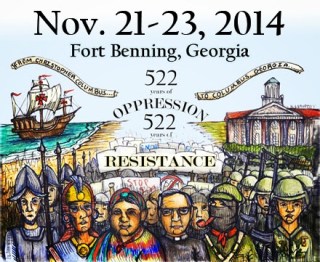
These graduates have consistently used their skills to wage war against their own people. Among those targeted by SOA graduates are educators, union organizers, religious workers, student leaders and others who work for the rights of the poor. Hundreds of thousands of Latin Americans have been tortured, raped, assassinated, “disappeared,” massacred, and forced into becoming refugees by those trained by the SOA. In all, the School of the Americas has produced a combined 329 graduates from El Salvador, Guatemala and Nicaragua.
So, the America we live in is the world’s paragon of freedom, liberty and justice. Our America also sells arms throughout the world — sometimes to both sides in a conflict. Our America also invades countries illegally when we have an interest in the region’s resources, but leave “unimportant” people to fend for themselves. And even when we were directly complicit in creating the instability, our America balks at helping the victims of our long history of covert interference.
I love my country. But I do not love everything our country does. I do not support our blithe ignorance of the needs of brave veterans, many of whom suffer physical and mental damage from their combat experiences. I do not support our protracted, unfounded and irrational efforts to withhold rights and benefits from people based solely on their sexual orientation or gender identity. I do not support the increasing militarization of our police resulting in tragedies like the murder of Michael Brown in Ferguson, Missouri. And I especially do not support our worship of war, our arrogant and righteous attitude that our culture is inherently superior and our misguided priorities that treat corporations like people, and our people like expendable commodities.

Truth and Meaning: What Can We Do About Depression?

We are all struggling to understand the apparent suicide of actor/comedian Robin Williams. How could someone with his talents and resources fail to cope with depression so much that he would take his own life? What can we do to fight this terrible illness before it takes the life of someone we know? The fact is that people who suffer from depression kill themselves every day. According to the World Health Organization, depression is the leading cause of disability worldwide. Statistics estimate that around 30,000 Americans commit suicide each year, or roughly one person every 15 minutes.
How is this possible? It is possible because those of us lucky enough to not suffer from this terrible disease do not understand it. According to Mental Health America, clinical depression is one of the most common mental illnesses, affecting more than 19 million Americans each year. Depression can complicate other medical conditions, and can even be serious enough to lead to suicide. Depression can occur to anyone, at any age, and to people of any race or ethnic group. Depression is never a “normal” part of life, no matter what your age, gender or health situation.
Unfortunately, although about 70 percent of individuals with depression have a full remission of the disorder with effective treatment, fewer than half of those suffering from this illness seek treatment. Too many people resist treatment because they believe depression isn’t serious, that they can treat it themselves or that it is a personal weakness rather than a serious medical illness.
Symptoms of Clinical Depression:
  • Persistent sad, anxious or “empty” mood
  • Sleeping too much or too little, middle of the night or early morning waking
  • Reduced appetite and weight loss, or increased appetite and weight gain
  • Loss of pleasure and interest in activities once enjoyed, including sex
  • Restlessness, irritability
  • Persistent physical symptoms that do not respond to treatment (such as chronic pain or digestive disorders)
  • Difficulty concentrating, remembering or making decisions
  • Fatigue or loss of energy
  • Feeling guilty, hopeless or worthless
  • Thoughts of suicide or death
If you have five or more of these symptoms for two weeks or more, you could have clinical depression and should see your doctor or a qualified mental health professional for help.
 
Many things can contribute to clinical depression.
 
Biological: People with depression typically have too little or too much of certain brain chemicals, called “neurotransmitters.” Changes in these brain chemicals may cause or contribute to clinical depression.
 
Cognitive: People with negative thinking patterns and low self-esteem are more likely to develop clinical depression.
 
Gender: Women experience clinical depression at a rate that is nearly twice that of men. While the reasons for this are still unclear, they may include the hormonal changes women go through during menstruation, pregnancy, childbirth and menopause. Other reasons may include the stress caused by the multiple responsibilities that women have.
 
Co-occurrence: Clinical depression is more likely to occur along with certain illnesses, such as heart disease, cancer, Parkinson’s disease, diabetes, Alzheimer’s disease and hormonal disorders.
 
Medications: Side effects of some medications can bring about depression.
 
Genetic: A family history of clinical depression increases the risk for developing the illness.
 
Situational: Difficult life events, including divorce, financial problems or the death of a loved one can contribute to clinical depression.
 
If you or someone you know is hurting, there is help. By calling 1-800-273-TALK (8255), the National Suicide Prevention Lifeline, you’ll be connected to a skilled, trained counselor at a crisis center in your area, anytime 24/7. Anyone can also reach them online at www.suicidepreventionlifeline.org.
Talk to someone — it can save a life. We MUST conquer the stigma that society places on all those who suffer from mental illness. So don’t wait — do it now.

Letting Go of Religion

We spend our whole lives letting go. We let go of things, places, people and ideas. Sometimes letting go is easy — we make a gift to give to a friend, we leave one job for a better one, we pack our belongings and move into a new home.

Other times, letting go can be challenging — we end a relationship with a loved one, we lose an heirloom, a favorite store closes its doors. Sometimes, letting go can be traumatic. A thief steals a car or valuable property. A fire destroys your home. A cherished love one dies. But, perhaps most traumatic of all is letting go of ideas.

From birth, we are blank slates, constantly written upon by parents, siblings, teachers and perfect strangers. Every scribble enters our mind and gets categorized into our identities, our sense of self, and our moral compass. And when we enter our teen years, we naturally begin to question whether or not that developed identity indeed reflects who we really are. We begin to question the easy dichotomies of Western thinking: good/evil; rich/poor; liberal/conservative; male/female; believer/non-believer.

The regressive mind will resist these questions, falling back on stock answers and dogmatic teachings learned throughout childhood. They will refuse to let go of comfort, privilege and even irrational beliefs that give them satisfaction.

Others will explore, willing to consider letting go of ideas, but the quest is a perilous one and not without its dangers. The act of questioning alone may cause us to let go of seeming truths and of self-obvious paradigms. These explorers may fall into a valley of doubt; they may climb a mountain rejecting everything and become hardened skeptics; or they may simply become lost and hopeless facing a foggy world they cannot change and are doomed to endure. But, those who make the quest along the valleys, over the mountains and through the fog emerge as seekers.

And the seeker is prepared to develop a progressive mind. And it is the progressive mind that is best suited to keep ideas that make sense and to let go of those that do not. The progressive mind thinks beyond its own happiness and comfort and concerns itself with the common good. The progressive mind lets go of asking “Why?” in favor of asking “Why not?”

As a minister, my expertise is religion. Young progressive minds often let go of religion once they find that their Sunday School stories don’t match the world’s reality. Young progressive minds often let go of religion when it makes irrational demands, rejects people who think differently and disempowers women, LGBTQ folk and other oppressed people.

But, letting go doesn’t have to be an “all or nothing” proposition, either. I can let go of a label without completely erasing all that comes with that label. The choice is not between being Baptist, Catholic, Muslim, Hindu, Buddhist or not. The question is whether there is truth and meaning to be found in any religion — perhaps in all religions — as you continually reshape your identity.

Sometimes, we rationalize letting go as an irretrievable loss. But it doesn’t have to be that way. Even if you feel betrayed by your religious upbringing, I believe that there is value in religion for the young progressive mind. For me, of course, Unitarian Universalism is one such religion. We support same-sex marriage, reproductive justice, environmentalism and most other progressive causes. I am a religious atheist and mystical humanist, serving a congregation with a wide range of opinions and beliefs.

So, as you let go of ideas, as you question the teachings of your youth, always leave the door open to keep the pieces of the past that make sense. The progressive mind never closes any door completely.

Revelation

Recently, the Islamic Center of Midland hosted the public as part of the Choosing a Culture of Understanding program in celebration of Ramadan. Attendees shared wonderful interfaith understanding, as presenters explained the month-long observance. The evening also revealed a surprising element of our programs this year, the auspicious coincidence of a recurring theme — revelation.

In May, participants discussed the meaning of Sabbath at Temple Beth El, and Rabbi Chava Bahle explained the Jewish practice of Counting the Omer (a measure of grain used in ancient times). Beginning on the second day of Passover, the idea of counting each day represents the Jews’ spiritual preparation and anticipation for God’s revelation of the Torah on Mount Sinai.

In June, we celebrated Pentecost, the festival that marks the revelation of the Holy Spirit upon the Apostles and other followers of Jesus Christ as described in the Acts of the Apostles 2:1-31. And this July, we observed Ramadan, the month in which the Qur’an was first revealed as guidance for all the people.

An Evening of Meditation on Sacred Writings is planned for Sept. 23 at the Creative 360. Participants will be invited to meditate silently while sacred writings from many of the world’s religions, including Eastern traditions such as Buddhism, are read. And on Nov. 1, we invite the public to the Unitarian Universalist Fellowship to observe Samhain (pronounced Sow’-in), a holiday shared by many religions as the day in the year during which the veil between the spirit world and the world of the living is at its narrowest. This is a time for honoring our beloved dead and seeking their revelation and guidance.

In many religions, periods of revelation come with some form of sacrifice. During Ramadan, for instance, Muslims fast between sunrise and sunset and avoid other behaviors deemed sinful, such as swearing, arguing, gossiping and procrastination. For some Protestants, the nine days between Ascension Day and Pentecost are a time of fasting and world-wide prayer in honor of the disciples’ time of prayer and unity awaiting the Holy Spirit. Similarly among Roman Catholics, special Pentecost Novenas are held and the Eve of Pentecost was traditionally a day of fasting.

Eastern traditions, such as Hinduism, often include a period of asceticism on the path to enlightenment, releasing oneself from worldly desires and connections. The Anishinaabe Naming Ceremony (Kchitwaa noozwinkewin) requires a person seeking a spirit name to undergo prayer and fasting for months, even years, before a name is decided upon. And Unitarian Universalism, as a noncreedal faith, offers its adherents no universal answers to the great mysteries of life, but rather places the burden of finding truth and meaning on each person. The struggle for revelation can be difficult and painful.

We might be tempted to view depriving ourselves as a harsh price to pay for revelation. But, as the Qur’an says in Sura 2: “God wants ease for you, not hardship. He wants you to complete the prescribed period and to glorify Him for having guided you, so that you may be thankful.” The Hindu Mundaka Upandishad says: “They who practice austerity and faith in the forest, the peaceful followers of who live on alms, depart passionless through the door of the sun, to where is that immortal Person, even the imperishable Spirit.” Isaiah 58 tells us: “Is not this the fast that I choose: to loose the bonds of injustice, to undo the thongs of the yoke, to let the oppressed go free, and to break every yoke? Is it not to share your bread with the hungry, and bring the homeless poor into your house; when you see the naked, to cover them, and not to hide yourself from your own kin? Then your light shall break forth like the dawn, and your healing shall spring up quickly.”

In explaining the Counting of the Omer, Rabbi Bahle told the story of two brothers with adjacent farms. The younger brother married and had a family, while the older brother lived alone.

One year at harvest time, both brothers bundled their stalks of grain into sheaves, counted them and took them into their barns to store. The older brother worried that his brother’s family might need more grain and so, in the dark of night took as many sheaves as he could carry across the field to his brother’s barn. At the same time, the younger brother knew his brother had no family to help him. So he too rose, dressed and took as many sheaves as he could carry to his brother’s barn.

The next night they did the same thing and in the morning, each brother stood in awe and counted their grain, which was as much as before they had given it away. Finally on the third night, both brothers rose and again, gathered as much grain as they could carry and headed out across the field to their brother’s barns. It was so dark, that they almost collided in the middle of the fields. They stopped, smiled and hugged one another for a long time. Then they knelt and thanked God for giving them such a thoughtful and generous brother. That spot became the Holy of Holies because the holiest place in the world is in the human heart where we bless and love and are generous to each other.

Whatever religious path we walk, we can all see that there is wisdom to be found in sacrifice and refraining from negative behaviors. In fact, some lessons in our lives can only be learned when we come to appreciate the gift of life, the comfort of community and the love of the divine — by whatever name we apply. So, let us join together with our neighbors of all faiths, thoughtfully and with generosity, in search of revelation of a better world.

Truth and Meaning: Extremism

One of the reasons I write this blog is to speak to the masses of you out there who consider yourselves “middle of the road.” Maybe you are a Republican, a Democrat, or even an Independent. Maybe you are a Methodist, a Catholic or an atheist. You read my blog because it speaks with a progressive voice. You would never post a comment, because you are not involved … yet.

But the time is coming when lurkers and bystanders are going to have to take a position. Extremely wealthy people are buying our government. Extremist conservatives have hijacked the Republican Party, making Ronald Reagan look like a moderate — and Dwight Eisenhower a positive liberal. On matters of public policy, the middle ground is shrinking. Debates today tend to be black or white, all or nothing, and compromise is disappearing from our public dialogue.

For years, we put up with the Westboro Baptist Church and their outrageous offenses. Few Christians publicly condemned their acts of hate, their complete misrepresentation of the message of love taught by Jesus. Every statistic shows that our national worship of guns leads to more killing than anywhere else in the world. And yet, the voice of the NRA goes largely unopposed except for small groups with little backing from the church. The only time the church got largely involved in Michigan was when a bill threatened to allow open carry spaces to include churches.

And now, an anti-abortionist group has invaded the sanctuary of a church in New Orleans, disrupting the worship service during a moment of silence honoring a recently deceased member. Fortunately, we Unitarian Universalists practice what we preach, so the protesters were escorted out of the church by trained peacekeepers as the congregation sang to overwhelm their shouts of hate.

When will it end? How far down the path of extremism must we go before you get involved? How would you feel if people violated your sacred, holy space, calling you names and damning you? In the 1960s, we called this the Silent Majority. Well, the time for silence is over and reasonable people must begin to reclaim the moral center of this nation.

Extremism is the weapon of the ignorant, of the bully. Extremism is immoral and silence only fuels its flame. It is time to get off the sidelines and let your voice be heard. It is time for true people of faith and love to stand up to the extremists and say, “Enough!”

Truth and Meaning: WWJD?

I remember when the WWJD bracelets first appeared and I learned that the letters stood for “What WouldJesus Do?” At first, I thought they seemed a little hokey; too much like a marketing ploy. But, I set aside my innate cynicism and saw them as a valuable tool offering Christians a constant reminder of the teachings of their spiritual leader.

Every day, I listen to politicians attack each other and ply their smoke and mirror tactics on the American people. “Look at this shiny scandal over here,” they tell us, and that way we won’t notice when they slash funding for public programs, attack our civil liberties, and increase the inequity of wealth in this nation. And I think to myself, what would Jesus do?

Jesus lived in a tiny and insignificant colony of the largest empire in the world at that time. Tyrants ruled capriciously, worshiped wealth and power, and entertained themselves by watching the suffering of others. Jesus had many options available to him. He did not gather armies and swords to fight Rome. And aside from one excusable instance reacting to the desecration of his most sacred place, he did not advocate violence or any kind of destruction. In fact, he preached the opposite – turn the other cheek.

What did Jesus do? He witnessed publicly his beliefs about how the world should be. And then he lived by those principles. He did not judge others who came to him for aid – young or old, man or woman, rich or poor, gay or straight, Jew or Gentile. He only rebuked people who placed adherence to rigid dogma over the crying need of the people.

Feed the hungry. Clothe the naked. House the homeless. Free the prisoner. Heal the sick. Give hope to those without hope. That’s what Jesus did. He ignored irrelevant rules and regulations. He accepted humble hospitality but assembled no material riches of his own. He didn’t kowtow to authorities. He simply spoke truth to power.

What would Jesus do today? He wouldn’t leave millions without access to healing medical treatment. He wouldn’t allow vulnerable children to be placed in harm’s way. He wouldn’t tolerate discriminating against any group of people for any reason. And when people are hungry, naked, or homeless, he would feed them, clothe them, and provide them shelter.

Many people consider America a Christian nation, and that our laws are heavily influenced by Christian morality. These people should ask themselves, “What would Jesus do if he were alive today?” War, racism, homophobia, misogyny, corporate personhood, and innocent people dying needlessly every day – is this what Jesus would do? If Jesus walked our streets today, would he preach these things, or would he preach acceptance and understanding, justice and equality, hope and love?

You don’t have to be Jesus to do what Jesus would do.

Truth and Meaning: Pro-Life

I am pro-life. But as another election cycle approaches, you will hear this phrase bandied loosely about by politicians courting your votes. So I want to be absolutely clear what I mean when I say that I am pro-life. I mean that:
  • I am a pacifist and oppose all war or violent military intervention as a solution to any problem. War inevitably leads to senseless death and destruction; war most often creates more problems than it solves; and war always gives birth to yet another generation who view violence as a means to their ends.
  • I believe that no government has the right to murder anyone, regardless of the crime they have committed. Human judgments are fallible, and one mistaken execution is one too many. Also, we do not possess god-like prescience to know that even the most hardened criminal cannot be rehabilitated, or that the most mentally-disturbed person cannot be cured.
  • We possess more than enough resources to feed, clothe and shelter every living person. No one on the face of this planet should ever go hungry, naked or homeless. And that means that sharing wealth must take precedence over protecting privilege.
  • Liberty and the pursuit of happiness are impossible without life. And while some disease and certainly death is inevitable, far too much medical and mental suffering is not. No one should ever lack of medical treatment because of something as ridiculous as placing a higher priority on stock dividends or tax cuts for our wealthiest citizens.
  • A woman’s body is her sacred gift and she deserves the right to have complete control of when and how many children she wishes to bear. And it violates our Constitutionally-guaranteed right of religious freedom when politicians place continuation of a nonviable fetus above that of a healthy mother.
  • “Rape culture” is a real and vulgar part of American society. No woman should ever fear for her safety because of her appearance, her actions or the puerile desire of a man to steal her most intimate dignity.
  • Our obscene obsession with gun ownership and gun purchase in this nation is an egregious offense to all life.
Here are the attitudes I consider to be “anti-life:”
  • If you believe that any nation has the right to murder those of another without exhausting every conceivable diplomatic option and every nonviolent course of action, then you are not pro-life. And if you send men and women into combat and then fail to provide them world-class mental and physical medical treatment, then you are not pro-life.
  • If you believe that the state has the right to murder prisoners convicted of crimes, given the inordinate number of mistakes that have been made in capital punishment sentencing, its inherent racism and classism, and the cruel processes used to take those lives, then you are not pro-life.
  • If you support funding cuts to food stamps, school lunch programs, early childhood education initiatives and public education of equally high quality for all, when more than enough is available in our bloated military spending to meet these needs and more, then you are not pro-life.
  • If you oppose the Affordable Care Act, but offer no viable solution to providing health insurance to every American, then you are not pro-life.
  • When you support the most intrusive invasion of a woman’s body, but offer our young people little realistic education about sex and obstruct their access to birth control, then you are not pro-life. And if you seek to deny victims of incest, rape and medical complications threatening the life of the mother with means to terminate those pregnancies, then you are not pro-life.
  • If you support “slap on the wrist” punishments for rapists and those committing domestic violence and sexual assaults on women, and excuse the behavior of beasts for violating a woman by blaming her for the crime, then you are not pro-life.
  • If you are not repulsed that this nation has done absolutely nothing to create mandatory background checks for all gun purchases, or to limit access to weapons whose sole purpose is the mass murder of humans — and you have not pressured you legislators to do so — then you are not pro-life.
So, when that politician knocks on your door and tells you he is “pro-life,” challenge him with these points as well. Because loving the unborn fetus without caring about its life after birth, the families that will raise it or the society that supports its successful development is not pro-life.

The Path to Truth

We face a world of confusing uncertainty and contradictions. Some prosper while millions suffer. Mean-spirited sound bites drown out civil discourse. We yearn for heroes and heroines only to see them eviscerated by our cult of celebrity and our celebration of cynicism. The jesters have taken over the castle while the feudal lords plunder the people and pillage the land.

We look to our churches, mosques, synagogues, and temples for guidance, for deliverance. But we find the poison creeping into those foundations as well. Our questions are answered with irrelevant platitudes and empty satisfactions of our simple desire to be cared about, our need to be cared for. Our young people naturally look elsewhere for relief from out-of-control tuition debt, for an end to the limitless hurdles to achieving their goals, for the self-respect to resist unattainable standards of beauty and virulence and societal definitions of success. Too often, our young people see their future as a desolate plain with no harvest in sight.

We live in a nation of incredible abundance, with a wealth of resources, but we feel empty. We live in communities with boundless activities, but we feel listless. We live unfulfilled lives and seek to fill that void with the bread and circuses of the internet, with drinking and drugs, with absurd reality on the television, and real absurdity in our daily lives.

The time has come for a frank and honest conversation about religion. We must discuss our souls as individuals and our soul as a nation. The time to seek the answers to the questions that matter has arrived. Why am I here? What is the purpose of living? Can I find meaning in this insane asylum of a world? What can I do to ease my overwhelming pain?

Some offer simple answers to these questions. You are here because God created you. Your purpose consists of worshiping him. This life offers only a path to a better world after you die. You must endure the pain as a test of your faith that God possesses all of the answers. As children, these answers can work. In the pleasant world of coloring pages and tales of good conquering evil, we need no further explanations. But, as we grow older, we learn that these answers no longer suffice. We begin to question. We fill our doubtful gaps with more complicated rituals; we desperately strengthen our commitment to blind faith and traditions; and we greedily consume more complicated interpretations to the stories of our childhood.

But, despite our valiant efforts, we still feel lost and alone, hopeless and in pain. Our faith never seems strong enough and the answers begin to ring hollow. The zealous shout louder and we assure ourselves that they must be right. How else could they be so convinced of the truth? But, how can we believe their truths when our life tells me differently?

Our own structure as a nation places the burden of resolving these conundrums on us. Our Constitution guarantees us the freedom to believe and to practice (within limits) our religions. As a nation, we declare no one religious belief to be “truth.” America does not proclaim that absolute morality resides within any one specific theology. We may consider others misguided or incorrect, and we can freely promote our particular versions of truth. But, those who profess to know “the” truth exhibit shocked indignation when refuted with facts and reason. Purveyors of divine insight claim persecution when their efforts to demonize people they consider sinful are deemed hateful and hypocritical.

Millions of people do not believe in the Christian god and live exemplary moral lives, just as many Christians do. Some people who do not hold Christian beliefs do awful things, just as do some professed Christians do. We do not live ethical lives because a supernatural agency makes it so. We live ethical lives because as human beings we make choices – choices to love and show compassion, or choices to be intolerant and selfish. A faith in some form of god that helps us live ethically is admirable. But faith in god is not required to be a good citizen, a spiritual person, or a soul aligned with the powers of the universe.

How, then, can I answer the burning questions without a belief in God? Some believe in Love. My Universalist predecessors preached that God is Love, and that works for many people. And while I often find fault with the texts attributed to the Apostle Paul, I agree with his assertion to the Corinthians that Love is patient and kind; Love is not arrogant or resentful; Love bears all things, believes all things, hopes all things, and endures all things.

Faith sometimes offers a wonderful power in our lives and can serve as a force for great good. But faith can also twist our perceptions and close our minds to the search for truth and meaning. So, when it comes to issues such as same-sex marriage and equality for LGBT individuals, I ache when I hear people profess their Christian faith to damn others, to sit in judgment on others, and to call down the wrath of the God they worship on others. And it pains me just as greatly when religious people stand mute while these voices of intolerance dominate the public conversation. There is no factual basis to believe that homosexuality is a “choice.” None. Therefore, if one claims the belief that we are made in the image of God, then our sexual orientation and gender identity is part of the grace bestowed by a loving deity who merely wants us to share that Love. We should practice ours faith to honor that gift and to respect its source. But Love is greater than faith. And the sharing of Love trumps any ritualistic practice or dogmatic adherence to sacred texts.

Relying on ancient passages written in another time and place, in a context wildly different than those we live in today ignores our most spectacular gifts as humans. If we are indeed children of a god, then that god bestowed upon us minds, emotions, and the capacity for discernment that raises us above the instincts of mere beasts. An active and engaged spiritual life uses our powers of reason, evaluates our life experiences, and amasses our collective powers of wisdom to determine what is moral. The spiritual life demands only that we understand and love each other. We are no longer children that need to view God as a schoolmaster beating unruly pupils, or an overseer whipping mindless drones. God is Love. It really is just that simple. And that choice lies in our hands.

And what does loving mean today? It means that we keep our beautiful and treasured traditions of spiritual practice but discard those outdated and meaningless rules that serve only to separate us. It means that we celebrate the marriage of loving people committing their lives to each other, whether they are a man and a woman, two men, or two women. It means that we say “Not One More” meaningless and stupid waste of precious life defending our obscene worship of guns. It means telling all women that they are beautiful just as they are, and telling all men that expressing kindness and gentleness does not show weakness. It means sharing the bounty in our lives with those less fortunate by paying living wages and fighting the root causes of poverty. It means providing every person with equal access to physical and mental health resources and freeing them from the crippling burdens of disease and affliction.

We live in a region of great wealth, knowledge, and potential. We can become a model of modern living by pioneering prosperity for every person. We merely need to heed the call to seek our own truths, to enable the search for truth by others, and then to come together in Beloved Community. It is possible and we have the power to do it.

Truth and Meaning: Hate

Emotions are the expressed transfer of living energy. When we feel, when we reside within an emotion, we emit a certain energy that others around us can sense. Children are the most transparent when radiating emotion. We easily sense when a child is joyful, confused, scared or frustrated.

As we grow older, we learn complicated emotional combinations and filters designed to hide our true emotions. The choreography of emotional exchange becomes a ballet of exquisite skill and complexity that opens the door to different kinds of feelings. But this dance also complicates our routines. As we see often in football, sometimes the “receiver” runs a different route than expected by the quarterback, and the passage of emotions fall incomplete to the ground.

As carriers of energy, emotions share many characteristics with living creatures. Some emotions hearken back to a more primitive state of reptilian instinct. Other, more mature emotions evoke feelings of family and tribal group. And some emotions combine with others in a symbiotic melding — a beautiful waltz of grace made possible by the willingness of those sharing the emotion to bare themselves, to make themselves fully vulnerable.

But there is a special class of emotions that share the attributes of a lesser life form — the parasite. These emotions wither and die without the energy stolen from other life forms. Hate is a parasite emotion. For hate only thrives by stealing vibrant life energy from others. Hate leeches the aerated blood of society, leaving only disease and weakness in its wake.

When someone expresses hate, the recipient naturally feels fear and anxiety in response. The recipient might naturally feel compelled to expend energy fending off the hate, and this only feeds the parasite. In this way, the hate-filled person poisons others and like a vampire drains the essence of life energy from a community.

But there is a cure for the parasite of hate. The medicine that repels the symptoms of hate is Love. For Love acts not only as a barrier to the viral attack of hate, Love offers a positive expression of emotion that not only makes the object of hate feel better, but also treats the root causes of hate. For in the end, the only difference between a parasite and a symbiote is cooperation. A parasite gives nothing and simply wallows in its own selfish desires. The symbiote returns gift for gift, bringing positive contributions to the living equation.

So when the parasite seeks to infect you with hate, do not feed its emptiness with fear or anger. Instead, inoculate yourself with the energy of Love. In this way, you also may help transform the useless parasite into a creature with contributions and, in time, its own Love to share.

Truth and Meaning: Religious Atheism

Occasionally, I am called an atheist by someone believing that by doing so they are insulting me. Nothing could be further from the truth. Largely, their misconception derives from the false assumption that atheism and religion are mutually exclusive. They are not.

Religion does not require god. Let me repeat and reframe that. Being a religious person does not require a belief in a supernatural being.

Hundreds of different definitions of religion exist, each reflecting either a scholarly or a dogmatic bias depending on the presuppositions of the person making the definition. “Religion” clearly contains intellectual, ritual, social and ethical elements, bound together by an explicit or implicit belief in the reality of an unseen world, whether this belief be expressed in supernaturalistic or idealistic terms. A number of the more common definitions are those that presume the existence of the Sacred (Peter Berger, Emile Durkheim), the Supernatural/Divine (James Frazer, Immanuel Kant, Rodney Stark), or Order/Purpose (William James).

Some definitions of the term focus more on the presence of different states of being and humankind’s grappling to come to terms with those differences, without making judgments regarding the nature of other states. George Hegel called religion “the knowledge possessed by the finite mind of its nature as absolute mind,” while Friedrich Schleiermacher called it “a feeling for the infinite,” and Alfred North Whitehead described it as “what the individual does with his own solitariness.”

Some etymologists connect “religion” to the Latin ligare, which is the same root of the word ligament, meaning “to bind.” Re-ligare, therefore, would mean to bind again, perhaps in a ritualistic manner, or in meaningful practices.

Therefore, as an atheist, I believe that “religion” is a collection of practices by which groups of people come together repeatedly to find meaning in the relationship of themselves and of humankind to all existence, known and unknown. And, that meaning need not derive from or be directed by a supernatural source.

So, if you do not believe in god, but feel something missing in your “feeling of the infinite,” there is a religious community that welcomes your search for truth and meaning.