Truth and Meaning: Real Love

So, another Valentine’s Day is upon us. My message today is simple. You are loved.

Even if you get no cards in the mail, you are loved. If no one buys you chocolates or flowers, you are loved.

Whether you are Christian or Muslim, Atheist or Jew, you are loved. Whether you are conservative or liberal, rich or poor, you are loved. Whether you are gay or straight, you are loved.

I know this because I love you. As a Unitarian Universalist, I affirm and promote the inherent worth and dignity of every person, and compassion in human relations. Because I love you, I fight for your civil rights and for your freedom from discrimination. Because I love all of you, I advocate for a living wage, better public school funding, and clean air and water. Because I love every person, I dedicate my life to being my brother’s and my sister’s keeper, to justice for all, and for an end to violence and war.

And because you are loved, you do not need the roses or the heart-shaped boxes of sweets. You do not need to buy love at the store. And you do not need to buy the lies sold by the hate mongers and fear peddlers.

Despite the awful tragedies happening every day, the world is a pretty terrific place. In spite of our failures and heartaches, there is much to be said for living. But our lives are only as good as we make them, and we can all try harder to help those who are less fortunate to have a voice and a vote about things that affect them.

The best way to do this is to express your unconditional love proudly and publicly, without any expectation of any benefit in return. Love without judgment. Love with no strings attached. Love simply for the sake of loving.

Do I believe human nature causes us to be hurtful, distrustful and prejudiced? Not for a second. Am I a doe-eyed, naive Utopian? You bet. Love will do that for you. Love helps you see the innocent child in every person before life teaches them to be afraid and angry.

I am blessed to be married to a woman who reminds me every day of the power of love. And I am fortunate to be part of a religious community whose cornerstone is human beings caring for each other and welcoming all spiritual seekers regardless of their identities. May you feel that power within you on this Valentine’s Day, and every other day of the year.

Truth and Meaning: Are You Economically Free?

According to the Heritage Foundation, economic freedom is “the fundamental right of every human to control his or her own labor and property.” In an economically free society, they argue, “individuals are free to work, produce, consume and invest in any way they please” and “governments allow labor, capital, and goods to move freely.” As you read this column, you might imagine that they are talking about you. You might logically think that they are concerned with your well being.

But are you truly free economically? If you lost your job tomorrow, how long would it take you to find a comparable job? Do you make enough money to plan for the future meaningfully? Are you really free to produce and consume as you please, or are you having trouble just keeping up with credit card payments, rising consumer costs, house and car repairs, medical bills, student loans and countless other expenses?

The problem is not with your understanding of work and money, but rather the hypocrisy of proponents of this skewed view of economics. Because, in reality, the Heritage Foundation could not care less about you, your home, your children or your future. All they care about are the handful of multi-millionaires who can invest more in one transaction than you will earn in a lifetime without any concern about losing it all. To the Heritage Foundation, you are not a person, you are a unit of labor, a commodity to be purchased, used and discarded.

Last Sunday, Northwood’s Timothy Nash explained in this editorial how America’s economy will suffer if we do not pass more pro-business tax reform and make it easier for the wealthy to trickle down their riches unimpeded. He based his recommendation on his concern that the ranking of the United States in the Heritage Foundation’s Index of Economic Freedom dropped from 6th to 12th place in the past five years. Let’s examine this hypothesis.

Nash’s use of this index provides a classic example of misusing statistics to make a dramatic point. First, the Index of Economic Freedom ranks nearly 200 countries, so a drop in rankings from 6 to 12 perhaps should not unduly concern us. But, who surpassed us in those rankings? Ireland, Canada, Chile, Denmark, Estonia and Mauritius. Do you even know where Mauritius is?

To benchmark the American economy against world peers, wouldn’t you limit the comparison to countries with a comparable economy? In 2013, there were only 15 countries in the world with Gross Domestic Products in excess of $1 trillion. Only two of the 14 countries other than the U.S. rank higher in the Index of Economic Freedom — Canada and Australia. Among the lowest ranking peer countries are Brazil (118th), India (128th), China (139th) and Russia (143rd). Other peers include Japan, Germany, France, England, Italy, Spain, South Korea and Mexico. Perhaps before we predict doom and gloom for the American economy, we should first benchmark ourselves only against appropriate peers.

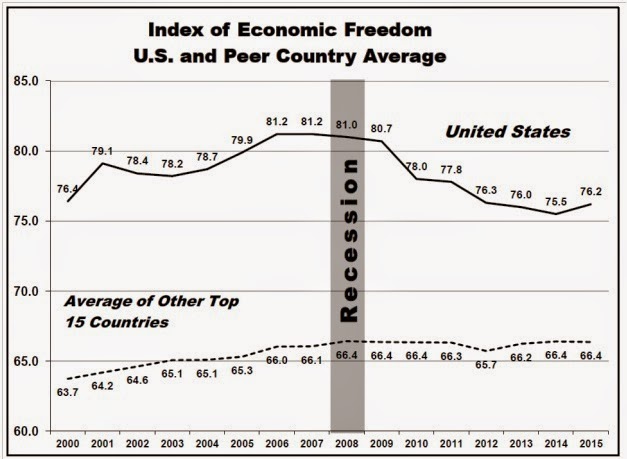
Second, the Index of Economic Freedom includes an impressive array of data elements, all of which have some relevance to examining global economies. However, a longitudinal analysis of a manufactured index such as this must also take account of external events that might skew the numbers radically. This chart shows the Index of Economic Freedom for the United States as well as the average of the other 14 countries with GDP’s in excess of $1 trillion. Note that the U.S. consistently scores significantly higher than our peer group. Also, notice that the index for the U.S. was increasing noticeably until 2008 — the year of the biggest recession to hit this country since 1929. As one should expect, that colossal calamity of criminal fraud and greed took its toll on our ranking — a toll from which we are only now beginning to recover. Lastly, note that the index for the U.S. is now almost exactly at the same level as 15 years ago.

A key problem when using statistics is picking and choosing the numbers that support your assertion and then overemphasizing their importance. In this case, to cry wolf over a drop in economic ranking caused largely by the malfeasance of bankers, venture capitalists and high risk investors is unwarranted especially when we still outrank most of our true peers. And to recommend that America reward the very institutions that facilitated our financial collapse is utterly uncalled for.

Now, let’s get to the real point. The Index of Economic Freedom is not an objective analytic tool — it is a propaganda device to support radical economic views that support a few billionaires off the sweat and sacrifice of the majority of Americans. One hundred economists could create 100 different models using the exact same variables and produce wildly different results. A real Index of Economic Freedom would measure the freedom that workers truly have to change jobs, to learn new skills, to negotiate for better and fairer wages and benefits, and to provide opportunities for their children. A real Index of Economic Freedom would place people over investments, and healthy neighborhoods over quarterly profit statements. A real Index of Economic Freedom would measure the quality of an economy as much as the quantity of its output, the standard of living for the average citizen as much as the return on investment of a corporate “person.”

So, I challenge economists to craft a real Index of Economic Freedom. Included in such an index might be percentages of:
  • minimum wage earners living in poverty;
  • unemployed as well as those underemployed;
  • college graduates unable to find work in their fields;
  • the availability of public transportation and the average commuting distance to work;
  • vacation time, sick leave and paid family leave;
  • workers without medical insurance and other benefits;
  • employers restricting benefits on the basis of sexual orientation or gender identity;
  • failed privatization efforts and the costs of corruption from privatizing schools, prisons, etc.;
  • income inequality for women and minorities;
  • incarceration of white collar criminals versus other offenders;
  • occupational safety violations and environmental “accidents;”
  • governmental spending on military versus human needs; and
  • individual taxes paid as a percent of actual gross income.
We don’t need to give Wall Street and the ultra-wealthy more freedom to wreak havoc on our economy. We need to give secretaries and teachers, managers and technicians, restaurant workers and occupational therapists more true economic freedom. We need to give women and minorities, and workers in our depressed cities more economic freedom. And we need to give our children the hope of economic freedom to attend college without crippling debt, to raise families without sacrificing leisure time and to plan for retirement secure in the belief that those funds will not disappear into an off-shore bank account.
 
Reject the statistical machinations of the Heritage Foundation and call for an American economy that truly cares about all human beings. Advocate for workplaces where workers are free to organize for their mutual benefit, and a marketplace free from gouging fees and interest rates. Tell our economists that every human person should be compensated fairly based on their labor, not on accidents of their birth and the privilege derived from inherited wealth or physical attributes. And remind our pundits, as people of faith, that human beings matter more than money, and that true freedom is measured by the way a society treats its most unfortunate, not its wealthiest.
 
With nearly one-quarter of the world’s GDP, no one should be jobless, homeless or hopeless in the United States. Parents should not have to worry about whether to pay the gas bill or feed their children. No one should have to worry about being fired because they are gay or transgender. Everyone should be paid fairly regardless of their gender. And no one working a 40-hour work week should be living in poverty. A fair and just society is not about wealth. Feed the hungry, quench the thirst of the parched, welcome the stranger, clothe the naked, care for the sick and visit the prisoner. When we do these things, we will have all the freedom we need.
 

Truth and Meaning: Not Only Once a Year

Let’s be honest — America has a problem with sex. On one hand, we prudishly dance around the subject and never really share our innermost feelings and desires with our partners. We freak out over public breast feeding. We blame rape victims for provoking their attackers because of what they wore or how much they drank. Bold men are considered forceful and strong. Bold women are seen as pushy and brash.

On the other hand, we surround ourselves with objectified images of women. The media defines feminine beauty as being young and thin, submissive yet sexy, revealing just enough to titillate, but hiding reality under make-up, hair products, tight clothes and high heels. From winged Victoria Secret models to breast-enhanced pseudo celebrities on so-called reality shows, women get identified as angel or whore and not as human beings.

The common thread among all of these attributes is a fundamental disrespect of women. Our society routinely discriminates against women by paying them less than men, constantly attacking their rights and access to medical care, and minimizing their personhood. Almost a century after earning the right to vote, women still struggle for equal treatment in the workplace, the halls of government, the media and our schools.

In a few days, we celebrate the national holiday of women’s oppression in this country — Valentine’s Day. For too many people, this becomes the day that reveals our worth as a partner, as a spouse, as a lover. We reduce our emotions to the amount of cash spent on commodities — products conveniently highlighted in our stores just for the occasion. Candy and card makers give us a wide variety of inexpensive ways to display our affection. Florists tell us that only roses will show her that we really love her. Jewelers tell us that only diamonds demonstrate a true sense of commitment. Girls are conditioned to believe that buying such gifts is how boys should show affection. Boys are conditioned to believe that girls want these things as proof of their devotion.

How did we allow ourselves to become so manipulated? History reveals millennia of repression of women. From Eve to Mary Magdalene, women have been reduced to weaker versions of men incapable of anything but betrayal, fickleness and irrationality. History writers routinely ignore the accomplishments of women, often writing women’s names from the narrative entirely.

Nowhere is this more apparent than in our religious history. Women still cannot be priests despite the fact that the Christian church in Rome was founded by a woman. Unless you are a midwife, prostitute or property of a man, women are hard pressed to find their way into our sacred texts. Even in the essential unique role as child bearer and nurturer, women have been methodically reduced from the Goddess from whom all life derives to something to be feared and controlled by men. Over the years, men have converted the deities of fertility, peace and love to the supporting cast of male dominance and violence.

We have made much progress in recent centuries, but we still have a long way to go. Going further will require than men take up the responsibility of being strong allies for women’s equality. A simple first opportunity is Valentine’s Day.

Don’t measure your love for someone by how much money you spend. Don’t try to purchase affection or sexual gratification through chocolate, flowers or bracelets. Ask the women in your lives what they want. Many women don’t want sparkly trinkets — they want real commitment to their dreams and well being. They want to be heard. They want their accomplishments acknowledged. They want to know that you consider them special and important in your life.

You won’t find love at the mall. Give the person you love a long message. Cook their favorite meal and watch their favorite movie. Write them a letter and bare your soul. Look deep into their eyes and say “I love you.”

That simple “I love you” means more than any store-bought present. And you don’t need the excuse of a manufactured holiday to share that gift. You can give that gift every single day of the year.

Truth and Meaning: To the Moon

I was 13 when Neil Armstrong took his first step on the moon. I remember sitting around the television with my family, all of us in rapt attention. Successfully landing on the moon was a monumental achievement of strategic planning — one perhaps unrivaled since the building of the Pyramids, Macchu Picchu or the Great Wall. Modern governments rarely plan for the distant future. We are lucky if they plan for the next quarter, let alone the next year or the next 10 years.

So now we are engaged in the seemingly endless debate over the Keystone XL Pipeline. Will it create jobs? Will it make America less dependent on foreign oil? Will it endanger our environment beyond repair? My answer to all of these questions is this: I couldn’t care less.

I don’t care about the Keystone XL Pipeline because building more pipes to pump more oil makes about as much sense for this nation as reintroducing the Edsel. Oil dependency has been a bad idea from its inception and throwing more time, money and human resources into that black hole is a colossal waste.

You may be asking yourself these questions. Why are we building this pipeline? Why shouldn’t we build this pipeline? We are building this pipeline for one very simple reason — because our economy is intimately and integrally connected to the production of energy through the use of fossil fuels. Moving away from oil and natural gas will cause many very large and very important corporations a world of grief. Exxon, Chevron, Texaco, BP and a host of others have no interest in America moving away from a society based upon the internal combustion engine. And they represent a lot of jobs, as well as a lot of rich people who own stock in those companies.

But, our ongoing support of these corporations also reveals other societal commitments — commitments that are incredibly short-sighted. Our dependence on petrochemicals commits us to poisoning our environment on a daily basis. Oil spills, carbon monoxide, fracking chemicals and coal mining are all contributing to the gradual destruction of an environment conducive to human life. Our commitment to these energy sources also drains each and every citizen of valuable financial resources in the form of gas and electric bills, and gasoline. There are roughly 125 million households in the United States. Conservatively, each household spends $2,000 per year on gas and electric usage. That is $250 billion that could be used for other purposes if energy cost nothing. There are 250 million cars and trucks on our roads. Conservatively, each uses 500 gallons of gas each year. That is another $125 billion if running a car cost nothing. And, in time, all of this oil and gas is going to run out or become prohibitively expensive to extract from our depleted earth.

Is it fair to assume that we could heat our homes and run our cars for no cost? Yes, because we can. And that is why we shouldn’t build one more pipeline. If we committed to solar, wind, geothermal and other alternative energy sources over the next few decades with the zeal we have used to pursue oil, then these limitless sources would in time cost little more than equipment maintenance to collect and use. And that does not count, of course, the trillions invested in military incursions in search of more oil.

Imagine our government setting a strategic goal of full energy independence from fossil fuels by 2025. Each home would be supplied with a solar panel and storage battery for little more than the cost of installing a satellite dish. Every car would be battery powered and gas stations replaced with charging stations. All of the oil companies could divert their valuable resources to creating 21st century jobs rather than perpetuating 19th century ones. Oil spills would become a distant memory because a sunlight spill is just a beautiful day.

Truth and Meaning: Community College Realities

Last Sunday, the Midland Daily News published an editorial titled “Our View: Aid, scholarships already available for community college.” An adequate response mandates that the falsehoods in each sentence be addressed.

“Community college should be affordable and doable for everyone who wants to take advantage of it. We agree, without a doubt.”

Obviously, the Midland Daily News does not agree with this statement because there are many people who cannot afford community college and this opinion piece opposes a proposal to eliminate those costs. The average student at Delta College taking two classes in one term pays $707 in tuition and fees. Add on the cost of books, gas, childcare and all of the other related expenses, and the total easily exceeds $1,000 per term. If the student is working 40 hours per week at minimum wage jobs, that is 3 1/2 week’s worth of salary.

“However, we believe in most cases there are many opportunities for people to attend community college at no expense or nearly no expense to them.”

No data support this claim. Last year, Delta College awarded $1,077,142 in scholarships to 15,000 students. That equates to a whopping $72 per student — not even the cost of one credit hour.

“Community college has always been an affordable and potentially debt-free way for people to start their path toward a four-year degree and beyond.”

Virtually no one attends college today without incurring massive loan debt. According to the Wall Street Journal, the class of 2014 was the most indebted ever. The average 2014 graduate is burdened with student-loan debt of $33,000, nearly double the amount for students 20 years ago after adjusting for inflation.

“Tuition is lower than four-year universities and most traditional students are able to continue living at home, forgoing the expense of living on campus or off-campus.”

One-third of the students at Delta College are 25 years old or older. One can hardly imagine that many of them are still living in their parent’s home. Another third are 20 to 24 years old, making this a grossly classist point. Just because people with financial resources can afford to pay for their kids to live on campus is no excuse for expecting poorer kids to continue living at home.

“Making these educations more affordable — and in a lot of cases at no cost to students — are federal financial aid packages based on income as well as scholarships, which often go unclaimed at some community colleges because they’re not sought after by students.”

According to Peterson’s, the definitive expert publisher of college guides, this claim is an utter myth. “This one has been around since the word ‘scholarship’ was invented… (colleges) seldom have university scholarships that aren’t awarded, and if they do, it’s usually because of timing or highly restrictive eligibility requirements.”

“Presumably, President Obama’s proposal for a free community college education for everyone is targeted at those who can’t afford the cost. “A quality education should not be a privilege that is reserved for a few,” he said in a recent speech at Pellissippi State Community College in Knoxville. However, we believe the costs associated with a community college education, because of federal aid and scholarships already available as well as the earnings from jobs most full-time students have, are affordable. Even older adults seeking to change careers or get back into the workforce can take advantage of federal financial aid and scholarships.”

This is an offensive and elitist statement that exhibits an intentional blindness to the state of the underclass in America today. In FY 2012, the average federal student aid awarded per student totaled $11,073, of which $6,654 (60 percent) consisted of loans. Students then typically make up the difference with additional loans from private sources. To claim that federal grants and scholarships are even remotely sufficient to meet the current need is absurd.

In addition, bringing the earnings of the average community college student into the equation is laughable. Two-thirds of the students at Delta College are 24 years old or younger. It is safe to say, therefore, that many are working at minimum wage jobs and and likely earning less than $10/hour. And since few of these students can find actual “full-time” jobs (where the employer provides benefits), many are forced to work two or more jobs to attain “full-time” employment status. And, by the way, according to the American Association of Community Colleges, only 41 percent of part-time students are employed full-time and only 22 percent of full-time students have full-time employment.

So, let’s calculate “affordable.” A student works 40 hours per week making $10/hour — just enough to be above the poverty level and not qualify for any government assistance. So, they make roughly $20,800 before taxes. If they take two courses per term for three terms at Delta College, the total cost will amount to roughly $2,500, or 12 percent of their total gross income. After rent, food, gas, car insurance, utilities, childcare, medical and dental expenses, and other necessities, what is left?

“The money is there for those who need help paying for community college, but the financial aid and scholarships need to be applied for first in order to be awarded. Really, what needs to become more affordable are the college costs that come after the community college degree. Those are the costs that are crippling people.”

No. What really needs to happen is for arrogant people of means to stop erecting even more roadblocks to honest, hard-working people trying to get out of the grip of institutionalized poverty in this nation. What we really need are fewer political hacks so intent on disagreeing with anything this president might suggest, that they are willing to throw the more than seven million community college students under the bus. What we really need are editorial writers who make at least a cursory effort to look into facts before parroting outworn prejudices and unsubstantiated myths.

Every struggling student attending Delta College deserves an apology for this opinion piece and I encourage readers to share your experiences in the comments if you have been a community college student.

Truth and Meaning: Respect

In an editorial earlier this week titled “We should respect our police officers,” the Midland Daily News asserted that “Police actions have been scrutinized to the point in which many law enforcement officials believe that they can no longer do their jobs effectively because of public pressure.” The editorial concluded, “Law enforcement officers have a demanding, difficult and sometimes dangerous job to do. And because of that, they deserve our respect.”

There are two ways for the reader to take editorial sentiments such as these. First, they can be viewed as the innocuous kind of flag-waving we see on Memorial Day and Veteran’s Day. However, on the other 363 days of the year, our veterans go without adequate treatment of the mental and physical afflictions they suffered performing the dangerous work of imposing American foreign policy around the world. On each of the other 363 days of the year, according to the Veteran’s Administration, 22 veterans commit suicide. On the other 363 days of the year, our best patriots must live with the knowledge that their dedicated service has contributed to innocent civilian deaths, torture, and the ongoing destabilization of sovereign foreign governments.

So this editorial could simply be rhetorical pleasantry, a pat on the back to men and women who do perform a truly demanding, difficult, and sometimes dangerous job in our society. No one taking to the streets in Ferguson, New York City, Washington, D.C., or elsewhere is questioning the courage of law enforcement officials. They would join in commending police for taking dangerous criminals off our streets, for protecting and serving the citizens within their jurisdictions.

But, the second interpretation of this editorial reveals a far more insidious agenda. In citing the findings of the statistics compiled by the National Law Enforcement Officers Memorial Fund, the editorial fails to offer the details of the 50 firearms-related fatalities of police officers in 2014. Only 15 of those 50 resulted from ambushes, including the two recent heinous murders of Wenjian Liu and Rafael Ramos in New York City. Most of the firearm-related deaths of police officers in 2014 came from the regular performance of their duties, including traffic stops, routine investigations of suspicious behavior or disturbances, and others including accidental shootings. A logical conclusion one might draw from these statistics is that too many people own and carry guns who should not have them and that our society should improve efforts to better manage the sale of deadly firearms.

The claim that “many law enforcement officials believe that they can no longer do their jobs effectively because of public pressure” is dangerous hyperbole. If our police must exact unquestioning loyalty in order to perform their function, then something is wrong with our law enforcement system. If we are unable to hold people accountable for the negligent acts of violence committed behind the shield of a uniform and badge, then something is wrong with our criminal justice system. And if we continue to allow unfettered access to deadly firearms without adequate controls, then we should hardly be surprised at the toll such a policy exacts on our citizens and on our police.

The concern being expressed about the recent deaths of unarmed African-American boys and men at the hands of police officers has nothing to do with being pro- or anti-police. Dismissing recent “public pressure” as anti-police sentiment is misleading and factually incorrect. Recent public pressure has focused on our inability to objectively follow our system of prosecutorial due process in order to find justice. It is about needless deaths and what must occur to prevent such waste from ever happening again.

Should we respect the police? Absolutely. But respect does not mean turning a blind eye when police abuse their authority or use lethal force inappropriately or unevenly. Respecting the police means not only honoring their contributions, but also holding them accountable when their actions result in the death of innocents.

Truth and Meaning: Names of God

My door bell rang unexpectedly. I found three young women standing there. As they introduced themselves, I saw their name badges and recognized them as Mormons on their mission. I explained that I was a Unitarian Universalist minister, assuming that they would wish me a nice day and move on to the next house. But they showed interest and we began to talk.

After a few minutes, I invited them in. We had a delightful conversation for an hour or so. We respected and listened to each other. We discussed the Bible and the history of the Abrahamic faiths. We talked about the commonalities shared by most of the world’s religions. Then, one of them expressed her opinion about people uniting in religious belief. She spoke of the “one true god” (by which she of course meant the god of her religion) as the way for all people to come together in salvation. When she finished, I told her that I could agree with most of what she had just said, except for that phrase.

I explained that as long as people cling to the notion that their god is the one (and only) true god, or that their faith is the one true faith, then humanity is doomed to perpetual war and violence. Soon afterwards, they were on their way. I think I had done much to personalize my religious tradition for them, just as they worked to dispel some of the unfair stereotypes assigned to their faith.

Whatever your beliefs – even if you don’t believe in god at all – there are forces currently beyond our understanding. And while we continue to make great strides grasping the birth of the universe and the nature of the cosmos, I do not believe that we will ever completely know everything about everything. That is not a justification for the existence of god – it is merely acceptance that there are things that exist beyond human comprehension. Homo sapiens is not perfect and never will be. So, one can reasonably presume that our species will never have a perfect understanding of all existence.

If you grant that argument, then what do you call the mystery, the unknowable, the incomprehensible? Some people do not feel the need to call it “god,” or to name it in any way. But many people do find comfort in naming the wonder of the universe. In particular, people take solace thinking that behind the unknown lies a force of inherent goodness or order.

For Hindus, there are millions of manifestations of the Oversoul, and adherents are free to worship through whichever god most helps them make that connection. For Muslims, their one god goes by 99 different names, from the Compassionate and Merciful to the Giver of Life and Bringer of Death. Trinitarian Christians believe that god can only be understood as three persons that are distinct, yet one essence.

Over the centuries, far too many people have died because they did not share the same opinion regarding the nature of god or the manner in which we should hold god in regard. Hasn’t humankind reached a point where we can live together with people who do not share our particular belief about the wonder and mystery of the universe? Can we make peace with the notion that we have many names of god and that our differing practices do not justify prejudice and hate, violence and murder? Can we latch onto the common denominators of all religions to respect the inherent worth and dignity of every person?

Truth and Meaning: Christmas Spirit

When my father was a boy, he considered an orange a special Christmas present. And while he grew up in relative poverty, he never considered his family poor. My grandfather was always able to find work that paid a fair wage. My grandmother was a stay-at-home mother. And my father was able to work during the summer and save up enough for college.

http://www.educatingwomen.org/poverty-in-the-us/But, times have changed. People like my grandfather – unskilled or skilled in outdated technologies – have few full-time job opportunities that pay enough to support a family. Fathers and mothers often work several jobs and then have to pay for child care. And young people today routinely graduate from college with massive student loan debt.

Like most of you that read David DeForest’s letter to the editor in the December 12 issue of the Midland Daily News (“No Reason to Work”), I was deeply saddened that such attitudes still exist in our community. Especially now, as we celebrate the birth of a man who loved all people and cared about the well being of everyone, the public expression of such sentiments reminds us of the pain that many feel in this country. The pain of hunger and homelessness; the pain of hate and discrimination; the pain of hopelessness that nothing we do can improve our lives.

My grandfather came to this country penniless, skilled in a trade that no longer existed. And yet, his children grew up healthy and went on to successful lives. Such is no longer the case for many of today’s immigrants. The path to citizenship is prohibitively expensive and takes as long as 10 years to complete. In the meantime, they perform the menial tasks beneath most Americans, living in constant fear that federal agents will burst into their homes and ship family members to undisclosed locations for uncertain deportation.

Especially painful was reading Mr. DeForest’s depiction of Americans living in poverty today. Jesus never asked for any justification when helping the poor or the sick. He simply helped them. Jesus never asked a hungry person, “Why don’t you just get a job?” He simply fed them. And Jesus did not tower over the poor in judgment, condemning them for their need. He simply gave them hope.

Mr. DeForest’s misplaced anger should be directed at the true parasites in this country – privileged rich people who contribute little and consume much; corporate CEO’s who are paid more in one day than a minimum wage employee can earn in a year; bankers who gamble with this nation’s economy with impunity. These leeches cost America billions of dollars each year. Every social welfare program combined does not come close to any such amount.

So, to Mr. DeForest, and to anyone who shares his sentiments, now is the time to re-examine your attitudes. Now is the time to walk among the poor and show them the respect they deserve by learning about the ravages of racism, xenophobia, sexism, homophobia, and institutionalized poverty. At Christmas time, let us all walk the path of Jesus – the path of sympathy, compassion, understanding and love.

Address Opposing the Religious Freedom Restoration Act

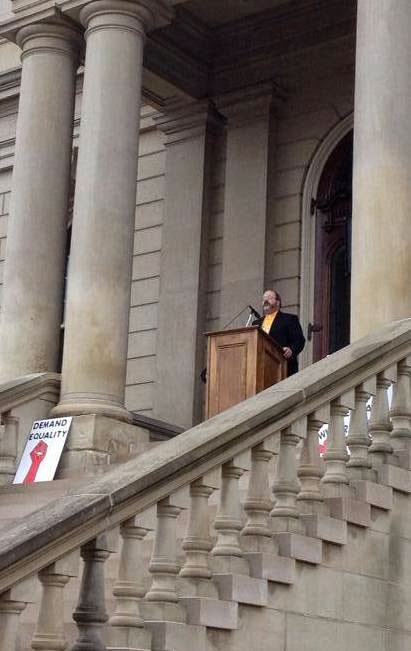
At the request of students from Adrian College, I was asked to speak at a protest on the Capitol steps in Lansing in opposition to the proposed Religious Freedom Restoration Act (HB 5958) on December 16, 2014 during the waning days of the lame duck session of the Michigan legislature.  The following are my comments (you may also see a video here, or listen to an mp3 version here).
————————-


Everywhere we turn today, politicians seek to justify the unjustifiable. “Corporations are people,” they tell us. “We need more bombs and so we must cut school lunch programs.” “The best way to fix our faltering economy is to double down our investment into the banks that got us here in the first place.”

And now we hear a new claim. With House Bill 5958, our legislators tell us, “Government must not burden people and businesses when choosing to exercise their religious beliefs, regardless of the consequences of that action on others.” Convincing us of the sincerity of such statements, especially given their inherent contradictions and the tremendous potential for and mischief by those taking advantage of such claims as these, presents a daunting challenge.

And because the task raises such difficulties, they must call on the greatest authorities to lend credence to their arguments. So, you hear many politicians today referring to the founders of this great nation. They quote Thomas Jefferson, John Adams, Thomas Paine, and others as proof of the righteousness of their cause.

They carefully sift through mountains of books to find just the right quote – even if they must take that quote completely out of context. When the founders stood mute on a subject, they tell us what the founders were really thinking. When those tactics fall short, they shout words like “Freedom!” and “Liberty!” confident that they can rely on our patriotism and our trust in the democratic process that they act in our best interests.

And when all else fails, they wait until the dead of night. They skulk in the shadows of the halls of government until after the electorate has spoken. They wait until the time when everyone looks forward to family gatherings and singing joyous praises.

Then, they slink from behind their desks. They quietly announce a hearing – or bypass the process of a public hearing altogether – and pass whatever laws please them. They do this because they know, were it not for the distractions of the holidays and our everyday lives, we might hold up our hands and say, “Wait a minute…I don’t understand what purpose this proposed bill serves.” After months of hibernation, they race through the lame duck session because they are afraid that we might have the time to read proposed bills and share our opinions. They feverishly plunge through this window because it is too late for us to voice our discontent at the ballot box with politicians whose terms will end shortly.

Perhaps the legislatures populated by our founders operated with a similar lack of transparency. But, I doubt it. It was Thomas Paine, who wrote in his landmark work Common Sense that the faithfulness of those elected to serve in public office “will be secured by the prudent reflection of not making a rod for themselves.” In other words, our elected officials should not rule over us like tyrants, but should engage with us in dialogue and informed debate.

Later, Paine specifically talks about the nature of America. “This new world,” he writes, “hath been the asylum for the persecuted lovers of civil and religious liberty from every part of Europe. Hither have they fled, not from the tender embraces of the mother, but from the cruelty of the monster…” So clearly, Paine would not have dreamed of a legislature using the tactics of a tyrant to pass laws abridging the rights of those who fear religious persecution.

Our ancestors came to this land because people used religious beliefs to hurt, to imprison, and even to kill them. I understand the corruption of religion by those who wield it as a rod to punish others. My grandmother Theresa fled her home in Europe for committing the sin of divorcing her abusive husband. For this act of self-preservation, the church deemed her unworthy and excommunicated her – a punishment that meant death; for she was now shunned by employers, shop owners, and landlords. Staying meant homelessness and starvation because she believed in her right to live free.

My grandmother met the man who became my grandfather here in America. He, too, had fled Europe because the Serbian army would routinely cross the river into his hometown and conscript young men to fight the never-ending religious conflict in the Balkans. No matter how many times the military dragged him to kill people who believed in God differently, he defected and returned home.

A century later, people still die in that region because of their religious beliefs. Governments that claim to fight for independence, for self-rule, for self-determination, use that fight as an excuse to rape and murder those who are different. A simple carpenter, my grandfather understood the corruption of freedom by those wielding it as a rod to kill others. So, he made the perilous journey here to America, where he could believe freely.

After years of struggle, my grandparents raised a family. My father honored his parents and cared for them in their later years. After my grandmother died, my grandfather’s life became simple again. He would sit at the kitchen table drinking coffee and playing solitaire all day. He believed he would soon rejoin his beloved Theresa in Heaven and was content to await his death patiently.

One night, my parents hosted a prayer meeting. The minister of our church spoke about the evils of card playing. Finally, my father asked our minister if he believed that my grandfather would spend eternity in Hell for the sin of playing solitaire. When our minister answered “yes,” my father threw him out of the house and we never returned to that church.

My father, an engineer, had designed our church building. He literally helped build that congregation. He raised his children in its Sunday School. I remember singing “Wonderful Grace of Jesus” during Sunday night services. But that same church used its religious belief to damn my grandfather.  So my father understood the corruption of restoration. He saw firsthand how a church could roll back the clock to a time when religion was routinely used as a rod to condemn others to perpetual flames and torment.

By the time I became a dad, I chose not to believe in the God of my father or my grandfather. My children went unbaptized. And I raised them in a Unitarian Universalist church, where they learned to respect all religious beliefs and to honor the spiritual path they would choose for themselves.

As a Sunday School teacher, I learned the history and heritage of famous Unitarians, like John Adams, who once wrote to his friend Thomas Jefferson:

We have…a National Bible Society, to propagate King James’s Bible, through all Nations. Would it not be better to apply these pious Subscriptions, to purify Christendom from the Corruptions of Christianity…[Some say] I have renounced the Christian religion…Far from it. I see in every Page, Something to recommend Christianity in its Purity and Something to discredit its Corruptions…The Ten Commandments and the Sermon on the Mount contain my Religion.

Don’t kill. Don’t cheat. Don’t steal. Don’t lie. Don’t envy your neighbor. In fact, love your neighbor. Love your neighbor as you would have your neighbor love you. Nearly every religion preaches this basic golden rule. Love everyone. Do not love only those who believe as you do. Do not withhold love from those who do not meet your approval. Everyone. No exceptions.

So I understand the corruption of laws that claim to restore religious freedom. Laws like HB 5958 are not an act of religion, bringing us together in common purpose and principle, but an act of division. The Religious Freedom Restoration Act is not an act of freedom, relieving us of governmental intrusion into our souls, but an act of invasion. This proposed travesty of a law is not an act of restoration, renewing hope for a people suffering daily oppression, but an act of destruction.  This so-called Religious Freedom Restoration Act is a corruption of religious freedom; a corruption of our democratic principles; a corruption of the core tenets of our human community; and a corruption of the very soul of our state.

I have the great good fortune to be married to a wonderful woman. Jody serves as advocate for victims of sexual assault at the Underground Railroad, a women’s shelter in Saginaw. She wanted to be here with me today. But her commitment to serving others, and my commitment to support her work, superseded our personal desires. John Adams, my Unitarian ancestor, spent many years apart from his love. To our great good fortune, they left behind a collection of correspondence exhibiting not only their devotion to each other, but also their shared commitment to justice, equality, and freedom.

Abigail and John wrote often of this new nation and of the true meaning of words like “freedom.” In one letter, Abigail wrote:

How difficult the task to quench the fire and the pride of private ambition, and to sacrifice ourselves and all our hopes and expectations to the public [welfare]! How few have souls capable of so noble an undertaking! How often are the laurels worn by those who have had no share in earning them! But there is a future… reward, to which the upright [person] looks, and which will most assuredly be obtained, provided [that person] perseveres unto the end.

You here today know about sacrifice. You have given up your time and energy to be here and to have your voices heard by your elected officials. You here today understand working toward the common good and the noble undertaking of guaranteeing freedom to all people. You here today see too clearly how those charged with guaranteeing our freedoms wear the shriveled laurels earned by catering to special interests, by pursuing power over others, and through the self-righteous delusion that they know the one truth.

Because Abigail Adams was right – there is a future reward. Moreover, we need not wait patiently until we die to receive that reward. We can unite as one people. White or black – whatever our skin color – we can unite. Woman or man – whatever our sexual orientation or gender identity – we can unite; Catholic, Protestant, or Orthodox…Muslim, Jew, or Sikh…Buddhist, Hindu, or Jain…Agnostic or Atheist – whatever our religious beliefs – we can unite; Americans all, regardless of our documentation or ethnic heritage – we can unite.

We can unite to fight for equal justice under the law. We can unite to provide affordable access to health care for all. We can unite to protect our decisions on when to have children, when not to have children, and how to parent the children we have in safe and healthy communities. We can unite to ensure that every person has equal access to a quality education and a job paying a fair and living wage. We can unite to protect our planet from those who would plunder its resources and from practices that threaten our existence as a species through global climate change.

And by standing united against the corruption of the Religious Freedom Restoration Act, we guard our right to believe or not to believe what we want in regards to religion. We oppose the sanctioning of discrimination against people on the basis of religious beliefs. We support the freedom of religious practice, so long as that practice does not harm others.

And we stand united to defend the wall of separation between Church and State described by Thomas Jefferson. For he acknowledged that the supreme will of the nation in behalf of the rights of conscience was that no legislature should pass laws respecting an establishment of religion, or prohibiting the free exercise of religion. Jefferson wrote that “our civil rights have no dependence on our religious opinions,” and that depriving people of their civil rights on the basis of religious beliefs will “corrupt the principles of that very religion it is meant to encourage.”

A people united will never be divided.

Truth and Meaning: One Question

A crisis looms on our horizon. How we cope with that crisis will depend on your answer to a simple question.

Ignore the media hype. Disregard the irrelevant facts. Set aside unrelated events that may sway your judgment. Look at the evidence yourself and answer one simple question.

  • Tamir Rice, a 12-year-old boy, is playing alone in a park with a toy gun. Someone calls 911 to report seeing Tamir and even says it is probably just a toy gun. Minutes later, a police car roars up to within just feet of Tamir and two seconds later he is dead. Did Tamir Rice deserve to die?
  • Eric Gardner is selling single cigarettes for 50 cents — a petty crime. A few minutes later, he is surrounded by police. One puts Eric in an illegal choke hold. Eric gasps time and again that he cannot breathe. In just minutes, he lies on the sidewalk dead. Did Eric Gardner deserve to die?
  • Michael Brown fits the description of a person reported to have stolen some cigarettes and scuffled with a clerk. Michael is walking down the street with a friend. An altercation ensues with a police officer, the exact facts of which are disputed. Even assuming the worst case scenario, Michael grabbed unsuccessfully for the officer’s gun and then ran away. A minute later Michael is 30 feet away, hands visible with no weapon. The autopsy reports show bullet wounds in his arm, two to the chest that indicate he was falling forward, and the kill shot to the head at an angle indicating that he was nearly on the ground. Did Michael Brown deserve to die?
I have skewed no evidence. I have included nothing in these scenarios about the neighborhoods, the police officers themselves, community relations with the police, national media coverage or subsequent investigations. In the case of Tamir Rice and Eric Gardner, video records reveal the events in real time for anyone to watch. Disregarding all of the irrelevant noise surrounding these tragedies, did Tamir, Eric and Michael deserve to die?
 
Whether you are white or black does not matter. Whether you are Republican or Democrat does not matter. Whether you are young or old, straight or gay, man or woman, rich or poor — none of that matters. Did Tamir, Eric and Michael deserve to die?
 
If you ask yourself that question, and your answer is no, then you are ready to explore the coming crisis in our nation. You are ready to objectively examine the research and data. You are ready to set aside the punditry and editorializing and look at the reality in America for yourself. And when you do, you will see our deeply embedded systems of structured poverty, institutionalized racism and the impacts of privilege in our society.
 
This is painful work. If you are white, male, straight, middle class, you will be tempted to feel shamed — your initial reaction will be that you are being accused of something you did not do. That is a natural reaction, but I encourage you to move through it quickly. Privilege is not the problem. The problem is that too many people with privilege do not acknowledge its benefits and do too little to level the playing field for all.
 
Once you have answered the question and read the research, imagine how you would feel if you were a black man in America today, 50 years after the Civil Right Act supposedly launched us into a post-racial society. Imagine that you are the mother or father of Tamir or Michael, or the wife and children of Eric. If you can put on those shoes and walk in them for just a short time, then your feelings of shame and guilt will quickly evaporate. They will disappear because you will want to do something. You will want to change things so that the senseless ending of young lives stops.
 
Yes or no?