“…it simply is not true that one can believe anything and be a Unitarian. This is not what creedlessness means. One cannot be a racist and a Unitarian; be a Nazi and a Unitarian; a polygamist and a Unitarian; a bigot and a Unitarian. In our zeal for growth, we must not sacrifice the character of our movement as a rational, idealistic, ethical religion. Everybody is not, and cannot be a Unitarian regardless of their unethical behavior or prejudicial beliefs.” – A. Powell Davies
In all the years since the merger that created the Unitarian Universalist Association, one issue remains constantly at the forefront of our unaccomplished vision. Year after year, we failed to adequately address institutionalized racism in our own churches, let alone in the world beyond our walls. The irony is that we know the causes – privilege and whiteness. The tragedy is that we have not yet developed the communal will to tackle these causes. Our goal of affirming the inherent worth and dignity of every person will remain beyond our grasp until we destroy these pernicious attitudes.
Many in our ranks work with great dedication toward this end. Some of our ministers and lay members represent models of allyship with People of Color. However, the vast majority of Unitarian Universalists remain unengaged in anti-racism and anti-oppression work. Like most of our social justice causes, we gently encourage members to educate themselves; we create painless ways to help ourselves feel like we are contributing to the greater good; and we provide a modicum of support to organizations committed to the cause. In the end, however, our commitment as a faith body to erase racism is tepid.
Every time another young Black man or woman is murdered by the police or some heartless “stand your ground” zealot, we wring our hands and opine at the scope of the problem. And yet, the solution is not only obvious, but one we have done before.
 The Reverend A. Powell Davies accepted the pulpit of All Souls Unitarian Church in Washington, D.C. in 1945. Living in Washington showed Davies first-hand the realities of segregation. He began by getting his own house in order, for while African-Americans had attended All Souls over the years, they were not welcomed as full members until 1950. He pressured the Police Boys’ Club No. 10, housed at All Souls, to integrate. They refused and ended their relationship with the church. Davies then helped create the racially integrated Columbia Heights Youth Club.
But his most significant contribution came in 1953, when Davies launched a successful city-wide campaign to patronize only those restaurants that would serve all people regardless of race. In his wonderful biography, George Marshall quotes Davies from his February 1953 sermon:
Suppose we said this – “I do not believe in segregation; it is unjust, unrighteous, unbrotherly; I intend to do what I can to end it.” Well, that is our intention, a good intention, and it makes us feel like fine people. We are very happy, very warm with self-esteem, and very safe within its shelter…Suppose we should say, “I will not eat a meal in any restaurant that excludes Negroes.” Suppose we said further, “I will make it known to the managements of such restaurants.” We might feel rather odd – and we might have to eat in unaccustomed places. Our friends would raise their eyebrows – not much, but just enough for us to notice it. “Isn’t that going a little far?” some of them would ask. Which it surely is. Because it is carrying a good intention to fulfillment…If America is to be a righteous nation, worthy of the greatness of its opportunity, it must come through righteous deeds, not lofty talk.
Davies then made that commitment and called on the 1000+ members of the church to follow his example. This call to end segregation in restaurants, hotels, and other entities spread across the country.
The time is long overdue to continue this work, to carry our good intentions to fulfillment by attacking not only the effects of racism, such as segregation, but its root causes. We must take our lofty words and resolutions and turn them into denomination-wide actions that are not merely suggestions but mandates of a people of faith. For you cannot be a Unitarian Universalist and a racist.
That means every one of us commits to understand and accept the role of privilege in our lives and to act and sacrifice to dismantle its effects. Every one of us must stand against white supremacy is all of its forms, and drive the bigots from positions of power and influence. We must defend victims of race-based violence as our brothers and sisters. And we must pursue a realignment of social priorities in order to eradicate poverty and provide basic human rights for all people, especially if that means sharing the wealth we obtained through the fruits of privileged birth and station in life.
This is not a creed. This is a test of our faith.
Let us resolve to take this opportunity afforded by the social effects of pandemic to reshape ourselves, our churches, and our society; to right historic wrongs; and to achieve the our dreams of equality, fairness, and justice.

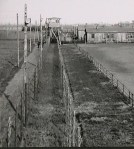 We have all seen pictures of “the wall.” Usually, the pictures are taken in isolated desert areas with no sign of nearby human activity.

 Nogales should be a unique and attractive city. After miles of relatively flat desert and mountains in the distance, you enter on Interstate 19, and are suddenly faced with hills covered with homes of many styles. It is a vertical city without the benefit of skyscrapers.
 Nogales should be an attractive city. But now, Nogales is a wounded city. A horrible gash splits the American and Mexican cities and a militarized gate makes passage between the two a burden, even a danger. The lumbering monstrosity dominates the landscape, looking for all intent making each city look like a prison.

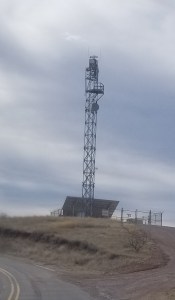 Migrants entering the United States face an incredible array of personnel and technology. Beyond the standard local police, county sheriffs and U.S. marshals, they must also evade the Border Patrol.
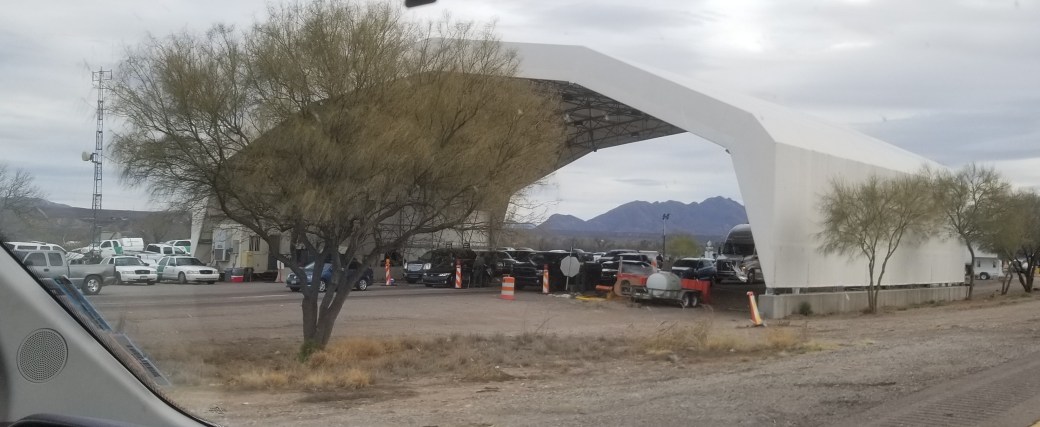 And what does it take to become a border patrol officer? A six-month course (only recently expanded from three months) and passing a test.
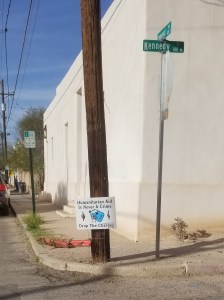
 drop on this trip, I was excited. I prepared for the walk carrying gallons of water jugs, as well as my own water and supplies.
 The area is beautiful and inhospitable at the same time. Huge temperature fluctuations, torrential rainstorms, and land that supports only thorny trees, scrub grass, and cacti make for a unique climate.
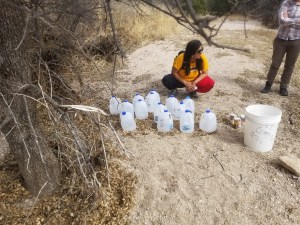 We arrived at a water drop. A shady area with a dozen or so water bottles and a few cans of beans. People had written messages on the many empty water bottles, such as “Via con dios!” Some food cans were empty. The pull top tab had corroded on others and we could tell that migrants had tried to open them.
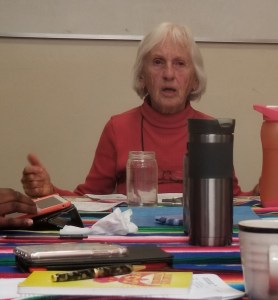 This morning, we met Lois Martin, an 84-year old who moved to Tucson 10 or so years ago to work on immigration justice. She is a member of
  Only after the hearing are migrants remitted to immigration services, where claims of asylum may be heard. But, often the only person who may hear the claim is the bus driver taking them to Nogales, or an officer who simply chooses to ignore it.
 My week here on the border will change me. My hope is that this time will also help me to change others.
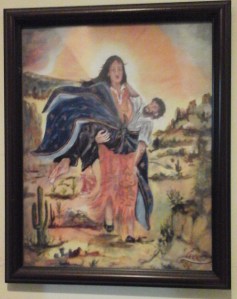 The Borderlinks offices are filled with art of all kinds, displaying a world that many only read about or hear described on the news. Even before we begin our immersion into the world of the undocumented, we are surrounded by their message, from photos to posters to original artwork.
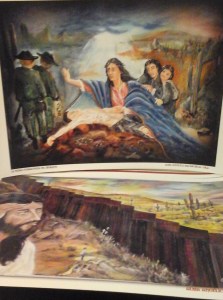 One of the sources of Unitarian Universalism is the teachings of the Jewish and Christian traditions – the laws of Moses, the justice of Isaiah, the wisdom of Solomon, and the gentleness of Jesus. We, too, can find meaning and inspiration in art, regardless of the theology of its creator.
 Rev. Jeff's Muse Kennel and Pizzatorium