General Assembly: Reconnecting

The first time one attends General Assembly, the worship services dazzle and the vast array of programs impress.  In my 10th General Assembly, it’s all about reconnecting with dear friends, past acquaintances, and valued colleagues.

During the Ministry Days programs, I chatted with cherished friends from Meadville Lombard Theological School, some still finishing their course of study.  Others, like me, are newly minted ministers facing the challenge of settled positions in new congregations.

Walking through the exhibit hall, I rediscovered fellow curriculum writers at the UU Curriculum and Resource Developers booth and others like my good friend Jennifer who prefers to be called an “extremist” (rather than “fanatical”) vegan and animal rights advocate. 

At the Mid-American region meeting, I ran into long-time acquaintances from youth and religious education work who are now serving as district staff for either Heartland (my new district), Central Midwest, or Prairie Star.  And I found my two on-site delegates from my new congregation, Judith and Sara, from the Unitarian Universalist Fellowship of Midland.  I am proud that we also have two more delegates participating off-site, back home in Midland.

Then, at the banner parade, I met old pals from the Unitarian Universalist Congregation at Shelter Rock, from my original home congregation, the First Unitarian Church of Pittsburgh, and from other miscellaneous travels over the years in UU circles.

Reconnecting with people makes General Assembly special and reminds me of the critical role churches play creating and fostering relationships.  In our modern world, where the focus is so often on individual over community, “me” versus “us,” our religious homes ground us in valuable and often lifelong relationship with others.

Days like this remind me of the origin of the word “religion,” which shares the same root as the word “ligament.  Re-ligio means to bind together again and again.  For me, reconnecting in meaningful relationship is the key to successful congregational and denominational life.

General Assumbly: Ministry Days

I spent most of the morning over my keyboard as my sermon muse arrived early.  I have learned to never ignore her visits, and so dutifully attended until my July 3 piece was completed.  I had a basic theme for this sermon in my head already, an important message since it will be my last visit to my home congregation, the First Unitarian Church of Pittsburgh.  I welcome the opportunity to say goodbye to old friends and long-time acquaintances.  This will also be for me a sort of pre-launch to my new called ministry position in Midland.

In the evening, the ministers gathered together to socialize, worship, and listen to the President of the Unitarian Universalist Association, Peter Morales.  While I do not consider myself much of a social butterfly, these events reunite me with dear friends from seminary – fellow travellers on this crazy path to ministry.  The food was great, the drinks pricey, and I could have done without having a glass of wine spilled on me by a senior colleague!

During President Morales’ talk, one theme struck me again and again.  We are a denomination with an opportunity to grow, to reach out to millions of people in search of our message who no longer find solace in traditional religions.  But, for the most part, congregations are on their own to address this opportunity.  The root “grassroots” arose many times, indicating that we should not expect a lot of help from the UUA in terms of funding or extensive staff support in order to expand programs and reach out to our communities.

While I do not welcome the content of this message, I do accept its honesty.  I very much want to see this religious movement grow in membership and influence on our society.  As a minister, I will be a primary mover and shaker in my community.  But, my principal task will be to encourage, harness, and support my congregants to become ambassadors of Unitarian Universalism.

In the search process, one observation appeared over and over again to me.  Our churches are often fantastic places – if one actually manages to find us.  It is natural that we build loving communities and then work to sustain them, even against perceived threats that new blood might visit upon us.  But, we must shed our fears and address those thousands (I would argue millions) of people out there who need us.  We must open our religious homes to the stranger out there desperately searching for spirituality, for comfort, and for the chance to make the world a better place.

Will reaching out to others change our congregations?  I hope so!  Will we lose what we love so much about our religious communities?  Not if we work with intention, with love, and with commitment to sustain them.  So, while I wish we had vast resources to fund innovative efforts and broad-reaching programs, I accept the challenge laid before us.  The task of changing the world and offering the hand of fellowship to our friends and neighbors is ours to accept or to ignore.  And I vote that we embrace that grassroots challenge.

General Assembly: Arrival

I just checked into my hotel here in swelteringly hot Charlotte.  I swear that the temperature rose 20 degrees as I crossed the border from Virginia into North Carolina.  The drive was thankfully uneventful, although I find myself taking more breaks than in my youth.  Ah, the delights of growing older!

I stopped at a couple of antique malls on the way down and spotted a few more that I will catch on the return trip.  Otherwise, it was a gorgeous drive with one tree-covered mountain after another.  There was a stretch in Virginia where the view was breathtaking.  Even in the slightly overcast sky, I imagined that I could see at least 20 miles into the distance.  There was an ominous looking mountain rising up from the plain, which (being the geek that I am) reminded me of Mount Doom rising from the dark lands of Mordor.  I suppose had it been nighttime, I might have seen the eye of Sauron watching for me.

Official activities do not begin until tomorrow afternoon, as Ministry Days begin for the Unitarian Universalist Ministers Association.  The UUMA events precede the opening of General Assembly each year, and offer a great opportunity to put faces to names and meet new colleagues.

General Assembly is intended to be a business meeting and an opportunity for learning and interaction.  But, for me (and this is my 10th GA), this week has always been about remembering that we are not just individual churches located here and there – a blip on the religious radar of America.  GA reminds me that we are a significant religious movement, a denomination with a storied history and the potential to impact our society still today.

I always return from General Assembly invigorated and loaded with ideas.  As the week progresses, I hope to check in with all of you.  I especially recommend that you check out the live streaming events throughout the week here.  If you can’t be here in person, these broadcasts are the next best thing.

The Unfulfilled Dream

My dear friend and mentor, David Bumbaugh, has written this article, his latest work exploring the dilemma of the lack of a clear Unitarian Universalist message — what defines us as religious people.  As an agitator and self-proclaimed windmill tilter myself (dare I say, a “pre-curmudgeon”), I identify with much of David’s frustration.  I, too, find enormously frustrating our lack of a clear answer to the simple question, “What is a Unitarian Universalist?”

David is correct when he points out that we too often let our fear of offending anybody steer us toward language loaded with ambiguity than fails to clarify or inspire.  But, as David points out, I suspect that his deep roots and prodigious contributions to our movement perhaps influence his perspective and weigh his hopes down with excessive expectations.

As a relatively new Unitarian Universalist (I’ve only been a UU for 25 years), I have no personal pre-merger history that influences my foundational thinking.  And, while I do fashion myself an historian, I believe this discussion depends far more on how we envision the future than the path we travelled to reach the current state.

I think one key piece missing from our equation will help define us as a religious denomination, both to ourselves and to the world.  Like other religious traditions, we interpret great truths; we help people cope with challenge and tragedy; we celebrate joys and life passages; and we educate ourselves and our children about our principles and traditions.  Specifically, however, we must declare boldly and proudly exactly what differentiates us from other religions.

For me, three things clearly separate us from most religions.. I believe that collectively they define us as a wholly distinct religious body.

  • Courage — Unitarian Universalism celebrates individual and collective acts of courage, specifically acts that challenge the authority of institutional power and dogma.  We not only elevate martyrs and people of great accomplishment to pedestals of admiration, but we encourage each and every Unitarian Universalist to do the same.  By holding no individual or congregation to creedal tests, we literally demand of everyone a commitment to crafting a unique philosophy of moral conduct.
  • Reason — Unitarian Universalism places the power of human thought above any sacred text, holy object, tradition, or vow of obedience.  The opinion of no single member of our denomination — be they minister, administrator, or even the President of the UUA — matters more than that of any other.  And, we promote the notion that Truth can be discerned through the application of reason.
  • Universal Love — Unitarian Universalism is not unique among religions promoting love of our neighbors.  We aspire, however, not to pick and choose which neighbor receive that love unconditionally.  This phrase also has the double meaning of portraying our love for our universe, a belief that all of existence is sacred and deserving of our caring devotion.

So, my “elevator speech” in response to the question “What is Unitarian Universalism?” is this.

Unitarian Universalism is a religion promoting the use of human courage and reason in the pursuit of universal love.

For me, that’s it.  No long preambles.  No “whereas” or “be it resolved.”  All of the rest can wait.  All of our principles and sources are covered.

On Memorial Day

When I was 12 years old, my brother Jon went to Vietnam.  The experience was formative for me in many ways.  Other men in my family had served in the military.  But, this was the first time that someone so close to me, someone I loved so deeply, was facing such danger on a daily basis during my lifetime.

Of course, I could have no sense of the suffering Jon experienced, or of the impact that time would have on his life after returning home.  I did know the daily anxiety, exacerbated by nightly news broadcasts of the carnage in Southeast Asia.  I felt the pang of separation with every letter I wrote.  And I felt elation the night he walked in the door, safe at home once more.

Jon brought me a copper bracelet given to him by the Montagnard natives where he was stationed.  He told me that it was a friendship bracelet, that once given should not be removed.  I wore that bracelet for many years, partly because it was the one tangible way I could share my brother’s experience of war.  That bracelet helped me imagine that there were real people over there that he had helped.

On Memorial Day, I join others honoring the enormous sacrifices of our veterans.  I especially hold my brother Jon in my mind, because I know that he paid – and continues to pay – a great price for his service to his country.  I owe him and those thousands of other vets a debt of gratitude for their sacrifice.

I also honor the sacrifices of the families and friends of veterans – the parents, brothers and sisters, spouses, children, and others – who waited, sent packages, prayed, and kept the dream of home alive.  And, while I hope for the day when we never need to take up arms again, let us always keep strong our will to support those who sacrifice for the good of others and never forget their dedication to preserving our freedoms.

A Pre-Mothers Day Observation

I consider myself a fairly organized person.  But, I never quite know where my muse will take me when I write a sermon.  Nearly finished with my Mothers Day message, I decided to take a break and walk down by the railroad tracks.  The trees finally budded out of their winter slumber.  And birds chatted their differing songs the further I got from the road.   I watched the water in the river and soaked in the sun.

Just as you often see alongside highways, one commonly finds animals along the tracks hit by trains in the night. I came across a muskrat, another victim of a passing locomotive. The body was recently dead and I noticed a small, unborn baby muskrat in the tangled remains.   I shook my head at the grim discovery and thought, “Oddly appropriate that I find this poor animal as I write my Mothers Day sermon.”  I reflected on this fresh reminder of the emotionless process of evolution in nature weeding out the weak so that the strongest and smartest live on.
I suddenly heard the crunching of gravel and looked up to see an older man walking along the tracks behind me.  We exchanged greetings and I told him I had never run into anyone else on the rails before.  He asked, “wasn’t it terrible about that young girl?”  After a second, I realized that he was talking about a 15-year old who had been struck and killed by a train last December.  He went on to explain that we were standing where the accident had happened and, from the details he provided, I imagined that he could have actually discovered the body.
We talked a little more, and then he moved on.   I stood staring at the spot for some time, and a deep sadness came over me.  Sadness for Erika Stefan’s family and friends.  Sadness for the conductor faced with the impossible task of stopping a train or alerting the girl wearing earphones and unable to hear his warnings. Sadness for the mother and grandmother, wife or partner, the woman that Erika Stefan would never become.
I finally crossed the tracks.   Unable to reach blossoms on trees up the steep incline, I broke off a small budding twig.  Dropping it on the tracks, I said, “Little one, wherever you are, I hope the universe treats you more kindly.”  And I began the walk home.
As I walked, I thought about what I could say as a minister to a parent who loses a child, especially under such tragic circumstances.  As the conversation went through my mind, a monarch butterfly flitted towards me. And as it passed, a voice inside said, “It’s alright…everything is going to be OK.” I turned as the butterfly winged passed, and found myself asking, “Is that you, little one?”  The monarch just continued on past in the direction from which I had come.
I realized at that moment that Erika Stefan will never be the mother of her own children.  But, for one passing moment, this young girl mothered me.  She comforted me in my sadness, and reminded me that death really just represents a transition of one state to another.  The universe comprises an inconceivable amount of star stuff and we are all made up of that same material that existed four billion years ago at its very beginning.  Little 15-year-old Erika reminded me of the interdependent web of all existence of which I am a very tiny part.
There are times when I wish I could just take a walk and have it be just a walk.  But, I guess the universe just has too many stories it wants to tell me.

Cosmic Tumblers

Five years ago, I began this journey to Unitarian Universalist ministry.  This part of the trek neared its conclusion a couple of weeks ago as the Unitarian Universalist Fellowship of Midland invited me to candidate for their settled ministry position.  I am thrilled and share their excitement at the potential for finding a good fit after years of hard work and dedication.  I can hardly wait to drive up in a few weeks and meet the folks I hope to spend many happy years with.

Of course, the cosmos needed balance and a few days later the plumber came to fix the blocked sewer line at the house.  When the plumber tells you that he has never seen a situation before, you know it is bad news.  Apparently my property had a septic tank that no one ever knew about (including the boro), which county codes demand must be removed.  So, my ant of financial flexibility to get me through until I start my new position just got stomped by a total bill of $16,500.
As the events unfolded, the scenario morphed from the merely tragic to the existentially comic.  It is amazing how we can agonize over a $1.00 coupon at the grocery store, but then once the damages hit five figures, the amounts simply become a blur.
Driving back to Smithton after getting the news, my mood sank.  Suddenly, the traffic ahead of me on the highway ground to a halt.  A few minutes later, the three lanes of traffic inched around an accident that must have happened literally a minute before I got to it.  Pieces of a car lay splayed across the road and emergency vehicles were just starting to arrive.  I immediately called my son back at the house and left a message that we would figure out a way to get through this, and that things could always be far worse.
As I wrote this posting, I got a call from my daughter Ashley, who had just returned from her sonogram appointment.  My first grandchild, due in early September, is a girl and looks very healthy.  There is also no sign of cleft palate/lip, which was a worry since Ashley’s mother was born with it.
So, all in all, I would say that the cosmic tumblers are still falling in my favor.  I may not be buying many books or records in the near future, but I have my health, two great and happy adult children, and the hope of a fantastic ministry for years to come — and that’s enough for me.

A Saturday Saunter

My future weighs heavy on my mind. I am happy.  But, finances, housing, job, relationships…nearly everything lies balancing on a tenuous slope with the spring thaw in sight.  I could not stalk my apartment for another day awaiting phone calls and emails, and so I set out on a saunter.

In his essay “Walking,” Thoreau describes sauntering, “which word is beautifully derived from…à la Sainte Terre — to the holy land…having no particular home, but equally at home everywhere.  For this is the secret of successful sauntering…For every walk is a sort of crusade, preached by some Peter the Hermit in us, to go forth and reconquer this holy land from the hands of the Infidels.”
I needed to hear the voice of the grace of the world in my mind.  Mindful wandering is my spiritual practice and I turned to it now so that I could listen without distraction.

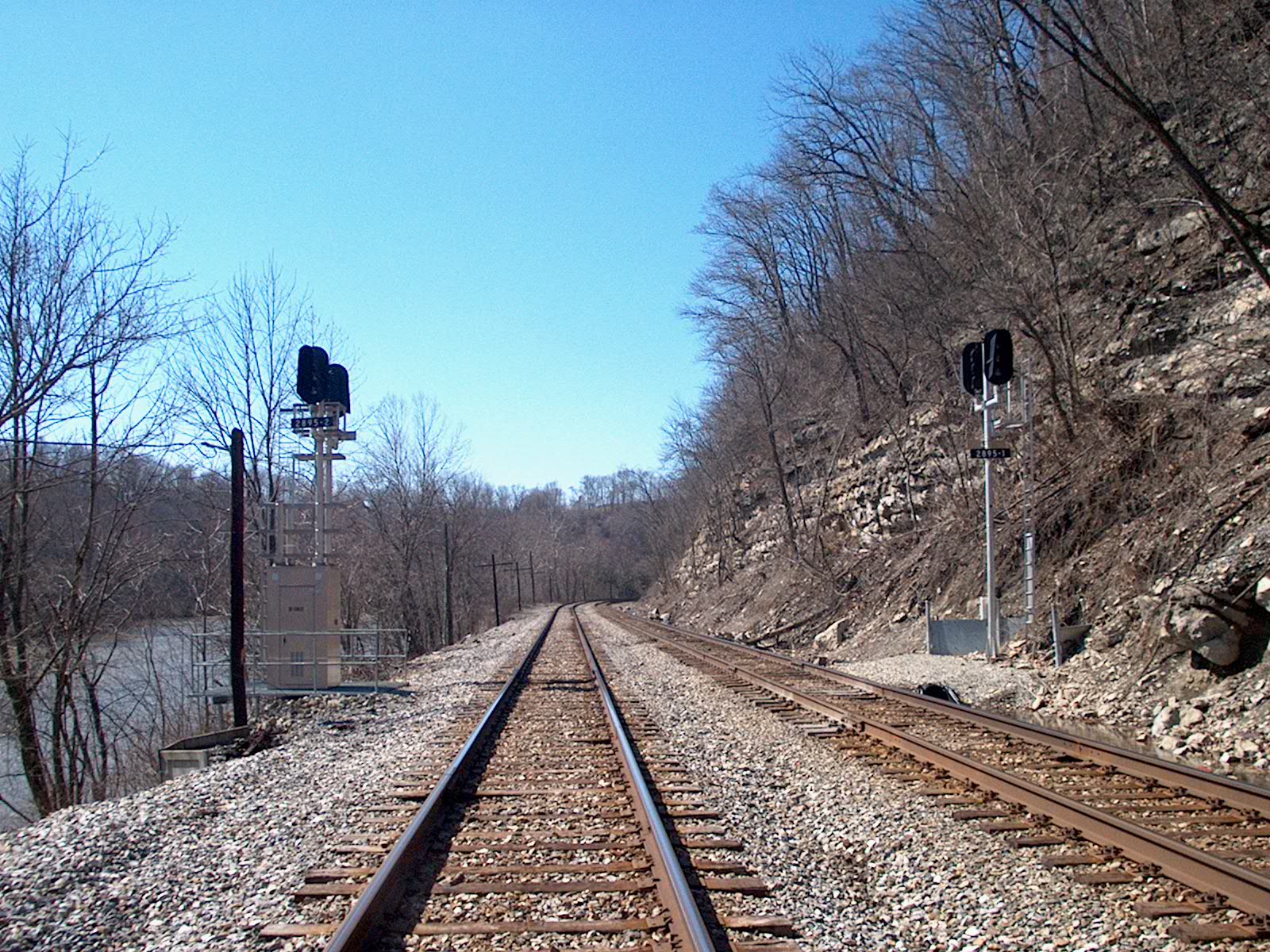
I loaded fresh batteries in my seldom-used camera and set off to the railroad tracks that run along the Youghiogheny River by Smithton.  I don’t know why the railroad tracks are my favorite place to saunter, but I did not hesitate.  To the left lay my church and relatively familiar territory.  To the right, a few houses and then the unknown as the tracks followed the bend of the river.
I had not gone far in this direction before.  Since my heart problems two years ago, I have found myself cautious about placing myself far away from help and cell phone signals.  But, today, I knew that I needed to cast all cautions aside.
I always wear sneakers on these walks.  Every time I return, I tell myself that I should wear boots, to better cope with the tricky footing.  But, somehow I like the feel of the ballast rocks through my shoes and the almost-skating motion of walking on the trackbed gravel.  The sun warmed me quickly for early March, and I removed my jacket after a short time.  I passed the last house and ventured forward, the steep hillside on my right and the swollen river on my left.

Soon, I approached the signal towers on either side of the tracks.  This was as far as I had ever gone in previous walks.  The sound of traffic crossing the Smithton Bridge had receded, and I hesitated for just a moment before proceeding.

After only a few minutes, an ominous omen (are all omens ominous?).  I saw the body of a dead muskrat lying between the tracks, clearly run over in just the past day or two.  Not an unusual sight – I saw half a dozen or so last year starting in early spring.  The message, however, seemed clear.  Death lay ahead.  I kept walking.

Another few minutes and another animal remnant.  This time, only the hoof and bottom half of a deer’s leg lie between the northbound and southbound rails.  That’s it – no other bones or any other reminder of the substantial body that once was.  Death lay ahead…and dismemberment.  A superstitious person might need no other signs.

The tracks had rounded another bend.  Ahead lay some pieces of wood strewn around the tracks.  Approaching closer, I recognized what remained of a century-old telephone pole – just a little of the cross piece and one glass insulator.  I was now cut off from all communication with my past, figuratively and literally.

Another bend and I saw three houses nearing on the river side of the tracks.  The smell of burning wood drifted toward me and I saw a man clearing away some dead branches and brush in a smoldering barrel.  He raised his hand in greeting and I returned the gesture.  I had emerged through the warnings.  Was I now being welcomed into some precognitive peek?

I caught a glimpse of what looked like bleachers coming up on my right and I wondered for a minute what spectator event could possible take place here.  Then I remembered.  The Smithton Hole racetrack – a very distant and poor cousin of Nascar and home to demolition derbies, truck pulls, and quad rallies.  The road that served as access to the houses I had passed crossed the tracks here.  A patch of color caught my eye.  In a ditch I saw a swath of green plants in a heavy-flowing runoff ditch – the first green I have seen this year.  Was something telling me that it was time to leave the railroad tracks?

On cue, I heard the whistle of an approaching train.  I walked over to the crossing sign to watch the behemoth rumble by.  Since I was a child, I delighted in counting the cars in long trains.  Only as an adult did I learn that this was one of the many relatively harmless obsessive-compulsive symptoms that seems to run in my family.  Nonetheless, I now find myself resisting the urge to keep track of the passing containers.  Instead, I feel the quiver of the ground and watch the vibrations of rail succumbing to the mass.

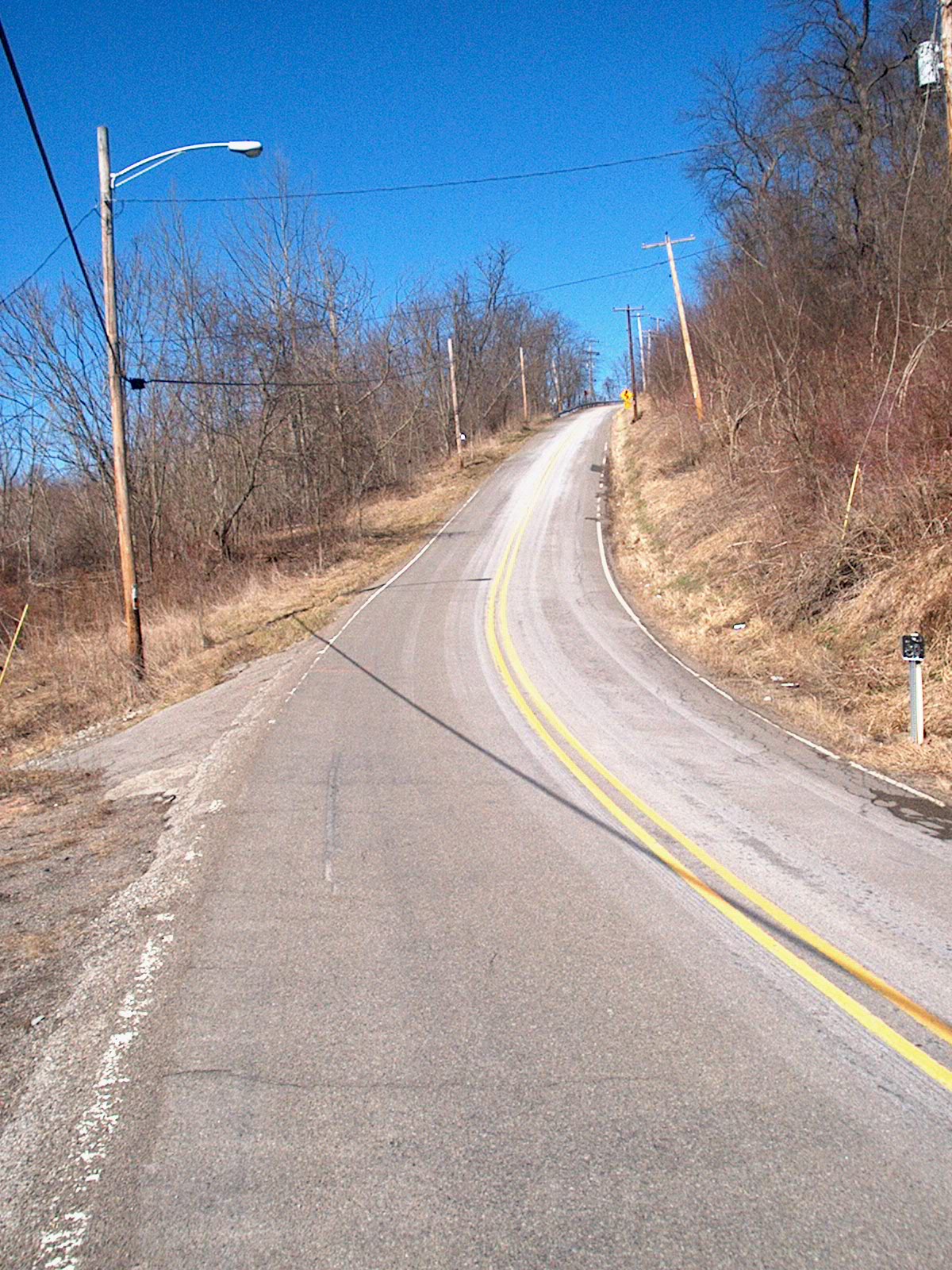
After the train went by, I turned and walked up the road. I soon came to a junction.  I knew the road to the right led to Fitz Henry and a dead end.  The road to the left led up a steep hill. I turned toward the open road.

Only a few buildings remain of what was once the town of Port Royal. In the late 1700’s, this area provided valuable access to the river and grain mills and iron furnaces.  George Washington once owned land just to the south near Jacob’s Creek.  What remains hardly qualifies as a town, however, and I soon approached a substantial climb out of the river valley.

By the time I reached the top of the tiny mountain, my joints ached.  A constant wind now blew against my face, invigorating me again.  No thought remained of needing my jacket again, as the sky supporting only one tiny wisp of cloud in the distance.

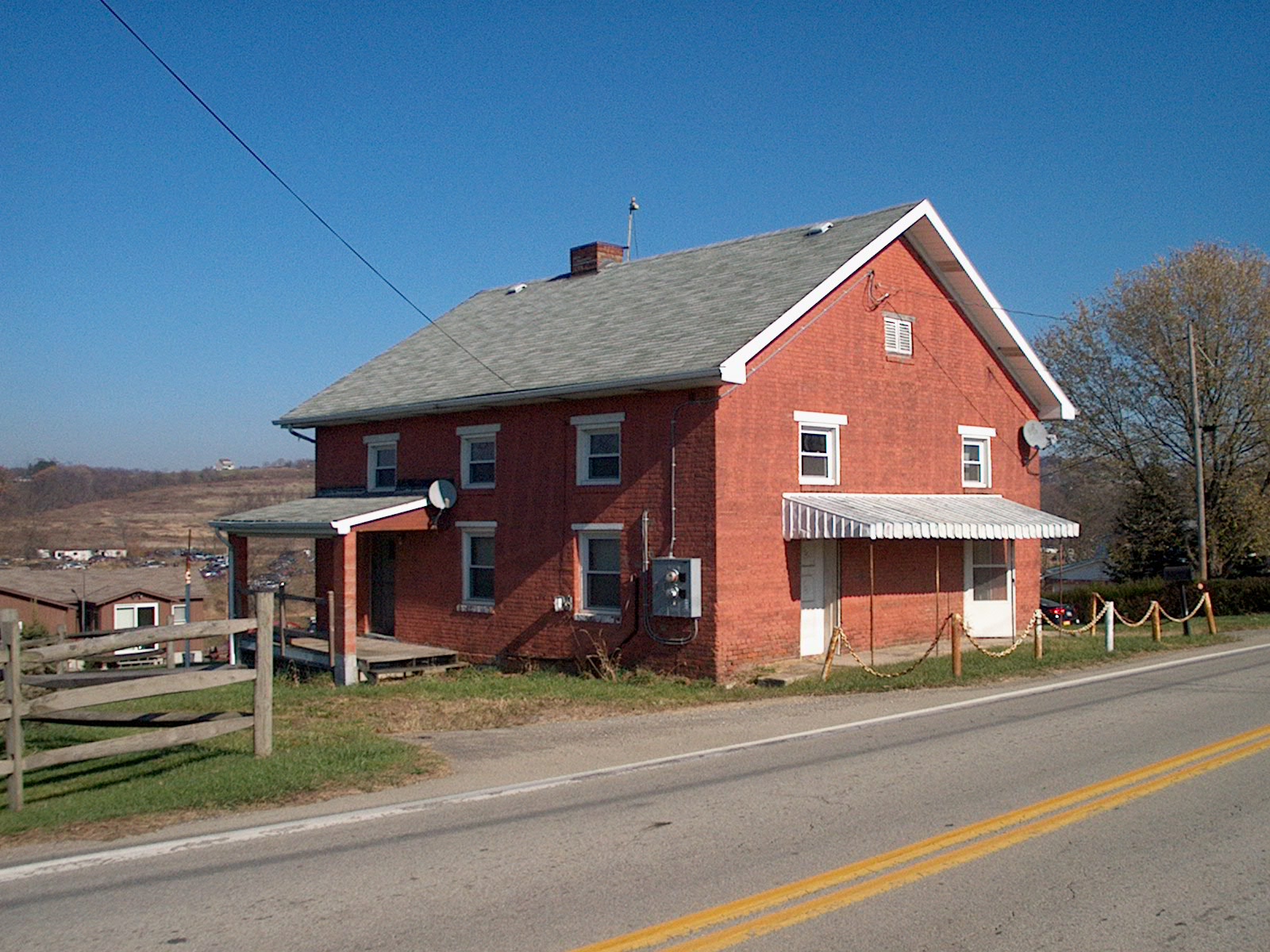
I knew that the old Port Royal School House sat ahead on this road.  I had researched this structure last year for the 150th anniversary of the Unitarian Universalist Congregation of Smithton.  Here, in 1860, the 11 charter members of the Universalist Church of Port Royal agreed on a covenant, creating the community that survives to this day.  I could not help but wonder if school children from Port Royal actually walked to this school house.  The thought put those clichéd parental stories of childhood struggle and hardship in a whole new perspective.

Also coming into perspective, still miles from home on this gorgeous day, was a calm.  My mind calmed.  For the first time in perhaps weeks, I wasn’t worrying about things over which I had no control.  I wasn’t trying to control things I couldn’t control.  Ironically, I’ve become addicted to an online game called Rebuild.  The game recreates survivors of the apocalypse trying to rebuild a city still infested with zombies, disease, and shortages of food and housing. It now occurred to me that I had spent the last five years rebuilding – my job, my home, my marriage, my mind, and my soul – so that I could set forth on this future as a minister.  In recent months, I kept thinking about all this effort and all that I have done and accomplished to poise myself at this gateway.  Now, I thought, maybe the time has come to stop focusing on the rebuilding and start living in the new life I had built.

Because, in the end, we can only build the best life we can and then we have to live in it.  We can renovate occasionally, but we can’t control everything – in fact we can control precious little.  So, my joints ached, but I walked a little freer, with just a slight spring to my step.

I walked by the old school house building and thought about those 11 people back in 1860.  The formed a church that still meets today.  But, little did they know that the nation would soon enter into an ugly Civil War.  They could not foresee the rocky future of the little congregation, constantly struggling against all odds to stay afloat.  I imagined the unbridled joy of those men and women starting something special, something that has endured.

I kept on, reaching the truck stop at the intersection Interstate I-70.  Ironically, the store lay in disarray due to major renovations (OK, I get it!).  I bought a Naked smoothie and a diet Mountain Dew.  I drank the smoothie too fast, but my poor out-of-shape body needed the 22 strawberries and 1.5 bananas.  I cracked open the pop and headed home.  The remaining mile down Dutch Hollow was all downhill – a stretch I have driven at least 100 times.

Whatever happens in the next few days, the world will continue.  I may be a little richer or poorer, a little more or less secure.  But, I will endure and I will do whatever I need to do and go wherever I need to go to continue my ministry.
Channelling H.P. Lovecraft

As a teen, I loved science fiction and horror, especially H.P. Lovecraft.  After reading one of my favorite books of all time – William Hope Hodgson’s The House on the Borderland – I took a stab at writing short stories.  I imagine they were terrible and I didn’t persist long in the effort.  But, I retained a hankering that, one day, I would craft an awesome story that was at least tolerably written.

About 10 years ago, I tried again.  The family was returning to Nags Head for a restful week of ocean and sand.  And, since I have little fondness for sitting on a beach for hours in the baking sun, I told everyone that mine would be a working vacation.  I wrote five short stories during the week, at the end of which I still harbored at least a whisper of a dream that I possessed a modicum of talent.

I only shared the stories with one other person, who let me down very kindly, and I have restricted myself to nonfiction and homiletics ever since.  Sermon writing suits my skill set far greater and also employs my oratorical abilities.  But, that little scribe in the back of my head still wishes that I could find an unimaginative but able crafter of language with whom I could collaborate to create the next great pantheon of outre fiction.

I just watched an absolutely delightful documentary on the life of my literary hero, Lovecraft: Fear of the Unknown, who was famous for ghost writing/editing for many published authors.  How I wish he were still alive that I could correspond with him today!  I’m not sure H.P. would have ever considered owning, let alone writing on a computer.  But, I have a direction I would love to explore that would suit his talents immeasurably, and for that even I would gladly write longhand.

I have in recent years been exploring what I call mystical humanism through the experience of affect in worship services (building on Thandeka’s work on Affect Theology).  Combined with Jungian notions of synchronicity, I have hypothesized a cosmos of infinitely connected threads constantly bombarding our lives with synaptic stimuli from which we can discern meaning and ultimately wisdom.

So, I have imagined an epic collection of tales about an intrepid minister (gee, ya think this might be just a little autobiographical?) exploring this web of existence, encountering colossal beauty, cyclopean terror, and unfathomable truths across vast and endless planes and universes.  Of course, every time the portal opens, it exposes our fragile little world to more of these enormous forces and influences.

All I need now is someone with the output capacity of Stephen King to produce the 49 books (or whatever our kindle-kind call them nowadays) needed to encompass this tome.  Then, I need the reincarnation of Rod Serling to produce a revisited Twilight Zone for the video generation.  Video games, soundtracks, 3-D movies, virtual reality sensatoriums – I could become the next Gene Roddenberry.

Sigh…what a wondrous vision!

Never Pass Up an Opportunity to Minister

My new year began with what is probably the most unusual experience I have ever had in ministry, either as a lay person or as a freshly minted fellowshipped minister.  It started a few days ago in the pizza place up the block.  Justin, the owner and a fun and engaging young man, has done a lot to help me feel at home here in this little town of 400 souls. 

“Pastor Jeff,” he started, “would you be interested in blessing the first beer of the New Year at the American Legion?”  I found myself agreeing immediately and he began making phone calls to confirm the event.  Back at home, I wondered about my decision.  Does blessing a bar condone alcoholism and all of its related maladies?  What would my temperance leading predecessors think?  Would my participation sully the general attitude among townsfolk toward ministers and the church?

After a little consideration, I decided to go through with my commitment.  One reason is that the American Legion is one of the few things holding this battered and broken town together, and any opportunity to support them helps Smithton survive as a community.  In a town where virtually all other businesses long since died, the bars are booming.  I certainly couldn’t expect many other invitations from them to ply my trade.  And, for a congregation struggling to survive with only a handful of active members, I reasoned that if I can’t get locals to come to the church, then I would bring the church to them.

So, I wrote a short blessing, and headed over at 11:00 p.m.  Justin met me at the door and began shepherding me around the club, introducing me to everyone.  Any reservations I might have had about attending quickly vaporized.  One man asked me repeatedly to bless his wife in the coming year.  One woman had just survived a brain aneurysm and was anxious for a sign from God about how she should devote the remainder of her freshly minted lease on life.  A couple had just lost their 19-year-old handicapped son, who had lived bedridden for most of his life.  Another woman asked for advice on how to get her husband to let her take her two children to Sunday School.  And, of course, being a veteran’s organization, a number of people wanted to honor loved ones past and present who had served.

What had begun as a bit of a lark now became quite probably my most intense ministerial experience to date.  As the countdown finished and the champagne toast was completed, the chapter president introduced me and handed over the microphone.  I began by offering everyone the chance to speak aloud the names of people important to them during the past year, and voices spoke out several dozen names.  I honored their memory and asked the bartender to pour a beer.  Lifting it, I said:

     May the spirits consumed here in the coming year empower our spirits:
     To fan the flames of friendship and community;
     To relax our worried minds and troubled hearts; and
     To promote only happiness and joy in our lives.

I then blessed all present and wished everyone a Happy New Year.  I stayed for another hour or so, talking and taking pictures.  The unanimous consensus was that having the blessing was a good idea, with people actually taking some pride at possibly inventing a tradition to be continued in future years.

So, the next time someone tells you that religion is passe, or that we have outgrown the need for churches, don’t believe them.  The need out there for what we offer is massive.  And I certainly hope in the coming year to do everything I can to meet this need head on.