Rethinking Our Holidays

Most Americans know Unitarian Julia Ward Howe as the author of The Battle Hymn of the Republic. But, her signature song is only one landmark in a long and active life. Howe was involved in many social reform movements. She opposed slavery and later worked with Lucy Stone and others on women’s rights issues. But, her early career in the 1840’s began as a writer. She published a number of scholarly articles in the New York Review and the Theological Review. Ten years later, after publishing collections of poetry, she wrote her first play, Leonora, that was “condemned as immoral” and closed after one week in New York City. She certainly was a woman possessed of many talents.

But, back to The Battle Hymn of the Republic. A year or two before Leonora was shut down, a South Carolinian named William Steffe wrote a stirring campfire spiritual song. In no time, the song spread across the country. Two years later, on the eve of the American Civil War, John Brown died leading a raid on the federal arsenal at Harper’s Ferry. Out of his death came the infamous John Brown’s Body version of the song, which inspired the anti-slavery forces. Shortly after that, the Civil War began, pitting the Confederate states of the American South against the Union forces of the Northern states.

Two years later, Unitarian minister James Freeman Clarke heard Union soldiers singing the song and asked Howe to write more uplifting lyrics. That night by candlelight, Julia wrote the now famous lyrics. That is the story of how a Southerner, with the help of two Unitarians, is responsible for the most patriotic song of the Union forces in the Civil War. By the way, for those of you who love irony, the music for the song Dixie was written by a Northerner.

The Battle Hymn of the Republic was all but forgotten until the 1940’s, when choral conductor Fred Waring re-introduced the song on his network radio show during World War II. The tune was such a hit for the Pennsylvanians, that Waring featured it as the closing number in his live concerts for the next 32 years. During the Civil Rights era, Dr. Martin Luther King, Jr. referenced lyrics from the song in sermons and speeches, including his last public words. The Battle Hymn of the Republic lives on as a cultural icon in film, music, books, and even video games.

Reflection (from “Our God is Marching On,” by Martin Luther King, Jr. )

On March 25, 1965, the Reverend Doctor Martin Luther King, Jr. spoke from the steps of the Courthouse in Montgomery, Alabama. In this speech, he quoted the first and fourth verses of Julia Ward Howe’s Battle Hymn of the Republic. The following is a short excerpt from that speech.

The battle is in our hands. And we can answer with creative nonviolence the call to higher ground to which the new directions of our struggle summons us. The road ahead is not altogether a smooth one. There are no broad highways that lead us easily and inevitably to quick solutions. But we must keep going.

My people, my people, listen. The battle is in our hands. The battle is in our hands in Mississippi and Alabama and all over the United States. I know there is a cry today in Alabama, we see it in numerous editorials: “When will Martin Luther King…and all of these civil rights agitators and all of the white clergymen and labor leaders and students and others get out of our community and let Alabama return to normalcy?”

But I have a message that I would like to leave with Alabama this evening. That is exactly what we don’t want, and we will not allow it to happen, for we know that it was normalcy in Marion that led to the brutal murder of Jimmy Lee Jackson. It was normalcy in Birmingham that led to the murder on Sunday morning of four beautiful, unoffending, innocent girls. It was normalcy on Highway 80 that led state troopers to use tear gas and horses and billy clubs against unarmed human beings who were simply marching for justice. It was normalcy by a cafe in Selma, Alabama, that led to the brutal beating of Reverend James Reeb…

The only normalcy that we will settle for is the normalcy that recognizes the dignity and worth of all of God’s children. The only normalcy that we will settle for is the normalcy that allows judgment to run down like waters, and righteousness like a mighty stream. The only normalcy that we will settle for is the normalcy of brotherhood, the normalcy of true peace, the normalcy of justice.
(http://www.historicaldocuments.com/MartinLutherKingOurGodIsMarchingOn.htm)

Sermon – Rethinking Our Holidays

After Julia Ward Howe wrote The Battle Hymn of the Republic, the American Civil War raged on for four more bloody years of death and destruction. Five years after that, the Franco-Prussian War broke out in Europe and Howe acted. She began a one-woman global peace crusade, starting with an appeal to womanhood to rise against war. She went to London to promote an international Woman’s Peace Congress. That effort failed, so she returned to Boston and initiated a Mothers’ Peace Day observance on the second Sunday in June. That meeting was observed for a number of years.

Now, there were other movements afoot to create a day honoring mothers. Ann Jarvis was a young Appalachian homemaker who tried to improve sanitation through what she called Mothers’ Work Days before the Civil War. When Jarvis died in 1907, her daughter Anna worked to found a memorial day for women. The first such Mother’s Day was celebrated in Grafton, West Virginia on May 10, 1908, at St. Andrew’s Methodist Episcopal Church, where Anna’s mother had taught Sunday School. From there, the custom caught on and eventually spread to 45 states.

In 1913, Congress declared the second Sunday in May to be Mother’s Day. The following year, President Woodrow Wilson made Mother’s Day a national holiday. Now, this is long before radio and television, and advertising was still a new industry. But, the growing American consumer culture had successfully redefined women as buyers for their families. Politicians and businesses eagerly embraced the idea of celebrating the private sacrifices made by individual mothers. As the Florists’ Review, the industry’s trade journal, bluntly put it, “This was a holiday that could be exploited.”

The new advertising industry quickly taught Americans the best way to honor their mothers – by buying flowers. Since then, Mother’s Day has ballooned into a billion-dollar event. Again, for those of you who appreciate irony, Anna Jarvis became increasingly concerned over the commercialization of Mother’s Day, saying, “I wanted it to be a day of sentiment, not profit.” She opposed the use of greeting cards, calling them “a poor excuse for the letter you are too lazy to write.” In 1923, Jarvis filed suit against New York Governor Al Smith, over a Mother’s Day celebration. When the suit was dismissed, she began a public protest and was arrested for… disturbing…the peace.

Most Unitarian Universalist congregations routinely observe Easter, Christmas, Passover, Hanukkah, Palm Sunday, and Yom Kippur, in addition to other holidays derived from Christian and Jewish traditions. We can understand the rationale for these celebrations and even concur with our commitment to them. But, harder to understand is our lack of uniquely Unitarian Universalist religious holidays. We engage in a Flower Communion in June – a deeply moving and meaningful practice honoring our service and dedication to justice across the globe. Many of our churches embrace a Water Communion ritual at the end of summer that embodies a spiritual depth and that unifies us in our common human experience. But, we do not set aside whole days to perform these worthy worship elements, nor do we plan our life activities around them for preceding days or weeks.

We can acknowledge the importance of Christmas and Easter to our Christian colleagues, both within this congregation and without. We can respect the place of Yom Kippur and Passover to all of our Jewish comrades. Thankfully, some of our churches offer solstice celebrations for our Wiccan and neo-pagan members and friends. But, where are the religious holidays that every Unitarian Universalist can embrace as his or her own, not just out of a sense of shared joy and reverence, not just out of tradition or habit, but out of true ownership?

The battle is in our hands. And we can answer with creative nonviolence the call to higher ground to which the new directions of our struggle summons us. In doing so, we too can disturb the peace. We can disturb the peace of normalcy that for too long has suffered the manipulations of the self-righteous and the war profiteers. We can disturb the peace of normalcy that turns every decent expression of sentiment and honor into an opportunity for retail sales and advertising bonanzas. For we can and should reclaim Mother’s Day for the purpose Julia Ward Howe intended. The Mother’s Day for Peace should rise up again to help us create a normal world where every person is regarded with inherent worth and dignity; a normal world with justice, equity, and compassion; a normal world with peace, liberty, and justice for all.

Three years ago, Unitarian Universalist women in Kansas City began planning an event for the upcoming Mother’s Day. “Julia’s Voice” is a group of mothers and others joined together to return Mother’s Day to its original intent. They peacefully assembled along a public sidewalk and, standing shoulder to shoulder, were joined by Julia Ward Howe re-enactors, musicians, and other special guests. That is one way to reclaim our holiday. There are many others. We can take the money we spend on greeting cards and use it to send letters to politicians and businesses and tell them what we think about war.

We can take the money we spend on flowers and use it to provide microloans, or to buy alternative gifts for women across the world in need of our assistance. We can use the day to write, to study, to talk with each other and plan for our future. And, we don’t have to wait for Mother’s Day to honor the mothers in our lives.

The original Mother’s Day for Peace envisioned by Julia Ward Howe possessed deep meaning. The origins of Father’s Day lack even this hint of significance beyond a maudlin celebration as manipulated by commercial interests. The beginnings of the first Father’s Day celebrations derived from people listening to Mother’s Day sermons in the early 1900’s. It was not until the 1930’s, however, when the Associated Men’s Wear Retailers formed the National Council for the Promotion of Father’s Day, that a concerted effort to legitimize the holiday arose.

People were slow to accept Father’s Day because they saw the holiday for the marketing device that it was. And yet, people increasingly felt compelled to buy gifts in spite of the facade, and the custom of giving gifts on that day became progressively more accepted. By 1937, the Council calculated that only one father in six had received a present on that day. By the 1980’s, the Council proclaimed that they had achieved their goal: that one day holiday had become a three-week commercial event, a “second Christmas.”

Well, if Madison Avenue can create a holiday celebrated across the country by millions of people, why can’t we reshape that holiday into one with deeper meaning and perhaps with broader purpose? Why can’t we, as we reclaim the Unitarian Universalist heritage of Mother’s Day as a day promoting world peace, recast Father’s Day with a new intent and with a new range of activities and ways to involve everyone in our religious communities?

As Unitarian Universalists, we affirm and promote the free and responsible search for truth and meaning. What exactly does that mean to you? When you come here for Sunday School classes, how do you see yourself freely and responsibly searching for truth and meaning?

For me, it means that I will think for myself and not let other people do my thinking for me. It means that when I decide to do something, I will do it because I want to, not because other people want me to. And, it means that whatever I think or do in my life, I want those thoughts and actions to mean something – to be important.

Now, I hope that everyone here has had a father, or one or more people in your lives who served the role of fathers. And I hope that the relationship that you have with that person is a loving one. You should feel free to take the time to honor and to share your thoughts with that person anytime, and not wait for the calendar to limit you. There is no rule that says that you must wait until Father’s Day to reach out to the fathers in your life. So, what then do we do with the Father’s Day holiday? As we reclaim Mother’s Day for world peace, let us rededicate Father’s Day as a celebration of domestic peace – peace in our homes and peace in our hearts. Responsive reading #602 in the back of our hymnal quotes Lao-Tse, the central founding figure of Taoism 2,500 years ago.

  • If there is to be peace in the world, there must be peace in the nations;
  • If there is to be peace in the nations, there must be peace in the cities;
  • If there is to be peace in the cities, there must be peace between neighbors;
  • If there is to be peace between neighbors, there must be peace in the home; and
  • If there is to be peace in the home, there must be peace in the heart.

The essence of this wisdom is this. We must have peace within ourselves and our families before we can become peacemakers in our communities and in our world. Father’s Day can become a time for reflection and study about our own lives; a time for families to bond and resolve differences; a time to strengthen the foundation of peace that can lead to a world without war. For the more practically-minded, Father’s Day can become a day to support agencies that combat domestic violence and that support healthy lives for children.

Mother’s Day and Father’s Day as we currently celebrate them can represent a noble exercise. Those who fulfill the roles of mothers and fathers in our society deserve our respect and our recognition. The question we must ask ourselves, however, is this. How do we best honor our mothers and fathers? How do we best honor the parents of all the other children of the world? How do we best honor those who assume this responsibility for tomorrow’s children?

Considered together, a Unitarian Universalist revisioning of Mother’s Day and Father’s Day can celebrate men and women as role models for children and as partners for each other. As religious celebrations, these holidays can represent our commitment to the principles of our covenant, from the inherent worth and dignity of every person to the goal of world community, with peace, liberty, and justice for all.

An essential broader message overlays this idea to remember when you leave here today, when you sit at your desk this week, or when you return to school in a couple of months. Ask questions when you do not understand why things are the way they are. Challenge rules and beliefs that you see as unfair or oppressive. Use what you acquire here on Sunday morning to shine a religious light on all aspects of your life. Use that religious lens to rethink every aspect of your life, of our society, and of our world.

Closing Words (adapted from the Mothers’ Day Proclamation by Julia Ward Howe, 1870

Arise, then, men of this day! Arise all men who have hearts, whether forged from fire or from fears! Say firmly: We will not have our families damaged by outmoded stereotypes. Our partners shall not come to us, cowering and frightened. Our sons and daughters shall not go into the world equating manliness with malevolence, but with mercy. Our children will know men capable of compassion with strength; patience with wisdom; and forgiveness with justice. We men of one community must be too tender of those of another community to allow our sons to accept violence as a tool of communication. From the bosom of our devastated homes a voice goes up with our own. It says “Men of the world! The fist of anger cannot wield the touch of parental caring and of spousal love.”
Setting a Course

Steward is one of those fascinating words that acquired a multitude of meanings over the centuries. Today, steward generally means one who carefully and responsibly manages something entrusted to their care. Appearing first in early Middle English, the stīweard cared for the pigpens, the ward of the sty. In time, people applied the term to those employed in large households or estates to manage domestic concerns, such as the supervision of servants, the collection of rents, and the keeping of accounts.

As civilization and technology expanded, steward took on the new role of the naval officer in charge of the officer’s quarters and mess onboard the ship. The word later became applied to all employees on ships, trains, buses, or airplanes responsible for the comfort of passengers, taking orders for, or distributing food. In early 20th century America, the shop steward became the union representative responsible for dealing with management. High quality restaurants and resorts employ wine stewards – quite a long way from tending the pig’s sty.

Today, stewardship expands even further. The Earth Charter resulted from worldwide, cross cultural dialogue on common goals and shared values. The project began as a United Nations effort, but was carried forward and completed by a global civil society initiative. Launched in 2000 by the Earth Charter Commission, an independent international entity, the work is a declaration of fundamental ethical principles for building a just, sustainable and peaceful global society in the 21st century. The Charter asserts that “common destiny beckons us to seek a new beginning…This requires a change of mind and heart…a new sense of global interdependence and universal responsibility.” In a sense, the Earth Charter stakes the claim that every person is a steward of every community and of our entire planet.

Every other year, the delegates at the General Assembly of the Unitarian Universalist Association select a Study Action Issue for a four-year process of examination. The issue selected in 2008 and currently under review among our congregations – Ethical Eating – may seem from its title to concern only issues of meat consumption and vegetarian or vegan diets. We are certainly not the first religious organization to discuss the production, distribution, and use of food. But, the Ethical Eating Study Action Issue goes far beyond this issue, to include the broad aspects of planetary stewardship.

For instance, some people enjoy many food choices while others remain hungry. The food industry produces wealth, but small farmers and farm workers are often poor. Food production and transportation contribute to many environmental problems. The scope of the discussion encompasses a wide range of stewardship issues, many of which bear relevance as we celebrate the 40th anniversary of Earth Day this coming Thursday. Let’s briefly review some of those issues.

Climate change
Scientific research increasingly links our food production and distribution systems to climate change and the energy crisis, uncovering deep-seated problems with our agricultural infrastructure. Leaders from many faith traditions now call for politicians, business leaders, the agriculture industry, and religious institutions to assume more responsibility for our planet’s health. Ordinary people – not just environmentalists or those working for social justice and rights issues, but people who are busy balancing issues of everyday living – are recognizing that the true cost of food far exceeds what we pay at the cash register. These costs include global warming, pollution, the destruction of ecosystems, and the degradation of fresh water supplies and arable land.

Hunger
We waste over 3,000 pounds of food per second in the United States. According to the Department of Agriculture, each year 27% of food produced for human consumption in America is lost at the retail, consumer, and food service levels. That’s nearly 1.5 tons of food for every man, woman, and child in the United States who face hunger. Globally, 4.3 pounds of food are produced daily for every woman, man, and child on earth – enough to make all of us fat. Yet every year, six million children across the globe die as a result of hunger and malnutrition – that’s one child dying every five seconds. Hunger and malnutrition are responsible for more deaths in the world than AIDS, malaria, and tuberculosis combined.

Trade
In a system of Free Trade, agricultural goods and services flow among countries unaffected by government-imposed restrictions like tariffs, taxes, and quotas that generally increase the costs of goods and services to both consumers and producers. Proponents assert that free trade makes society more prosperous and qualitatively improved by increased commerce. Free trade has been said to decrease war, reduce poverty, enrich culture, enhance security, and increase economic efficiency. Free trade is also understood as a sovereign right of free nations.

In a system of Fair Trade, agricultural goods and services flow among countries based not only on classic economic considerations, but also social, environmental, labor, and sustainability requirements. Fair Trade relies on consumer readiness to pay slightly more for products that empower, rather than exploit, vulnerable populations. Most Fair Trade standards also mandate progress requirements that ensure continuous improvement in the conditions of workers, communities, and the environment.

Fair Trade advocates suggest that we should be at least as concerned with sustainability, environmental considerations, and fairness as we are with efficiency measured in dollars and cents. Also, we must recognize that the conditions in which Free Trade might lead to the best outcomes are not present in much of the Global South with whom the North trades. These include classic economic assumptions such as perfect market information, access to credits and markets, and the ability to change equipment and techniques in response to changing market conditions.

Labor
Historically, large farms in the United States consistently depended on poorly paid labor, often to the point of exploitation. Much of our agricultural system was built on the backs of indentured and enslaved agricultural workers, and in the 21st century farm workers remain among the lowest paid laborers in our economy. In recent centuries, immigrants from Europe have been able to leave America’s fields within a single generation; immigrants from Africa, Latin America, Asia, the Caribbean, and the Pacific Islands have fewer options, however, and disproportionately toil under inhuman conditions for less than living wages for generations.

In addition to its low wages, agricultural labor today features some of the economy’s most dangerous jobs. From physical demands to operating unfamiliar and ill-maintained equipment to exposure to animal bacteria and massive doses of chemical pesticides and fertilizers, agricultural work ranks as the second most dangerous occupation according to the Occupational Safety and Health Administration. And, workers who do not speak or read English are often at greater risk for injury due to insufficient notification of occupational hazards.

Neo-colonialism
Neo-colonialism exists when a nation or state appears sovereign and independent, but has its economy, politics, and/or culture largely directed from outside, often by a former colonial or imperial power. Modern trade, immigration, and foreign aid policies in Europe and the U.S. continue to exacerbate the historic ravages of colonialism for indigenous and subjugated peoples worldwide.

Poor regions of the world shift from producing crops that support their self-sufficiency to “cash crops” valued by the dominant world economy, like cotton, tobacco, sugar, tea, rice, coffee, cocoa, bananas, pineapples, corn, soy beans, and livestock. Combined with free market economics, this perpetuates dependent, inequitable relationships and a system of poverty, malnutrition, and exploited labor. Because indigenous and poor populations lack access to traditional hunting, gathering, and farming lands, they must resort to foreign diets, whose poor quality and highly processed nature lead to nutrition related diseases.

Environmental justice
Just as power in society has been misused to oppress various social groups in the U.S. (people of color, women, GLBTQ people, people with disabilities, and so on), power has also been misused to create vast areas of environmental devastation throughout the world and to thwart attempts at environmental reform and preservation. Today there is growing realization that negative environmental impacts disproportionately burden socially marginalized groups in developing countries abroad.

Proponents of environmental justice argue that one of the significant reforms needed is a shift in the dominant worldview that commodifies land and objectifies living things. Proponents of environmental justice encourage a shift from viewing the environment as a resource to exploit to a web of interconnected living things, and the source of life itself. In addition, proponents advocate for prioritizing the needs of low income people, people of color communities, and other oppressed groups, who disproportionately lack access to nutritious food, clean air and water, parks, recreation, health care, education, transportation, and safe jobs. Self-determination, participation in decision-making, and gaining control over land and resources are also key components, since justice making activities not accountable to oppressed communities tend to perpetuate the very oppression they try to fight.

Animal rights
The simple act of eating expresses one of our most basic and profound relationships with Earth and life. For some of us, our main connection to non-human animals is through our forks and knives. But, the freezer pack wrapped in cellophane bears little resemblance to the creature that sees and breathes and sighs. As Ralph Waldo Emerson wrote, “You have just dined, and however scrupulously the slaughterhouse is concealed in the graceful distance of miles, there is complicity.”

Zoologists, biologists, and cognitive ethologists all now agree that animals are emotional beings, and that like us, they evolved capacities for satisfaction and frustration, pleasure, and suffering as biological necessities. Though animals are often considered part of “the environment,” the complexity of their experience suggests that they are much more than animated gardenias or slabs of granite. Animals are not so much a part of environment as they are subjects moving through the environment, with experiences all their own. As anyone who has gotten to know a dog, cat, bird, pig, or cow can tell you, animals are experiencing, sentient creatures with wants, needs, and frustrations. At the heart of the impulse we call religious is the desire to lessen suffering and to extend justice and compassion.

Climate control, hunger, trade, labor, neo-colonialism, environmental justice, animal rights – this is a massive agenda. Even the combined energy, courage, and faith of the more than 1,000 Unitarian Universalist congregations in the United States cannot hope to address all of these issues in significant ways. Some religions comprise mighty armadas in the ocean of social, political, and economic issues. Relatively speaking, one might imagine us a single light cruiser patrolling the shores against the currents of circumstance and the waves of human need.

But, we should not let our size, whether we consider our denomination or just this congregation, limit our dreaming and striving for a better world. O. Eugene Pickett, one-time President of the Unitarian Universalist Association once said, “We pray that we may live not by our fears but by our hopes, not by our words but by our deeds.”

Ours is an empowering faith. We may not make huge inroads in every field of social justice. Sometimes, we are just the jounaling observer of the beauty around us, or the barking dog bellowing for justice. Whatever role we play, we can ever steer our steward-ship in the direction of action and service to humankind and to our planet. Every one of us can live by our hopes and deeds, setting a course toward a world community with peace, liberty, and justice for all.

The Earth Charter begins with the following Preamble.

We stand at a critical moment in Earth’s history, a time when humanity must choose its future. As the world becomes increasingly interdependent and fragile, the future at once holds great peril and great promise. To move forward we must recognize that in the midst of a magnificent diversity of cultures and life forms we are one human family and one Earth community with a common destiny. We must join together to bring forth a sustainable global society founded on respect for nature, universal human rights, economic justice, and a culture of peace. Towards this end, it is imperative that we, the peoples of Earth, declare our responsibility to one another, to the greater community of life, and to future generations.

In our individual lives, as a congregation, and as Unitarian Universalists, may we find ways to steer the course of our stewardship to such lofty purpose.

NOTE: Much of the material cited in this sermon comes from the Ethical Eating Study Action Issue Study Guide, a wonderful resource of information and links for further research.


Standing on the Side of Love

When we were kids, a classic joke went,

“What’s the hardest job in the world?”
“I don’t know. What is the hardest job in the world?”
“Wheeling West Virginia!”

Ah, the simple humor of youth. But, yesterday I witnessed what may be a harder job as people from diverse faith traditions gathered in Wheeling Park for a Peace Rally and Concert.

You see, the Westboro Baptist Church had brought their traveling hate show to town, protesting four local Catholic churches. Resisting the temptation to respond in anger, face-to-face with their incredibly offensive tactics and distortions of religious wisdom is a mighty task. Of course, any group whose web address proclaims that “God hates fags” is clearly only interested in inciting the basest response from people of faith and secular citizens committed to democracy and the freedoms that allow and protect even the most vile speech.

Instead, a coalition of religious leaders, in large part spearheaded by our own Unitarian Universalist Fellowship of the Ohio Valley, held a wondrous celebration of compassion. After an invocation including myself and various Jewish and Christian leaders, we witnessed one talented performer after another, including an amazing 64-year-old belly dancer who simply exuded joy in her gyrations. The theme of the event was “Standing on the Side of Love,” and the banners and signs were displayed prominently. At the same time, the several hundred people in attendance contributed over $1,000 to the families of the Upper Big Branch miners in Montcoal, West Virginia.

Responding to hate with hate only fans the flames of violence in our world. Standing on the side of love adds warmth to the chilliest clime and light to the darkest recesses.

Rolling Stones – An Easter Service

Opening Words

A rolling stone gathers no moss. The original proverb is attributed to Publilius, a Syrian writer from the century before Jesus. Historians believe that he meant that people who roll like stones avoid cares and responsibilities, and thereby contribute little. But, when Erasmus published the modern translation around 1500, he implied that the agility of those who roll like stones constantly generates creative and fresh ideas.

We see this conflict of values often in our lives. Do we value stability and the regular, if perhaps unremarkable fruitfulness of rootedness? Or do we value constant change, and a perhaps less reliable life of imagination that sheds rust and stagnation? How does the stone of your life roll?

Time for All Ages

What do you think of when you think about Easter (rabbits, eggs, baskets, etc.)? Many of the common symbols we associate with Easter have ancient roots.

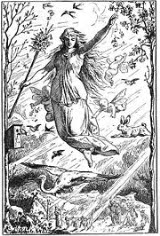
Eostre was a Germanic goddess of the dawn. The light of dawn was carried by rabbits (or hares). Ostara and the egg she carried were symbols of fertility, of new and continuing life. Some descriptions say Eostre herself is hare-headed, and the goddess of rabbits and birds. Whether Eostre herself is hare-headed or her attendants are hares, she is strongly associated with the hare – and later its cousin the rabbit.

A popular myth says that the children of the time presented eggs to the goddess as a gift in return for her bringing them the spring. She was so touched by this gift that she recruited her rabbits to return the eggs (only brightly colored now) to the children in baskets (the birds’ nests). That is where our tradition of rabbits delivering eggs to children comes from.

Now, the question then is why do Christians call the holiday celebrating the resurrection of Jesus following his crucifixion as Easter? As Christianity spread northward in Europe, the priests hoped to convert the native pagans away from their gods and practices to Christian belief. So, the priests would adapt pagan ideas into Christian ones as a way of encouraging the pagans. For instance, it is believed that the priests would encourage children to seek out eggs and bring them back to the church, where the clergy would pay them a small token for each egg collected. This may be where the practice of the Easter egg hunt was born.

Modern pagans have generally accepted the spelling Ostara (Oh-star-ah), which honors this goddess as the word for the Vernal Equinox. The Vernal Equinox is also known as the first day of spring. This day has been celebrated from ancient times for the resurrection, the rebirth of the Earth itself, from the cold of winter.

Reflection Reading – Parallel Readings from Mark, Matthew, Luke and John

The Christian portion of the bible, popularly known as the New Testament, contains four accounts of the life of Jesus of Nazareth whose authors claim some authority to knowledge of the history of the man and of the era. The earliest of these texts, the Gospel According to Mark, is believed to have been written around year 65 of the Common Era, likely preceding the destruction of the temple in Jerusalem in 70 C.E. as Rome squashed the Jewish rebellion. Scholars place the writing of the Gospel According to Matthew between 80 and 85 C.E., with the Gospel According to Luke appearing shortly afterwards. The Gospel According to John was written in stages, possibly between 90 and 110 C.E.

So, you will hear four accounts of the events of the morning following the Sabbath after the crucifixion of Jesus. These four accounts were likely written as much as 45 years apart. And while the surviving accounts may have derived in part from earlier documents that have not survived, it is unlikely that the contributors of the gospels witnessed any of the events they describe.

Part One
Mark 16 – When the sabbath was over, Mary Magdalene, and Mary the mother of James, and Salome bought spices, so that they might go and anoint him. And very early on the first day of the week, when the sun had risen, they went to the tomb. They had been saying to one another, “Who will roll away the stone for us from the entrance to the tomb?” When they looked up, they saw that the stone, which was very large, had already been rolled back.

Matthew 28 – After the sabbath, as the first day of the week was dawning, Mary Magdalene and the other Mary went to see the tomb. And suddenly there was a great earthquake; for an angel of the Lord, descending from heaven, came and rolled back the stone and sat on it. His appearance was like lightning, and his clothing white as snow. For fear of him the guards shook and became like dead men.

Luke 24 – The women who had come with Joseph of Arimathea followed, and they saw the tomb and how his body was laid. Then they returned, and prepared spices and ointments. On the sabbath they rested according to the commandment. But on the first day of the week, at early dawn, they came to the tomb, taking the spices that they had prepared. They found the stone rolled away from the tomb,

John 20 – Early on the first day of the week, while it was still dark, Mary Magdalene came to the tomb and saw that the stone had been removed from the tomb.

Part Two
Mark 16 – As they entered the tomb, they saw a young man, dressed in a white robe, sitting on the right side; and they were alarmed. But he said to them, “Do not be alarmed; you are looking for Jesus of Nazareth, who was crucified. He has been raised; he is not here. Look, there is the place they laid him. But go, tell his disciples and Peter that he is going ahead of you to Galilee; there you will see him, just as he told you.”

Mathew 28 – But the angel said to the women, “Do not be afraid; I know that you are looking for Jesus who was crucified. He is not here; for he has been raised, as he said. Come, see the place where he lay. Then go quickly and tell his disciples, ‘He has been raised from the dead and indeed he is going ahead of you to Galilee; there you will see him.’ This is my message for you.”

Luke 24 – but when they went in, they did not find the body. While they were perplexed about this, suddenly two men in dazzling clothes stood beside them. The women were terrified and bowed their faces to the ground, but the men said to them, “Why do you look for the living among the dead? He is not here, but has risen. Remember how he told you, while he was still in Galilee, that the Son of Man must be handed over to sinners, and be crucified, and on the third day rise again.”

John 20 – [The gospel says nothing about Mary Magdalene entering the tomb at this time]

Part Three
Mark 16 – So they went out and fled from the tomb, for terror and amazement had seized them; and they said nothing to anyone, for they were afraid. Now after he rose early on the first day of the week, he appeared first to Mary Magdalene, from whom he had cast out seven demons. She went out and told those who had been with him, while they were mourning and weeping. But when they heard that he was alive and had been seen by her, they would not believe it.

Matthew 28 – So they left the tomb quickly with fear and great joy, and ran to tell his disciples. Suddenly Jesus met them and said, “Greetings!” And they came to him, took hold of his feet, and worshipped him. Then Jesus said to them, “Do not be afraid; go and tell my brothers to go to Galilee; there they will see me.”

Luke 24 – Then they remembered his words, and returning from the tomb, they told all this to the eleven and to all the rest. Now it was Mary Magdalene, Joanna, Mary the mother of James, and the other women with them who told this to the apostles. But these words seemed to them an idle tale, and they did not believe them. But Peter got up and ran to the tomb; stooping and looking in, he saw the linen cloths by themselves; then he went home, amazed at what had happened.

John 20 – So she ran and went to Simon Peter and the other disciple, the one whom Jesus loved, and said to them, “They have taken the Lord out of the tomb, and we do not know where they have laid him.” Then Peter and the other disciple set out and went towards the tomb. The two were running together, but the other disciple outran Peter and reached the tomb first. He bent down to look in and saw the linen wrappings lying there, but he did not go in. Then Simon Peter came, following him, and went into the tomb. He saw the linen wrappings lying there, and the cloth that had been on Jesus’ head, not lying with the linen wrappings but rolled up in a place by itself. Then the other disciple, who reached the tomb first, also went in, and he saw and believed; for as yet they did not understand the scripture, that he must rise from the dead. Then the disciples returned to their homes.

But Mary stood weeping outside the tomb. As she wept, she bent over to look into the tomb; and she saw two angels in white, sitting where the body of Jesus had been lying, one at the head and the other at the feet. They said to her, “Woman, why are you weeping?” She said to them, “They have taken away my Lord, and I do not know where they have laid him.” When she had said this, she turned round and saw Jesus standing there, but she did not know that it was Jesus. Jesus said to her, “Woman, why are you weeping? For whom are you looking?” Supposing him to be the gardener, she said to him, “Sir, if you have carried him away, tell me where you have laid him, and I will take him away.” Jesus said to her, “Mary!” She turned and said to him in Hebrew, “Rabbi!” Jesus said to her, “Do not hold on to me, because I have not yet ascended to the Father. But go to my brothers and say to them, ‘I am ascending to my Father and your Father, to my God and your God.'” Mary Magdalene went and announced to the disciples, “I have seen the Lord;” and she told them that he had said these things to her.

Sermon – Rolling Stones

My mother loved music. She was blessed with a powerful singing voice that I acknowledge with great pride she passed on to me. Naturally, I continued the tradition by instilling a love of music in my own children.

Among the many casualties of age is that we often find it difficult to keep up with new trends in music. So, as our children grow and are exposed to new songs and performers, we parents are often the last to hear about these novel influences. Now, I have what I consider to be a wide taste in music, leaning toward classic rock, jazz, progressive and alternative sounds. But, when my daughter went to the dark side of country and my son to the cacophony of hip hop, I had trouble keeping up.

Over the years, though, I listened to their music and tried to share their passion for these genres. Sometimes, they would bring home a “new” song, only to have me tell them that it was a cover of a song from my youth. I can’t help it. The historian/trivia buff in me can’t resist the buzz kill of putting this new music in its place.

For instance, if you mention The Rolling Stones to a young person, they are likely to think about rock and roll legend Mick Jagger, now an aging shadow of his former self. The Rolling Stones were inducted into the Rock and Roll Hall of fame in 1989, a year when my son and daughter were listening to music from the “new” movie The Little Mermaid. They were certainly not yet aware of The Rolling Stones of my childhood, whose shows consisted mostly of covers of Chicago blues tunes and the hits of R&B artists like Chuck Berry and Bo Diddley. In fact, The Rolling Stones took their name from a 1948 song by Muddy Waters, Rollin’ Stone.

Now, blues musicians often borrow lines and verses from each other and employ common symbols and phrases that can’t be traced back to one source. That first hit of Muddy Waters derived in part from the 1941 song, Catfish Blues by Mississippi delta singer and guitarist Robert Petway. Petway’s song, in turn, was likely influenced by Jim Jackson’s Kansas City Blues from 1928. And, all of these pieces owe some credit to the work of Victoria Spivey and Blind Lemon Jefferson in the 1920’s.

So, like The Rolling Stones who seem to have been producing music forever, certain lyrics and melodies roll along from one artist to the next, crossing genres and performance styles over the years. Similarly, human stories and myths travel across space and time from one teller to the next. With each age, our legends adapt to changing circumstances and needs, either through design, outside influence, or simply the whims of style and preference.

Myth plays a powerful role in our lives. We remember the stories passed onto us in our youth from far flung cultures. We remember the courage of Moses wielding the staff of righteousness against Pharaoh. We remember the foolishness of Icarus when the sun melted his ambition to fly to the heavens. We remember the gallant ride of Lady Godiva, seeking redress for the oppressed citizens of Coventry, as well as the justice meted out to Peeping Tom, the only person who dared to spy upon her progress.

The specifics of each story – in fact, whether these events actually occurred at all – matters little. We remember the images of a rod transforming into a consuming snake, the disintegrating wings of feathers held together by wax, of a noble woman shedding her pride for a just cause. Throughout human history, mythic imagery motivated us, inspired us, warned us, and taught us. The fact that no actual evidence exists for the miracles of Moses, the flight of Icarus, or the ride of Lady Godiva fails to deter us from utilizing these stories in our lives.

When biblical historians examine the gospel accounts of the Christian testament, they confront stories written more than 30 years after their alleged occurrence and penned over the stretch of subsequent decades. These works were then transcribed and translated any number of times over the centuries until reaching the forms known today as the King James, the New American, the New Revised Standard Version, and dozens of other bibles. You heard this morning the resurrection stories as recounted in the four gospels from the New Revised Standard Version of the bible. You can appreciate the challenge facing the reader in search of consistent accounts of the life and death of Jesus.

We heard the many variations in the accounts of that morning. So, what details do the four resurrection stories in the gospels have in common?

  • Mary Magdalene goes to the tomb and then informs the disciples of its condition. There is much to be said about her seminal role in every account of this event. But that is the deserving subject of other sermons.
  • Jesus in his mortal form is not visible, and perhaps appears in other guises. Again, a subject of future sermons – when do we know if we have seen the face of Jesus?
  • And, of course, we have the massive round stone, placed by the Romans to prevent his followers from spiriting away the body of Jesus in the night.

Any further agreement on the specifics of the events of Easter morning disappeared over time and countless telling.

In the end, we may find that the actual details of the story don’t really matter. Does the truth of whether or not these events actually occurred bear any relevance in our lives? This morning, we celebrate the arrival of spring, a true miracle of nature. We consider whether a hare-headed goddess actually helps usher in the morning sun, or whether a first-century Palestinian was executed and rose from his tomb. We consider how those stories influence the choices you face in your daily lives.

Perhaps what matters is whether or not you find meaning in these mythic stories. What lessons or images from these stories work for you? Is it the exhilaration of the hunt for colored eggs, or is it the discovery of an empty crypt in fulfillment of prophesy? And, if you cannot find meaning in these tales, then how can you set them aside and allow yourself to look for new stories?

Many people find the variations in biblical accounts and the many interpretations of the texts challenging. Sometimes, our past experiences hamper our ability to apply the lessons of these texts in our lives. Sometimes, we even find the consideration of these memories hurtful. If we are to honor the historical Jewish and Christian teachings that call on us to respond to God’s love by loving our neighbors as ourselves, then we must find ways to make peace with the ambiguities of the myths and feelings that these stories may evoke.

One way to find relevance for mythic stories in our lives is to focus on their larger messages. The story of Eostre is one of conquering the dark and cold of winter, transforming our world into the warmth and light of spring. The exodus of Passover recounts the story of a people on the march, shedding the bonds of centuries of slavery. And, the tale of the risen Jesus holds out for us the rebirth of the promise of our lives, the triumphant resurrection of hope for a better tomorrow over the forces of despair, violence, hate, and indifference.

More simply, the Easter story can be that of a rolling stone. This morning, we can consider all of the myths associated with the day.

  • We can think of the task of removing obstacles that confront us.
  • We can imagine the outcome of attaining unexpected goals, whether one considers such attainment as the serendipitous intersection of cosmic forces, as coincidence, or as the grace of a loving god.
  • We can envision our successful resistance, challenging unlawful authority or rejecting the temptations of weakening influences and unethical behaviors.

Many of us employ chocolate rabbits or decorated eggs in our Easter celebrations. So, I invite you to employ another tangible object in your Easter morning considerations. [pass out basket of stones] Observe the stone in your hands. Study its colors, its shape, its weight, and its texture. Imagine your stone rolling down a slope. Perhaps you have trouble imagining this stone rolling at all, given its irregular shape and flat edges. Perhaps you can easily see this rock sitting undisturbed on a shelf literally for years.

Now, put this stone between the palms of your hand and rub your hands in a circular motion. Feel the stone rolling between your palms, noting how much pressure is required to turn the rock and how much coordinated movement of your hands is needed. Imagine how long it would take for this rubbing to begin wearing down those edges, until your stone rolled effortlessly. Can you imagine the diligence, the patience that such commitment would require?

Now, here is another Easter image to consider. Have you ever seen rock tumblers, used to create smooth and shiny stones for jewelry and craft projects? Think about this congregation as a big rock tumbler. Now, you could work on your rock alone, eventually smoothing it into a rolling stone. Or, you could drop your rock into the tumbler of this congregation along with all of the other rocks being held in hands here today. In the months and years to come, we can gather, work, talk, sing, and worship together, hewing those rough edges and honing the surfaces of our rocks.

An important message of this time of year is the value of religious community. Whether evoked by the stories of Ostara, Passover, or Easter, we can all use help rolling those stones in our lives. This congregation and this faith can help you remove obstacles, attain goals, and resist oppression in your life. So, as you consider the rock in your hand once more, think of the biggest obstacle in your life, or a goal you really hope to achieve, or a struggle you face against injustice. Now, bring your rock forward and place it back in the basket, where it will join others in an avalanche of common purpose and mutual support.

Closing Words from The Rolling Stones, by Robert Heinlein

Everything is theoretically impossible, until it is done. One could write a history of science in reverse by assembling the solemn pronouncements of highest authority about what could not be done and could never happen.

Roaming the Religious Road

Many of you know the recent events in my life that brought me here to serve as your minister. Since the age of 10, I lived in Pittsburgh. I worked for 29 years for the same employer, and lived most of those years in the same home. Since entering the seminary, I lived the past four Januaries in Chicago. Early in 2009, I moved to New York City to complete my ministerial internship. Then, a few months ago, I moved again here to Smithton. So, after a relatively stationary existence, in recent years I gradually adopted a somewhat nomadic lifestyle.

The transition presented its challenges. I gave up some luxuries that I took for granted for many years. I downsized my possessions, finding that many of the things I valued for decades held little import now. And, I began to rely more on electronic social media to maintain connections with valued friends and colleagues.

Like many people, when the stress of major life changes confronts me, I find comfort in the stories of others who encountered similar changes in their lives. I can say that I have found comfort in the stories of other wanderers who trod this religious road before me. And, I would like to share three of those stories with you today.

I learned about the first of these people from the various histories of the Unitarian Universalist Congregation of Smithton written over the years. Most agree that early settlers of the Yough River valley were introduced to our liberal faith of Universalism by an “itinerant minister from New England named the Rev. D. Bacon.” Our histories include no other information about our first minister.

E. Davis Bacon was born in Greenfield, Massachusetts on August 15, 1813. His family moved to New York when Davis was seven. Young Bacon attended the Clinton Liberal Institute, a school founded by the Universalist Church. He taught school briefly in Kentucky, returned to New York and married. He began preaching soon after and in 1843 returned to Kentucky. Over the next ten years, he moved to several towns in Ohio spreading the Universalist message.

In 1853, he settled in Pittsburg, where the Universalist church had been unable to sustain itself. He reinvigorated that church, and in 1860 met with 11 stalwart adherents in nearby Port Royal, where the seeds of our current congregation were sown. It seems that he only served as part-time minister of the fledgling church for one year, however.

In 1870, while (ironically and quite appropriately) traveling to an appointment in West Virginia, he was suddenly struck ill. He moved to Colorado for the climate, but on January 10, 1871, he died at the age of 58. E. Davis Bacon and his first wife are buried here in Pittsburgh. His obituary in the Universalist Register bemoaned his early passing as “much too soon for the completion of his mission and the welfare of the cause of which he was a pure, faithful, energetic and successful advocate.” [i]

I find it intriguing to imagine the life of E. Davis Bacon at that time. In the year he served this congregation, Abraham Lincoln was elected President and six months later the attack on Fort Sumter initiated the Civil War. The contrast between the rural, family-oriented congregation along the river and the apparently cantankerous lot of city Universalists in Pittsburgh must have been stark. Making the 30-mile trip to Port Royal entailed at least a day’s ride each way by horseback.

Such travel, however was the norm for Universalist ministers of the day. As Russell Miller writes in his extensive history of the Universalist Church in America:

There was not a single Universalist preacher in the formative days who did not
“itinerate” sometime during his life, whether to a community next door to his
own town or village, or to locations hundreds of miles distant…all geographical
areas were frontiers to be conquered. [ii]

The second person I wish to introduce today was the second and longest serving minister of this congregation. Andrew Getty was born in 1826 in Saltsburg, on the southern border of Indiana County. A teacher, farmer, and businessman, Getty began working at the age of 15 and apparently prospered at all of his endeavors. He became a canal boatman along the western branch of the Pennsylvania Canal, which ran along the northern border of Westmoreland County: from Johnstown westward through Blairsville and Saltsburg along the Conemaugh River; through Apollo and Leechburg along the Kiskimanetas River; and on to Freeport and down the Allegheny River to Pittsburg. Thus, he had access to the city and the other river communities of Western Pennsylvania.

Despite his successes in life – as a eulogist wrote in the monthly publication, The Pennsylvania Universalist – his orthodox Christian upbringing left him feeling “out of harmony with reverent and reasonable ideas of God’s character, and human nature, duty, and destiny.” [iii] He converted to Universalism and became a preacher at the age of 36. Apparently, Getty possessed a sharp mind, a deeply rooted common sense, and a keen knowledge of the Bible. So, in spite of his being surrounded by those of more conservative religious persuasions, Getty never failed to triumph in public debates, whether held in churches, school houses, halls, or parks.

He served the original Port Royal congregation, then the Smithton Universalist Church in its brick home on the outskirts of town, and later the Thomas Universalist Church in our current home as a part-time minister for most of the years from 1867 to 1905. He likely made the trip to Smithton once or twice each month. We don’t know if he traveled the 40 miles over land via horseback, or took the longer, circuitous route via canal and river from his Saltsburg home. He eventually moved to Florida, where he died on July 23, 1912, at the age of 86.

With his background on the water, I like to imagine him traveling our rivers to preach here. I can envision him a passenger on the canal boat drifting along with the current, contemplating sermon ideas as the shorelines rolled by. Not yet a steel town, Getty would have watched the rapid growth of Pittsburgh’s glass and textile industries and petroleum refineries. He would have passed barges filled with iron and coal, and steamboats headed for the Ohio River and beyond to the West. Each year, he witnessed the growth of river towns, industry, and the increase in smoke from the coal furnaces.

The third of my itinerant ministers was also born in a rural town near a major metropolitan area. Jesus spent his years of ministry wandering through villages, spreading his message. Jesus would likely have felt at home as a Universalist minister in 19th century America, as many of the towns in Galilee lacked a formal temple building. As Crossan and Reed suggest in their book, Excavating Jesus, the synagogue was more descriptive of the actual gathering of Jews for communal and religious purposes than a specific structure.[iv] So, like our gathering at Port Royal, I can easily imagine Jesus meeting with groups of a dozen or so in remote villages, under shady groves, or as a guest in the home of a town leader.

Now, perhaps Jesus did not have to contend with the untamed wilderness of the developing American Midwest. The paths of Judea were well trod with centuries’ of use. Universalist ministers spoke to farmers, millers, and miners; to the children of independent spirits that settled in the frontier and built the roads, the rails, and canals. The audience of Jesus was used to hosting wandering teachers preaching the history of their ancient culture, the widely-known stories of myth and legend, and the well-established laws of the people. My ministerial predecessors generally worked alone, supported only by dedicated spouses, and little denominational support. But, while Jesus worked with a cadre of followers, he never settled into any one place, or relied on the long-term support of any specific congregation.

So whether on foot, by boat, or on horseback, others forged a path toward ministry similar to my own. I join the ranks of E. Davis Bacon, Andrew Getty, and Jesus as itinerants serving a ministry to the people of a rural land. You know, itinerant was always a word I took to be derogatory. Among standard synonyms of the word are wanderer, vagrant, and vagabond. I always found the word synonymous with “unreliable,” sort of “here today, gone tomorrow” attitude.

But, I have come to appreciate the word’s unique meaning in certain lines of work as those who routinely travel in the conduct of their labors. Where after all would the hundreds of millions of us in this country be without the efforts of those who harvest our food, but must travel from one farm to another in the annual cycle of ripening of various crops? Where would our justice system be without the marshals and judges who cycled from town to town in the growing years of our nation? Where would comedians have been for years without “traveling salesman” jokes? And, where would our denomination be without the hundreds of congregations founded through the loving cultivation of the circuit rider preacher?

The Latin root of the word “itinerant” means “to journey.” Unsettled, roaming, roving – Isn’t that the case with us all, to one degree or another? Are we not all itinerants in various aspects of our lives? We wander in search of love, or purpose, of roots to sustain us. We wander in search of the meaning of our lives, the meaning of the underlying structure and sense of our environment, and the meaning of the universe itself.

Today, we celebrate Palm Sunday, the date when legend tells us that Jesus left his rural ministry to enter the metropolitan heart of his region. His reception in the big city started wonderfully, but quickly turned sour and ended abruptly just a few days later. After three years of successful itinerant service to his message, Jesus was viewed by the leaders of the temple and the civic authorities of the city as a dangerous interloper to the status quo.

Now, of course, your personal theology defines whether or not the triumphal entry into Jerusalem was, indeed, the end of the personal ministry of Jesus or just the beginning. His execution just one week later certainly ended his human life as an itinerant minister. But, the story subsequent to his death and burial marks just the beginning of what has become a religion with billions of followers. His labor – the compassion, the healing, and the preaching – lived on far beyond the passing of his mortal body.

Death may claim us as young adults, like Jesus, or in middle age like E. Davis Bacon, or in our twilight years like Andrew Getty. Until we breathe our last, however, we yearn not so much for deathlessness but for wholeness. We seek a sense of union with the essence of life itself. The traditional message of Universalism offered the comfort that while this longing cannot be fully satisfied in our earthly life, a fulfilling afterlife awaits us all.

But, I would suggest that modern day Universalism must move beyond this isolated view of wholeness.

  • We must recognize that death is not the defect but the reality that can motivate us to live more fully, more wholly. Regardless of one’s view on life after death, we can live each day more intentionally, more purposefully;
  • We must accept that sometimes the journey itself may be the goal. Whether on foot, by horse, by boat, or moving van, wholeness may derive from our motion; and
  • We must comfort ourselves with the knowledge that we might not ever know all the reasons things happen, or understand the full consequences of events around us.

We can never let adherence to either dogmatic creed or soulless rationality blind us to the wondrous possibilities that the cosmos provides us.

Our lives may at times seem too transient and our support systems may fail to maintain us in our normal comfort zones. But, in some ways, we are meant to lead itinerant lives – unsettled lives of roaming and roving – pursuing the rigorous journey, which demands the highest degree of dogged persistence. To that end, let this congregation serve as a terminal of bustling journey, of travels to distant lands, and to periodic stopovers at home.

[i] “Obituaries (1870-71) in the 1872 Register, The Universalist Register (Unitarian Universalist Historical Society web page) http://www25.uua.org/uuhs/duub/register/1872.html
[ii] Miller, Russell P. The Larger Hope: The First Century of the Universalist Church in America, 1770-1870, (Boston: Unitarian Universalist Association, 1979), p. 233.
[iii] Vincent, James. “Remembered for What He Did: Fifty Years a Minister,” The Pennsylvania Universalist 7:8 (September 1912), pp. 4-6.
[iv] Crossan, Dominic and Reed, Jonathan. Excavating Jesus: Beneath the Stones, Behind the Texts. (San Francisco: Harper, 2001), p. 26.

Attila the Pun

I was reminded this week of the moment that I laughed harder than ever in my life. The Facebook status line trend of the week is to post your favorite quote from Monty Python’s Flying Circus. Now, there are many fantastic examples to quote from. “No one expects the Spanish Inquisition!” Or “This is an ex-parrot.” And, “Number One…the Larch.”

But, my favorite line has as much to do with my state of mind at the time I heard the actual pun. I was working, going to school, and performing in a local straw hat theatre production. So, when I returned home, I was usually so wired and excited that I needed to just sit and unwind before I could go to bed. Reruns of Python were airing late at night, so one evening I was introduced to “The Attila the Hun Show.” The episode contains several puns on the name, such as Attila the Nun. And then, in an animation that lasted only a few seconds, I witnessed the vicious and energetic Attila the Bun rampaging across a banquet table.

Now, generally, I find the pun to be among the lowest forms of humor. But, that night, I was exhausted and my laughter guard was down. The ridiculous pun and Terry Gilliam’s simple cartoon just caught me perfectly and I lost it. I don’t know how long I laughed uncontrollably. I laughed so hard that I fell out of the chair and onto my knees, almost in supplication to the gods of humor.

In retrospect, this was the master of all puns. For me, Attila the Bun succeeded brilliantly in every aspect by which a successful pun is measured. First, it built on a previously established theme, ramping up the silliness a notch with each repetition. Second, the message was short, simple and impactful. Third, the transition to the pun included the set up introduction by a much longer joke — a newscaster voiceover saying, “That’s the news for wombats, and now, Attila the Bun!” In some perhaps bizarre ways, this perfect pun exhibited some of the traits of high quality sermons.

Anyway, I don’t wish to belabor this analysis, so I will go back to work, taking great pains to avoid toiling too much in my efforts. Perhaps I will start with a cup of coffee and read the latest news on efforts to repeal the recently passed health care bill. “Well, that’s all for Attila the Bun. And now — idiots!”

Bells

(As background context, when I started at the Unitarian Universalist Congregation of Smithton, I found an old fashioned school bell sitting on the pulpit, which inspired this sermon.)

I moved into my apartment here in Smithton a little over a month ago. In the weeks preceding installation of my internet access, I sat reading most evenings in my easy chair. On the first night of silent study, I was suddenly jolted out of my chair at 9:00 p.m. by the siren of the Volunteer Fire Department in the building next door. Apparently, they test the alarm with a single cycle each night at exactly that time. A few nights later, the alarm sounded three times in the wee hours of the morning. I have subsequently learned that our fire company responds to many emergency calls in the region, particularly accidents up on Interstate 70.

Roughly once an hour each day, I also hear the horns of the passing trains and the bells of the crossing gates on Peer Street and Second Street, just a few blocks north and west of the church. The laying of the old Baltimore and Ohio line preceded the founding of this congregation in 1860 by just a few years. Now run by the CSX Corporation, the track running through Smithton hauls materials from as far north as Detroit and as far west as Chicago and St. Louis, and from a wide range of destinations throughout the Southeastern United States.

And, periodically throughout the week days here in Smithton, the carillon of the Hope Lutheran Church just down the street chimes. The sound of traditional Protestant hymns float through the air, bringing a calming lilt to the small town quiet. Hearing the tones makes one bemoan the lack of a town commons at that intersection, perhaps with a gazebo for summer concerts and a grassy space for playing children.

Bells serve a myriad of roles in our lives. Doorbells and telephones announce the approach of visitors, heralding their desire for our company and conversation. Dinner bells, often used on farms where the sound must traverse great distances to reach the listener, proclaim the availability of food and the time to cease work and begin the meal. Clocks chime the hour and awaken us from our restful slumbers to start the work day. Timers alert us to completed tasks, and warn us not to exceed set limits.

At a race, a bell announces the final lap. While on Wall Street, a bell proclaims the start of the trading day. In a store, a bell may summon us from the front of the line to someone who will assist us. While in a hotel, we may use a bell to summon that help to us. At school, bells signify the time to move and change our locations and the focus of our studies. Around the neck of a cow or a cat, a bell notifies of comings and goings. And, wind chimes simply resound with the gentle tinkling of just being in the breezes.

Here at the Unitarian Universalist Congregation of Smithton, we have our own bells. The bell in our steeple was donated when our current structure was built in the late 1880’s. For more than 100 years, our name was the Thomas Universalist (then Unitarian Universalist) Church, in honor of that donor. The ringing of our bell continues to announce to the surrounding community the commencement of our Sunday morning service each week.

We have another bell – a far less imposing figure of a bell. Going through the historical files of our congregation, one finds many mentions of “Mr. Thomas from Philadelphia,” who donated our steeple bell in spite of never seeing our building in person. But, it wasn’t until I found this lone slip of paper that I learned the story of this other bell. It reads:

My mother, Barbara Hermann Bolling was born in 1881. When she was 18 years
of age she became ill with Typhoid Fever and to summon help she was given this
bell.
I am donating this bell to the church for its use only and to remain a part of the church.
Please record this donation in the minutes at your next meeting.

Signed, Clarence Bolling, August 14, 1983

Several aspects of this piece of paper intrigued me. A common disease around the world, typhoid plagues have ravaged human civilizations for centuries. The earliest recorded outbreak occurred in Athens in the fifth century B.C.E., when one-third of the population of this then-thriving metropolis succumbed. In the late 19th century, typhoid fever was well known in American cities, where the typical mortality rate in cities like Chicago averaged 65 per 100,000 people a year. The most notorious carrier of typhoid fever was New York cook Mary Mallon, also known as Typhoid Mary. In 1907, as the first American carrier to be identified and traced, she was associated with 53 cases of the disease and three deaths.

A vaccine was developed by the U.S. Army around that same time. With vaccinations and advances in public sanitation and hygiene, most developed countries saw declining rates of typhoid fever throughout the first half of the 20th century. Antibiotics were introduced in clinical practice in 1942, greatly reducing mortality from typhoid. Today, the incidence of typhoid fever in developed countries is around 5 cases per 1,000,000 people each year. Yet still, an outbreak in the Democratic Republic of the Congo in 2004-05 recorded more than 42,000 cases and 214 deaths.

Probably more curious to me, however, was the wording of the letter, especially when combined with the nature of this unusual gift. Now, I am somewhat knowledgeable of antiques, although I will admit that bells are not a specialty. But, I have little reason to imagine that this bell has any particular monetary value. So, placing conditions that the bell’s donation is contingent on its being used for the church only and that it remain a part of the church is unusual at the least. Even if an item has significant resale value, the recipient of a charitable gift is typically under no obligation regarding the item’s use or eventual disposition.

And yet, upon my arrival, I found this bell not only in the building, but prominently placed here on the pulpit, literally at the nexus of our worship center. I can well imagine that the impetus for putting this bell here is long past and inertia has allowed it to remain in its place. But, as one who tries to stay attuned to the little synchronicities that occur in life, I am inclined to see some meaning in the intersecting vectors of my life with this bell.

For instance, its shape is reminiscent of traditional school bells, when teachers taught many grade levels in a single large room. So, this bell can represent for me my teaching role as minister, and our commitment to lifelong learning. This bell can represent our collective search for truth and meaning, whether that portrays our individual efforts, or our collective labor to provide religious education for children, youth, and adults.

Like other elements of this congregation, this bell represents our long history, serving its function for 120 years. It becomes part of the rich legacy that this building and its hundreds of inhabitants forged in this region, bringing the message of hope and love to the frontier bursting with industrial growth, and the eventual booms and busts of our economy.

But, what strikes me most about this simple bell is the story of its origin. The original purpose of this bell was to summon help. The ringer was calling out from her sickbed for someone to come and offer assistance, to provide sustenance, to support her resistance to a terrible disease. In this way, our lives do indeed resound with the sound of bells. All across the world, bells are tinkling, ringing, chiming, sounding, clanging for help.

(ring bell) When Port-au-Prince, Haiti was rocked by a catastrophic earthquake on January 12, 2010, it affected close to 3.5 million people, leaving hundreds of thousands dead and causing untold suffering for those who survived. Already the poorest nation in the Western hemisphere, Haiti is rife with radical inequality, its society systematically leaving out large numbers of people. For them, daily survival was a challenge even before the earthquake.

(ring bell) The genocidal war in western Sudan’s Darfur region has raged for five years, killing more than 300,000 and forcing 2.5 million to flee their villages. The war has particularly targeted women and girls, who face armed attacks each time they leave their camps to find firewood, food, or work. The Sudanese security forces and their allies have used rape and sexual violence as a deliberate strategy of war as a way to shame and destroy families and communities. The violence and subsequent displacement weaken women’s support networks and their access to livelihoods, even as many more of them are now heads of households, making it all the more difficult for them to survive.

(ring bell) In this country, our state and federal governments continue denying men and women who love each other of basic human rights. Gay and lesbian couples face discrimination, and still fight for their rights in areas including adoption, employment, taxes and benefits, and their ability to openly serve in their country’s armed forces. This same government that purports to support the family enforces unjust immigration laws. We spend billions of dollars rounding people up, breaking up families, shutting down businesses, and deporting people who are working, learning English, and putting down roots here. Our broken immigration system divides families and keeps loved ones apart for years and even decades, which discourages them from following the rules and working within the system.

(ring bell) The Unitarian Universalist Service Committee stands with those who are working to reverse the cycle of collapse and dependence that has historically plagued Haiti. As hundreds of thousands of survivors stream out of the city in search of water, food, medicine, and shelter, the very structure of the Haitian countryside is changing. Many villages have doubled and tripled in size, and people are scrambling to feed and house everyone. UUSC is partnering with Haitian organizations and social movements to ensure that their vision becomes reality. We can answer this bell by contributing our financial resources, and by becoming members of the UUSC.

(ring bell) While the Unitarian Universalist Service Committee supports a viable peace process to end the conflict in Darfur, action now is needed to weave a web of protection for women and girls in this war-torn land. The UUSC is working to improve women’s livelihoods and leadership skills, as well as providing human rights training, coordinating among humanitarian aid agencies in Darfur, and improving security for women living in camps. We can answer this bell by supporting advocacy campaigns, such as the UUSC’s Drumbeat for Darfur campaign, which calls for constant action urging the White House, Congress, and other institutions to make ending the genocide one of their highest priorities.

(ring bell) The Standing of the Side of Love campaign of the Unitarian Universalist Association is building interfaith support for equal treatment for lesbian, gay, bisexual, and transgender people in all matters of law. We are working with coalitions and lobbying governments at all levels for laws that protect everyone who face violence, intimidation, and discrimination because of their identities. We affirm the full humanity of all people: harnessing love’s power to stop oppression; honoring the spark of the divine in each and every person; pledging to uphold love as a guiding principle in our treatment of others.

We live in a time when most organized religions are experiencing a decline in active participation. Like Barbara Bolling, we lie ailing in our beds calling out for help. We call out for people to listen to us. We call out for people to be with us. We call out for people to share their lives with us in common purpose and commitment. We do that by sounding the bell of freedom of belief, a well recognized sound in this great nation, made famous at least figuratively by our steeple bell’s cousin across the state in Philadelphia. And, while we may respond to bells ringing for specific causes or concerns, the framework within which we hear that music and respond to those vibrations are the principles of Unitarian Universalism.

So, we will continue to ring our steeple bell at the beginning of services every Sunday. But, we ring our bell not just to proclaim the start of worship to the neighborhood. We ring our bell as a way of answering all of those calls for help that we hear each day. We ring our bell to summon help from others as we struggle to nurture spirits and heal the world. And, we ring our bell in remembrance of those who have gone before and kept this Unitarian Universalist pulpit serving Smithton, Southwestern Pennsylvania, and the world vibrant and free.

Back in the Kennel

Well, dear readers, I have been on hiatus for some time as life has intervened. I completed my ministerial internship in New York, moved back to Pittsburgh, spent January in Chicago finishing my last seminary classes, and started my new job as the Consulting Minister for the Unitarian Universalist Congregation of Smithton. I am thrilled to be at the helm of this intrepid little church, which is celebrating its 150th anniversary in June.

A great irony in all of these massive changes is moving from our wealthiest congregation back to the real world — a church building with no computer, no DVD player, and no photocopy machine. But, we’ve got a wonderful structure, complete with a working bell in the tower, and a feisty group of folks who very much want this congregation to grow and have pinned a large lot of their hopes on my ideas and energy to help them make it happen.

It is a daunting task. Smithton is a town of 400, with one grocery store, one bank, and four bars. But, it also has a tiny public library (the volunteer librarian is a former Lutheran minister) and, the town’s pizza shop serves amazing food. I find both of these auspicious coincidences.

So, stayed tuned as I expect my muse will be keeping me very busy in the coming months. And, if you ever find yourself on Interstate 70 south of Pittsburgh, take a one mile detour at exit 49 and stop in for a visit.

Trepidation and Trauma

Back on September 6, I was shocked in the pulpit (literally), when my defibrillator fired during the closing hymn. After a serious increase in medication dosage, my ventricular tachycardia seems to be under control. However, the medication does have side effects with which I am learning to cope.

One side effect I did not expect has occurred when I have been in the pulpit since that event. Each time, I have endured 5-10 minutes of cold sweats, high anxiety, and fear that my device was going to be set off once again. I have fought through each instance with deep breathing, some water, and focus.

After sharing my experiences with a colleague and expressing the fear I was feeling about my ability to continue pursuing a life in the pulpit, she suggested that I had in fact suffered a trauma. She offered some ideas about reclaiming my sacred space and regaining some equilibrium in my life.

I found this suggestion incredibly wise and wondered why I had not thought of it myself. Of course, that is perhaps the first quality of trauma – that we can see it in others but rarely in ourselves. Ironically, I have been leading Building Your Own Theology sessions, where we have discussed definitions of words like sin as separation, and evil as that which prevents creativity from occurring. Anyone who has taken Suzy Pangerl’s course in “Evil, Trauma and Ambiguity” at Meadville Lombard Theological School can certainly relate.

A valuable lesson for me in this ordeal has been the reminder of the delicate connection between body and mind, between physical and mental health. I’m not sure all the pills in the world will help me reclaim my pulpit, and spiritual practice alone will not cure the electrical failings of my heart. Like many things in life, I must find a balance if I am to achieve an equilibrium that will sustain my prophetic voice and my passion for ministry.

Trauma comes in many guises in our lives. If you are suffering and pills provide no relief, perhaps this perspective will be useful. And remember that life is too short to let guilt, shame, or inertia prevent you from seeking the happiness and fulfillment you deserve.

Oscar’s Muse Burrow

Oscar here, the world’s first Unitarian Universalist groundhog. While Jeff is in the other room taking a nap (it was a rough service this morning!), I thought that I would stop in and type hello to all of his loyal readers. A lot of you has asked me, what about Unitarian Universalism appeals to me, that is, as a groundhog? Well, I have to admit a particular fondness for the seventh principle, the one about the interdependent web of all existence of which we are a part. I mean, it isn’t about revering Nature…I am Nature, after all!

But, then, as I see it, we are all part of Nature. And that brings me back to the first principle. the inherent worth and dignity of every person. Now, I’m no Punxatawney Phil-osopher (heh, heh!), but I saw the faces of the people coming out of the Worship Room on Sunday. Many of them looked right into my eyes, shook my paw, and talked to me (I think Jeff was getting just a little jealous). I really felt welcomed by everyone. I felt like a person, which is the way we want all of our visitors to feel.

And, another thing while we’re on the topic of “persons.” I helped Jeff in the pulpit today while the children were still in the worship service. It did these ol‘ woodchuck eyes good to see those precious faces and the innocent smiles of those pups looking back at me. The world can be a tough place, so I love talking to the child in all of us on Sunday mornings.

Uh oh, I hear Jeff stirring, so I better sign off for now. TTFN (ta-ta for now!)