Disillusion

Over the winter break, my son and I had a number of conversations about his future and the state of the world in general. He is a 21-year-old student attending Ohio State University. Tyler is a bright and creative young man. But, he also feels a good deal of frustration in his life and sees few role models out there to mentor or inspire him.

Interestingly, we found that we agreed on many observations about 21st America, although our approaches to dealing with those problems may vary in technique and intensity. As one might expect from a young man, he is inclined to revolutionary change and abandonment of dysfunctional systems. I am still inclined to changing the system from within. The upshot of our discourse was that we would begin the process of drafting a manifesto for a new kind of revolution — one that creates a new type of society within the existing structure — and eliciting feedback from others. So here goes.

Why are so many people disillusioned with the current state of American society? Everywhere we turn, we hear people who have turned off the political discourse and, when they do vote, make their choices based on selecting the lesser of available evils. Many young people, after spending 16 or more years in institutionalized education, find themselves unemployable, unfulfilled, or significantly unprepared for the “real” world. Our daily lives seem filled with a bombardment of consumerism and the resultant unhappiness derived from debt and impossible expectations. Many adults find that they cannot give their children the quality of life they received from their parents, and must combat seemingly uncontrollable forces of substance abuse, over-medication, and over-exposure to sex and violence in our media.

Why are so many people disillusioned with the current state of American society? Because we are reminded every day that our nation is not what we thought it was. We are reminded every day that our nation is not what we were taught it was. We are reminded every day that our nation is not what it should be.

What does it mean to be disillusioned? Disillusionment is betrayal. Many of us are frustrated because we cannot live lives that make us happy. We feel angry because it sometimes seems that everyone in any position of authority is either a liar, a cheat, or a fraud. We sense hopelessness because we see no answers to the multitude of problems that beset us. Many Americans feel that their country has in many ways fundamentally betrayed them. That is the negative view of disillusionment.

Is there a positive meaning of disillusionment? I believe that there is. Disillusion means that we are being freed of our illusions. Disillusion means that we have the capacity to make change and to define our nation. By embracing disillusion, we can shed ourselves of outmoded ways of being and create a new society. In my next installment, I will begin to discuss our illusions in 21st century America.

Reaching Across the Generations

I have been enormously tardy posting lately as life has been intervening. Between searching for an internship site, preparing for classes, leading two worship services this week, and actually working at my University job, things have been hectic. I’ve also spent a good deal of time lately talking with my 21-year-old son. Probably the hardest part about parenting is watching your children struggle to find their way in the world. I just want to swoop down and solve every problem and provide every answer. But, I know those are the worst things to do if you want your children to become mature and responsible adults, fully equipped to explore the joy, the angst, and the fulfillment of life.

Like many young adults his age, he is searching for a life path and a career that matches his talents and desires with at least the ability to keep himself reasonably fed and sheltered. One thing he enjoys is poetry. Now, this is one area that I am particularly inept at providing much assistance. I have never been much of a poetry fan – “The Cremation of Sam Magee” is a personal favorite – so I feel relatively useless providing him with much in the way of support. Like me, though, he thinks big and likes to envision art in large scope. His ideas for novels start out as trilogies and his film ideas are 24-hour marathons.

But, I had an idea that combined my love of sermon writing with his poetic muse. I though it would be interesting if we exchanged pieces of our work and then wrote accompanying pieces – he would give me a poem and I would write a homily, and I would give him a sermon and he would write a poem. If we could put together enough examples, I even imagined that this might be something that Skinner House might consider publishing.

So, here is our first crack at this project. We would love to hear any feedback. What did it make you think? Do you like the format? Would you read more?
==========
My Brother’s Dreams
Tyler and Jeff Liebmann

The smooth penetrating glow of your radiant smile
A toothy grin of ambivalence and naivety
I dreamt of you abbreviated brother, pervading my eyes,
shining through the cloudy maze of my thoughts
You hadn’t aged, brown slivery locks danced above your
lids, constantly peering, laughing
Visits have slowed over the years, with each rustling
autumn I wonder, have you forgotten me?
How do you pass the days, slumbering in dark corners
of my mind, tucked away from the harsh reality that
stains the memories
Words spill from your rounded lips, half-phrases of
inequity and longing, muted words of love and
abandonment, long forgotten, dust in a desert wind.

Growing up, I never heard of Unitarian Universalism. And yet, my parents possessed a streak of religious nonconformity we often brandish with great pride. My parents were Christian, but they each assumed that label on their own terms.

For instance, my mother was raised Methodist in Moundsville, West Virginia – named for a large Adina Indian burial mound in the middle of the town. As a young girl, she once told her minister how she looked forward to going to Heaven so that she could be reunited with her deceased pet dog. The minister informed her (I always imagined in a rather patronizing tone) that her dog would not be waiting for her because there are no animals in Heaven. Without missing a beat, my mother told her minister that if her dog was not in Heaven, then she had no interest in going herself.

When I knew her as an adult, my mother was no shrinking violet. Many was the time she left some store clerk, teacher, or anonymous bureaucrat quaking in their officious shoes. But, I have to really admire the courage of a little girl to challenge the senior ecclesiastical authority in her life on an important point of theology. I take some measure of delight in her raw chutzpah, risking her minister’s vision of eternal hell fire over her love for the family pet. With genes like hers, I suppose it is little wonder that I eventually took the path toward Unitarian Universalist ministry.

This relatively harmless, amusing anecdote lived in our family’s history for decades and, obviously, made an impression on me as well. My mother has been gone for many years now, but her telling of that story lives clearly in my memory. An interesting question, however, is that of all the memories of childhood she could have retained, why would my mother, who lived into her 70’s, remember that brief exchange? Of all the folksy wisdom she could pass on to her children, why would that conversation rate consideration?

I believe my mother clung to that story because it represented her most primary belief in the nature of the human soul. My mother clearly felt that Heaven was not merely a Shangri-La of limitless joy and boundless serenity. No, she obviously felt that Heaven is a very personalized paradise populated by all of the dearly departed in a sort of mirror of our Earthly world. To her, Heaven would not be heavenly without her beloved pet, because her dog was an essential component of her life – a life that had earned selection into the Kingdom of God.

Let me carry the Gospel According to Helen one step further. My mother believed that her soul, once shed of its mortal body, would live for eternity in Heaven. Now, animals are not baptized, nor do they make any conscious choice to accept Jesus into their lives. I doubt that she believed animals have souls, per se, so one might ask how her dog would earn entry into the hereafter. Certainly not all animals would be there. If there is a Heaven at all, then surely it is devoid of rats and roaches and rattlesnakes, since they would evoke memories of fear and danger. So, for a particular animal to earn ascension, they must do so by displaying a humanlike devotion, living on even after death as part of the loving memory of the soul of a human being. I imagine that my mother would have agreed that as long as that dog lived on in her memory, even subconsciously, then her Heaven must include that dog.

My mother was no theologian. I am not sure that she could have given you much of an answer if asked to define the human soul. But, she knew what the concept meant to her and that was sufficient. To her, the soul was the immortal essence of each human being. The mind is the seat of thought and reason, but the soul is the seat of understanding and compassion. The mind may be the end result of neural synapses and biochemical reactions. To my mother, the soul was the vessel of the spirit, that divine spark, that piece of God within us. And, upon death, that piece of spirit reunites with God in Heaven.

But, not all of us are so fortunate, as my mother was, to have an unambiguous faith. Very few Unitarian Universalists believe in a continuing, individualized existence after physical death. Even fewer believe in the material existence of places called heaven or hell where one goes after dying. If we believe in the concept at all, we believe that immortality manifests itself in the lives of those we affect during our lifetime and in the legacy we leave when we die.

So what do Unitarian Universalists believe about the human soul? I somehow doubt that you can find any two Unitarian Universalists who will answer that question in quite the same way. To even begin would require a month of Sundays to simply lay the philosophical groundwork. Thinkers of distinguished pedigree have considered the nature of the soul to be one of the most fundamental notions of human existence, worthy of entire careers of contemplation and learned writing.

My mother lives on in my memory. I do not remember her as she would be today, in her mid-80’s. I do not remember her as she was when she died, after fighting liver cancer for a year. I remember her mostly as she was during my adolescence, when we talked for hours after school, over the dinner table, or during summer vacations. Ageless. Divorced of static from the distractions of life. She lives in a corner of my mind, tucked away from the harsh reality that stains the memories.

Does some measurable aspect of her actually live on in some tangible way? I doubt it. But, until science determines the nature of memory, how do we define the ripples left in the universal pool by the skipping of our mortal lives? Until science unlocks the mysteries of time and space, who is to say that some flicker of our life light does not continue on in the cloudy maze of thought, perhaps even retaining some mote of consciousness?

I do not believe in heaven or hell, but do take comfort in knowing that my life matters and will matter, even in a small way, after I die. I do not believe that a god imbued me with any special essence. I do think, however, that there exists something more to us than the sum of our molecular composition and collected energies. For now, I am willing to accept the uncertainty of soul and embrace the undetectable influence of others’ souls on my life.
Boy Scouts and the Press

I had my first encounter with the press as a budding minister and, so far, I have to say I’m am very satisfied. Our local scouts hosted their second annual Ten Commandments hike the day after Thanksgiving. A group of 350 scouts, parents, and leaders walked to a number of churches in the local area, stopping at each to hear presentations by representatives of different religious traditions. Presenters included Jews, Catholics, Byzantine Catholics, Baptists, Episcopals, Lutherans, Christian Scientists, Hindus, and Buddhists. At each stop, we were asked to address one of the 10 Commandments and how our religion interpreted that particular rule, as well as briefly discuss our religion.

I was assigned the commandment against taking the Lord’s name in vain — which is enormously ironic since I am particularly fond of swearing. But, I explained that my interpretation of the commandment is that we should not judge or disrespect others vainly in the name of whatever we consider of ultimate importance (referring to Tillich’s concept of Ultimate Concern). As an example, I asked the scouts to look at our principles in the hymnal and pointed out our commitment to the democratic process. I said that it would be wrong for me in the name of Democracy to disrespect another person’s religion just because its structure was hierarchical.

In describing Unitarian Universalism, I told the scouts that the people they meet in one of our congregations might display a wide range of religious beliefs. I explained that they might find Christians, Jews and Muslims; atheists and agnostics; pagans, wiccans and pantheists; humanists and folks with many other views on the nature of god. Then, I told them that I am an atheist and that I do not believe that atheism and religion are mutually exclusive. That definitely raised a few eyebrows.

Funny, though, was that when the boys asked questions, they were mostly about the church building and our organ. One young man asked if Unitarian Universalists could also belong to another church. I explained that it was common for our families to have one UU parent and one parent of another faith tradition, and that these families often attend services at both churches.

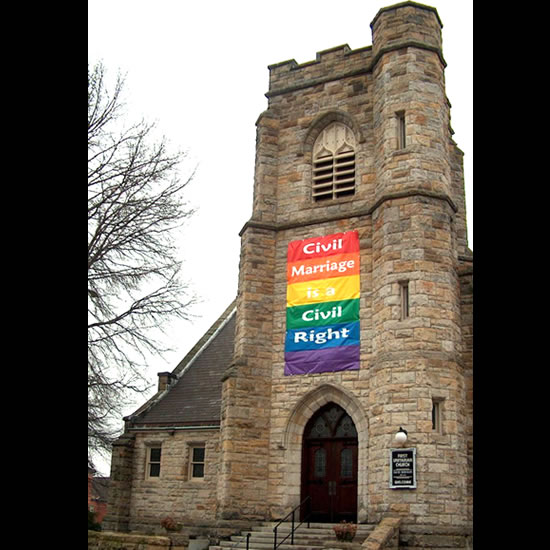
A reporter for the Pittsburgh Post-Gazette attended the event. She asked me about the conflict between the Unitarian Universalist Association and the Boy Scouts. I explained my understanding of the situation and added that that conflict at the national level has not yet hurt our relationship with local scouting groups. Needless to say, I was amazed when the article came out the next day how much focused on what I had said. I was even more amazed at how well she quoted me and represented my comments. She not only mentioned my comments on atheism extensively, but also mentioned prominently our church’s banner, “Civil Marriage is a Civil Right.” So, I was able to address both of the major issues of contention with the Boy Scouts in, I believe, a constructive way.

Of course, it remains to be seen if there will be any follow up on the article or comments from readers. I really hope that some folks will read it and try us out. I particularly hope that some teens who are questioning their religious beliefs will read it and realize that we are there as a noncreedal alternative as they search for truth and meaning in their lives. I know that as a teenager, I would have loved to know an adult I could talk to on these issues.

Atheism and the Destruction of Religion

I recently listened to the latest podcast of the Institute for Humanist Studies’ Network News. Noteworthy were several brief interviews with the notable “New Atheists,” such as Richard Dawkins, Daniel Dennett, and Sam Harris (http://humaniststudies.org/podcast/). The broadcast focused on comments made by Sam Harris at the Atheist Alliance International annual conference in September, where he told the crowd that they should not identify with the atheist label.

The rationale was perfectly logical (and frankly not a new argument), and reflected my own thoughts about the term for many years. “Atheist” as a word carries an immensely negative connotation, and is really not a particularly valuable label. As Harris pointed out, atheism is not a world view, as is a belief in rationality. Atheism is simply a rejection of an unsubstantiated notion.

What troubled me, however, was not the comments made in response to this argument, but rather a question asked of all three figures and their answers. The interviewer asked whether atheists should pursue the reform of religion or its destruction. Now, obviously, as someone pursuing the life of a minister, the question is at best problematic. My more visceral reaction, though, is one of offense at its simple mindedness and nastiness. My reasons for such a reaction are these:

  1. Contemplating the destruction of organized religion is a waste of time, given that billions of people on this planet support the concept and many of them are willing to kill themselves and others to defend it. As a long-term evolutionary goal of human society, perhaps I would be willing to consider the idea, but it’s priority would lag far behind a multitude of more pressing human needs.
  2. Simply discussing the desire to eliminate religion as a “yes/no” question ignores the many positive contributions of religion. One might just as logically argue for the elimination of all government because some politicians are corrupt, all families because of instances of abuse or divorce, and all other forms of human interaction and organization because they produce some negative as well as positive outcomes.
  3. The question assumes that atheism and organized religion are mutually exclusive (an assumption which all three of the speakers appeared to share). This assumption is unwarranted even under the current dominant paradigm of our modern view of the cosmos. There are at least hundreds of thousands of American atheists (many Unitarian Universalists, for instance) who belong to and participate regularly in churches, fellowships, societies, etc.
  4. The assumption is particularly erroneous if one is open to new quantum views of the universe, in which one acknowledges that many fields and forces exist that we do not yet understand, cannot yet quantify, and may well have wide ranging effects on our lives in biological and perhaps spiritual ways (however one chooses to define the term).

Obviously, I have no desire to take on these giants of the movement, who are far more adept at verbal repartee and public debate. I do, however, think it matters when public figures present their views in a cavalier manner that divides potential members of a movement. Atheism has faced this problem for decades, as have humanists. I find this paradox fascinating, given that two billion people are comfortable labeling themselves Christian and another 1.5 billion are comfortable with the term Muslim. Until atheists and humanists even come close to 1% of any nation’s populations, how can they ever hope to become the dominant paradigm of thought?

Pizza Polytheism

Pizza in Pittsburgh resembles American politics. You can love Mineo’s and hate Vincent’s. You can love Vincent’s and hate Mineo’s. Or you can love one of the multitude of third party candidates who have no chance of ever getting more than a percent or two of the popular vote.

Personally ironic is that I love it as a metaphor, but am wholly monotheistic when it comes to pizza. I not only worship at the altar that is Mineo’s, but I am a zealous member of the thick crust double-cheese sect. In 30+ years of eating Mineo’s pizza, I am not sure if I have ever even tried any of their other varieties. I suppose one might consider my culinary tastes boring, if not downright dogmatic. I prefer to think of myself as pious (and no, I’m really not trying for an awful pun).

However, since I have adopted the pizzatorium as a reflective metaphor, I find myself straying ever so slightly from the fold. After all, I risk being hypocritical if I preach the value of diversity in pizza only to adhere to a rigid creed in my own dining.

So, at the invitation of a friend, I tried not only a different type of pizza, but a different brand – a double heresy. We went up the street from Mineo’s to Aiello’s and had a pizza with pepperoni, pineapple, and green pepper. This combination would have revolted me perhaps only a year ago. But, you can be surprised by the directions your spiritual quest can take you.

Now, I’ll have to admit that the meal was supplemented by several hours of delightful conversation, which always enhances digestion. That said, the pizza was not bad (it also helped that I had just worked out and was starving). They used canned pineapple, which I love, but not necessarily baked in a pizza. Otherwise the flavorful blend was tasty and spicy.

I suppose that I could now be tempted to engage in a global quest for pizza perfection. But, my pizzatorium is not about seeking out variety for the sake of variety. Frankly, the primary value of the experience was the invitation to try something new and sharing that communion with a friend. That is the real spirit of my muse kennel and pizzatorium.

Do you have a favorite pizza? If so, then the next time you feel inclined to partake, invite a friend to commune with you and experience it together. Perhaps the world is not ready for “Peace Through Pizza,” but I can imagine a broad ecumenically Epicurean approach to bridging the gaps between people and even societies.

Braaaaiiiins!

After about nine straight months, I finally took a Sunday off from church work (well, at least until 5:00 p.m., when I met with our Director of Religious Education about our upcoming intergenerational Thanksgiving service). Why am I still tired Monday morning? Because I spent much of the weekend at the Pittsburgh Zombie Fest! In the picture from the front page of this morning’s Pittsburgh Post-Gazette, you can just barely see my arm holding up my shillelagh in the lower right corner.

Pittsburgh is the undisputed zombie capitol of the world. Since the filming of Night of the Living Dead back in 1968, Pittsburgh has been famous for great football, being named America’s Most Livable City (twice!), and zombies. Last year, the Sunday morning Zombie Walk in 2007 attracted 894 shamblers, setting a Guinness Book of World Records mark (that was actually published in the 2008 edition). Other cities have tried to break our mark over the past year, most recently including Orlando and London. But, no one came close. Yesterday’s Zombie Walk smashed our own record, attracting 1,124 of the living dead to Monroeville Mall, site of the filming of George A. Romero’s Dawn of the Dead.

Aside from now being part of a world record, I am so proud of everyone involved in this event, and am delighted to call them friends. For the most part, the entire weekend was planned and executed by a dedicated group of fans (called the Lifeless on the bulletin board of The It’s Alive Show broadcast locally on WBGN here in Pittsburgh). The Lifeless consist of an enormously friendly and talented group of folks who come together out of their love of horror movies. We call ourselves the Lifeless because, instead of going out on Saturday nights, we stay at home and watch The It’s Alive Show. In addition, the Zombie Fest hosted a number of charity opportunities, from collecting donations to the Greater Pittsburgh Community Food Bank and Central Blood Bank (of course), a charity auction that raised over $1,000 for Komen for the Cure (breast cancer research), and a booth for the Animal Rescue League of Western Pennsylvania.

(I am just under the front of the banner with my left hand holding up the bottom right center)

At the Zombie Ball Saturday night, people from older teens to folks in their sixties came together talking and admiring their costumes. We listened to the music of the Ubangis, the Forbidden 5, the Motorpsychos, and Deathmobile, knowing that music is a universal language that speaks to all ages (even punk and metal). In fact, I would argue that “garage” sounds have a visceral appeal that can appeal to a level we all share (but that is a subject for another posting).

There are many communities that make up our lives. I think all of them have what one might call a “religious” component to them. Our church community obviously represents a gathering with a substantially religious purpose. But, I think even communities like our Lifeless serve a fundamentally religious purpose in our lives. They help bring together diverse people over areas of common interest. They help focus our energies on issues of importance while having a good time in a spirit of fellowship. They provide support for participants in times of stress and turmoil (one of the great benefits of the Internet when people are geographically dispersed). And, they offer opportunities for people to come together and express themselves openly in an atmosphere that is welcoming and respectful.

Irreverent (but Respectful of Boundaries)

Certain words delight me. They find their way into my speech and writing, partly because they have deep meaning. But, they also usually possess something interesting as words in either a visual or auditory sense. For instance, I love the word “paradigm.” Ever since I read Joel Barker’s book on the subject years ago, the concept (and that silent ‘g’) have given me immense joy.

I was reminded of another delightful word recently. In closing an email, a friend signed off with “Yes at times irreverent, but respectful of boundaries.” What an absolutely wonderful expression! Of course, now that I travel the path toward a life of ministry, the word “irreverent” has new meaning. How exactly does a minister act irreverently? Can a “reverend” be irreverent?

Well, I certainly intend to explore irreverence as a “reverend” in my ministry. For one, I strongly encourage people to challenge assumptions in their lives and to facilitate paradigm shifts. My most commonly asked question is “Why?” Why do we follow certain rules and behave in certain ways? And, please, never expect me to accept as a valid answer, “Because we have always done it that way,” unless you are able to substantiate the tradition with detailed justification.

Another favorite form of irreverence is humor, particularly satire. My ministry is as informed by the “sermons” of George Carlin as it is by any theologian past or present. Humor gives us permission to lower our guard, so that we can examine ourselves safely and with an open spirit. The act of laughing relaxes our bodies and eases tensions that might make us less open to insight and sharing.

Perhaps my favorite form of irreverence is the use of popular culture as religious metaphor. I frequently infuse imagery from movies, television, and so-called “lower” art forms into my sermons. This summer, I delivered a sermon on the Gospel According to Ed Wood, and I am currently writing a paper on Themes of Religious Humanism in the films of George A. Romero. If someone had not already written them, I would have composed religious education curricula on the Simpsons, Star Trek, and Dr. Seuss.

Irreverence, however, should be wielded with a substantial degree of precision. Like any tool in the arsenal of the minister, irreverence can hammer a point home, or smash its intended target indiscriminately. Sometimes, paradigms exist for legitimate reasons. Sometimes, making light of a topic is simply not appropriate. And, sometimes, we need to appeal to a “higher” state of intellect, emotion, and being to achieve a desired affect. So, I shall strive to always maintain a healthy irreverence, while remaining mindful and respectful of boundaries.

New Orleans Trip: Afterword

The past week seemed to be immensely rewarding for each of the participants. It is hard to assess the impact one short week of effort by our little group had on this city still recovering two years later from the trauma of Katrina. In some ways, our presence alone appeared to have as significant an effect on the residents as did the weeds we pulled, the nails we hammered, or the food we sorted. And, even though we paid Hands On New Orleans for room and board for the week, we brought to the trip additional financial resources by purchasing a good deal of food, drink, and souvenirs, and through charitable donations.

For me, the experience was an interesting contrast of the close quarters and strenuous effort for six days among adults with my many past weekends spent at weekend district youth conferences. As the week progressed, we learned a good deal about each other and many friendships developed. We spent much time in the common lounge area at Hands On talking and sharing. At the same time, the living quarters presented unfamiliar challenges that created moments of modest tension. Living in bunk beds in a room with 8 to 16 people, and sleeping in the Southern heat and humidity, fosters forces that bind folks together in shared intimate exploit, but also produces strains that accentuate the differences that can separate us.


A lesson that this week strongly reinforced for me was the importance of assuming the good intention of others. Affirming and promotion the inherent worth and dignity of every person entails an appreciation of the very different personalities we all possess. When these personalities clash, we can avail ourselves of many tools to resolve conflicts and reunite in common purpose – a caring thought, humor, a gentle touch or a hug. But, most important, I believe, is the discipline of walking in another’s shoes just long enough to see the world from their perspective, and hopefully understanding the influences that produced the person as they are today. Just a moment of reflection can help all of us see the basic goodness that lies in each person.

Living in a human society, our lives intersect which each other on a daily basis. At school, at work, and at church, our interactions can create moments of shared joy and wonder. But, crossing paths can also generate friction. When that happens, before we look for the hurtful cause, or the evil in another, it helps to first assume the good intention of others. Finding the good in others may also help us intensify the good within ourselves.

New Orleans Trip: Friday

This was our last work day here in NOLA (New Orleans, La.). Most of the job sites were repeats, including the Live Oak School, Project Lazarus, and the various construction projects. I spent my last day back at Ms. Evelyn’s house pulling down plaster and lath. We got the huge timber installed under the sagging corner of the house, so our crew chief was excited.

I do not consider myself a gourmet by any means. In fact, I am really not all that discriminating an eater at all. But, there are some foods that turn me into that drooling vision of Homer Simpson. We ate lunch at Cafe Reconcile again, and today I had the Shrimp Creole, Crawfish Bisque, and chicory coffee. New Orleans deserves to be restored to its original condition if for absolutely no other reason, meals like this.

Tonight, I walked a few miles along St. Charles Avenue to the Camellia Grille. My daughter has been raving about this place for years on her visits. Again, my palate was delighted. They had a chocolate pecan pie. I told the man behind the counter that I do not order pecan pie north of the Mason-Dixon line, because we Northerners just don’t know how to make it. He assured me that I would be delighted.

I watched as he cut the slice of pie and inverted in onto the grill. Then he squirted a little butter on the grill and flipped the pie over. After placing it on the plate, he topped it with a huge scoop of vanilla ice cream. Words fail me in describing that experience.


I don’t exactly know what makes a memorable experience religious. Perhaps seeing a child’s precious stuffed animal atop moldy textbooks in a collapsed elementary school in the Lower Ninth Ward two years after Katrina is a religious experience. Perhaps every experience is religious to some small degree. I am not sure what the percentage must be in order for an experience to be truly described as religious. I think that I have reached a point where any moment in our lives that takes us beyond the normal and routine, and that stimulates our thoughts and emotions, is religious.

Because if God is the ultimate, or the combination of all experience, or the universe, or however one views the concept, then any experience that opens our senses, our hearts, or our minds to something beyond ourselves is placing us in the presence of God. Perhaps thinking of eating a chocolate pecan pie trivializes the nature of experiencing God. I certainly do not intend to do so. I am trying to say that a simple act – feeling a breeze, wading in the surf, watching the first golden rays of sunlight in the morning – can inspire awe, and put one in a state of self awareness and awareness of our connectedness with all of existence.

The potential for such an experience should exist every Sunday morning in worship services. But, we should be on the lookout for these moments all during our hectic lives. Perhaps a truly religious life is one filled with religious experience – some that are life changing epiphanies, and some that waft on the wind like a butterfly.

The UUA and Madison Avenue

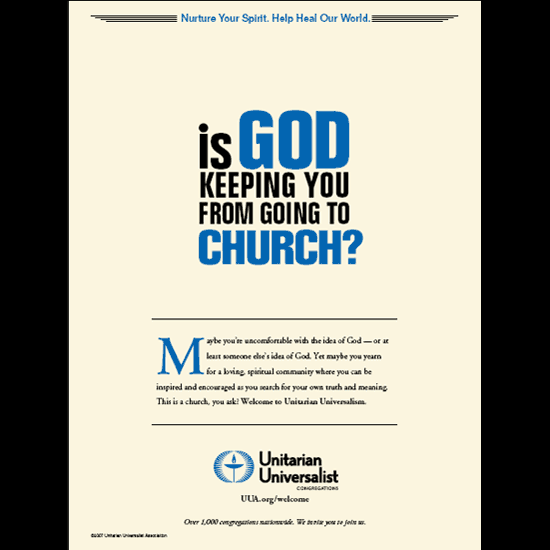
The Unitarian Universalist Association’s national advertising campaign has begun. Advertising in Time Magazine began with the October 15, 2007 issue and will continue over the next several months with placements such as this UUA print ad (also shown to the left).

According to the UUA’s press release, the Time.com Religion Pages will offer links to articles and essays authored by Unitarian Universalists on topics including: the relationship between religion and science; the role of religion in American democracy; and religion, morality, and sexuality.

I certainly applaud the goals of the campaign and believe such an effort is long overdue. Our denomination will always debate issues of the relative merits of any continental efforts and their impacts on congregational polity. But, I personally feel that the relative benefits far outweigh the potential harm.

That said, this first print ad even made me cringe just a little. “Is God keeping you from going to church?” I do understand the desire to be catchy, even controversial, in getting the reader’s attention. The ad certainly appeals to the atheistic, yet religious person within me. But, I have no doubt that many Unitarian Universalists will see this ad and explode in anger over what they will perceive as an anti-theist tone and the heavy reliance on the term “church.”

I will not be one of those criticizing the ad (do not, however, ask me what I think of the new UUA web site, grrrrr). For while I deeply respect those who might find the ad objectionable (and I have no doubt that conversations will continue for many weeks), I will suggest that nearly any attempt to attract broad public interest in Unitarian Universalism in eight words will displease many dedicated UU’s. The reality, however, is that we certainly will never get the millions of readers of Time magazine to read Channing’s Baltimore Sermon or Ballou’s “Treatise on Atonement.” Even the text of the seven principles is too long for the average modern attention span. I do not see this as sufficient reason not to produce such a campaign.

We are a tiny denomination – a soft voice amidst a cacophony of shrill shouts. And yet, we have evidence that many people share our religious philosophy, but are simply unaware that we exist. I see no harm in helping people learn that we are here and that we welcome them with open arms; in fact I believe we have a duty to make our presence known. I see no way to make this omelet without breaking eggs.

The key, in my opinion, is to assess the materials and calmly reflect before reacting one way or the other. Then, encourage discussion in your church, congregation, fellowship, society about the issues. Most importantly, now is the time that we should all pay extremely close attention to our visitors. For while we may take issue with this campaign or its specific contents, the result may be to bring people through our doors asking that question that so many of us have asked — “Where have you people been all my life?”