Illusions in America Today #6

In the past day, I read two articles that characterize the state of health in our country today. One was an opinion letter from a doctor decrying schemes of socialized medicine that guarantee health care only by destroying the rights of physicians, hospitals and insurance companies. Another was a blog posting from discontinuous permafrost about toxic chemicals in common plastic bottles. If you are like me, you are so thoroughly sick of hearing about how everything in our lives causes some debilitating disease, that you do not even pay attention anymore. Unfortunately, that is exactly the reaction people who crave wealth at your expense hope for.

In America today, there are dedicated people who genuinely care about making your world healthier and safer for you and future generations. But, for every one of them, there is someone else who could not care less about your well being and whose number one priority is reporting the maximum possible quarterly profits for his or her corporation. And, for every one of them, there are hundreds of investors (including you and me if we have money in stock-based retirement plans) who want to get the biggest bang from their hard-earned investment dollar. Who wins? I think it is easy to see that the driving force of the American economy will win out over inconvenience, environmental degradation, and potential health risks most of the time.

You may be thinking, but what can I do? I am one person, and I do not have the time or energy to keep up with this mountain of threats. I am one person, so my little boycott or letter to a company cannot possibly make a difference. I am one person, so what can my $100 donation to the Sierra Club accomplish up against billion dollar corporations. And, you would be right. By yourself, there is little you can do. American citizens, lacking a comprehensive and purpose-driven structure, can do little but ride the waves of special interests who wield the power in this country.

But, as intentional communities, there is much that people can do. If we organize ourselves into neighborhoods that share the burden and act collectively, we could make a difference. At first, we would merely set an example for others to emulate. But, in time, hundreds of such communities, working together to make ethical choices, investing only in products that meet stringent codes of health and safety, and ensuring that everyone has fair access to health care, could make a difference.

Perhaps I am innocent…even naive about the way the world works. But, it seems to me that if even one child dies today because health care was not available to help them, then as a society we have failed. If one person develops cancer because of a toxin in plastic bottles who only purpose was to shave 1/10 of a cent off the cost of production, then as a society we have failed. The rights of doctors and the rights of patients are not mutually exclusive. The earning of fair profits and maintaining the health of our citizens are not mutually exclusive goals. But, it will take a new American Revolution if we the people are to reclaim this nation from those who do not share our goals of life, liberty, and the pursuit of happiness.
New Orleans Trip: Wednesday

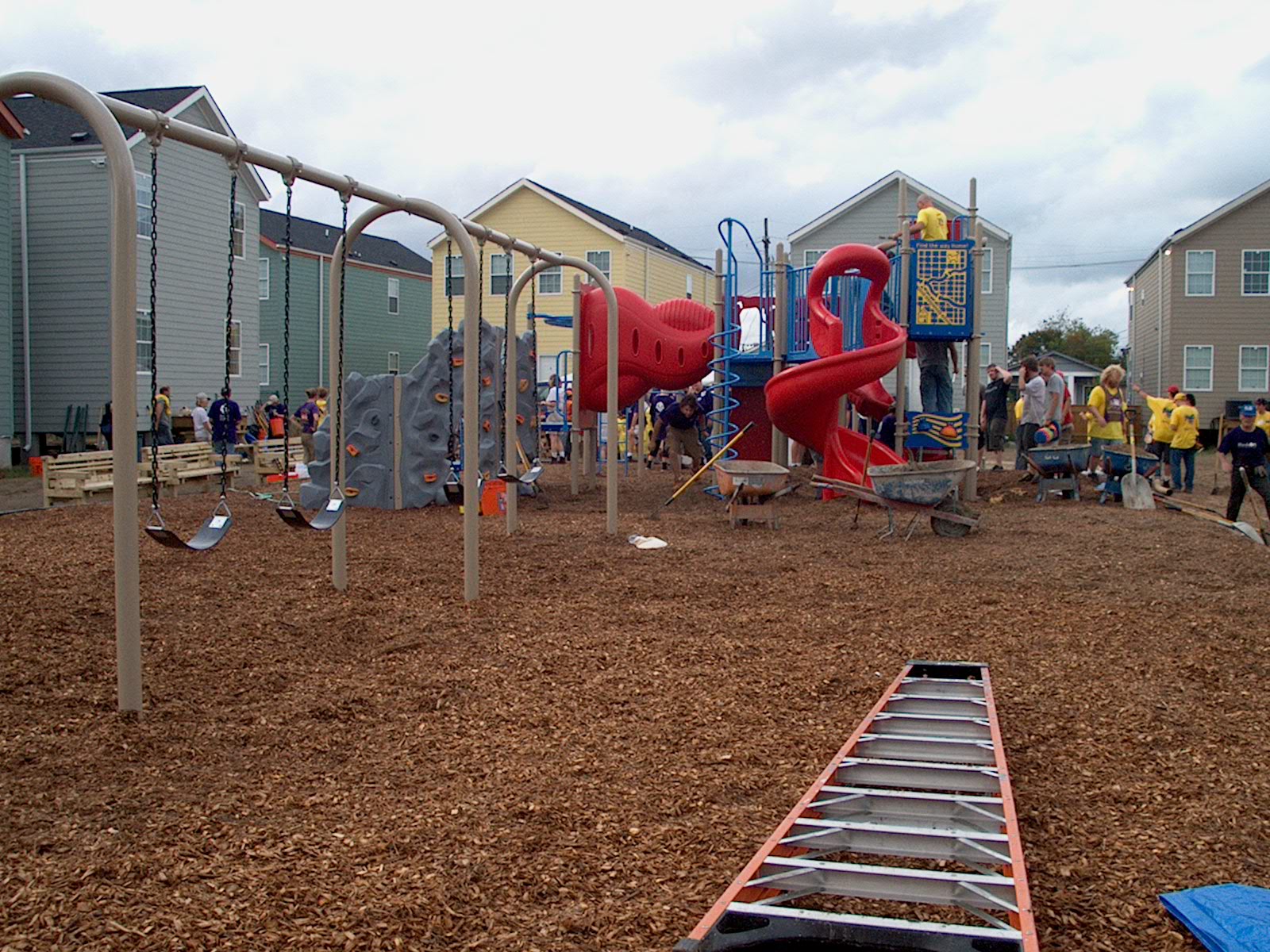
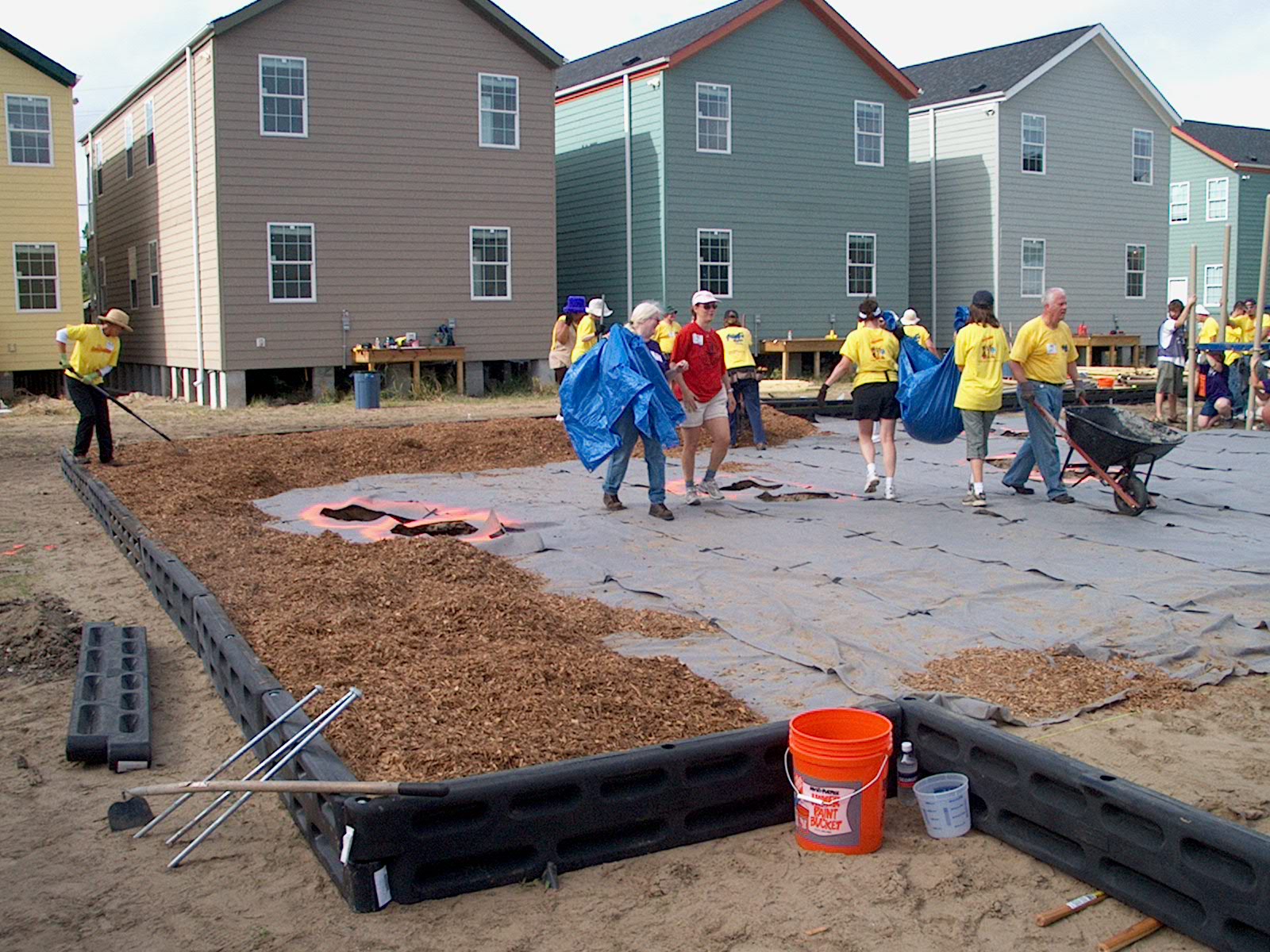
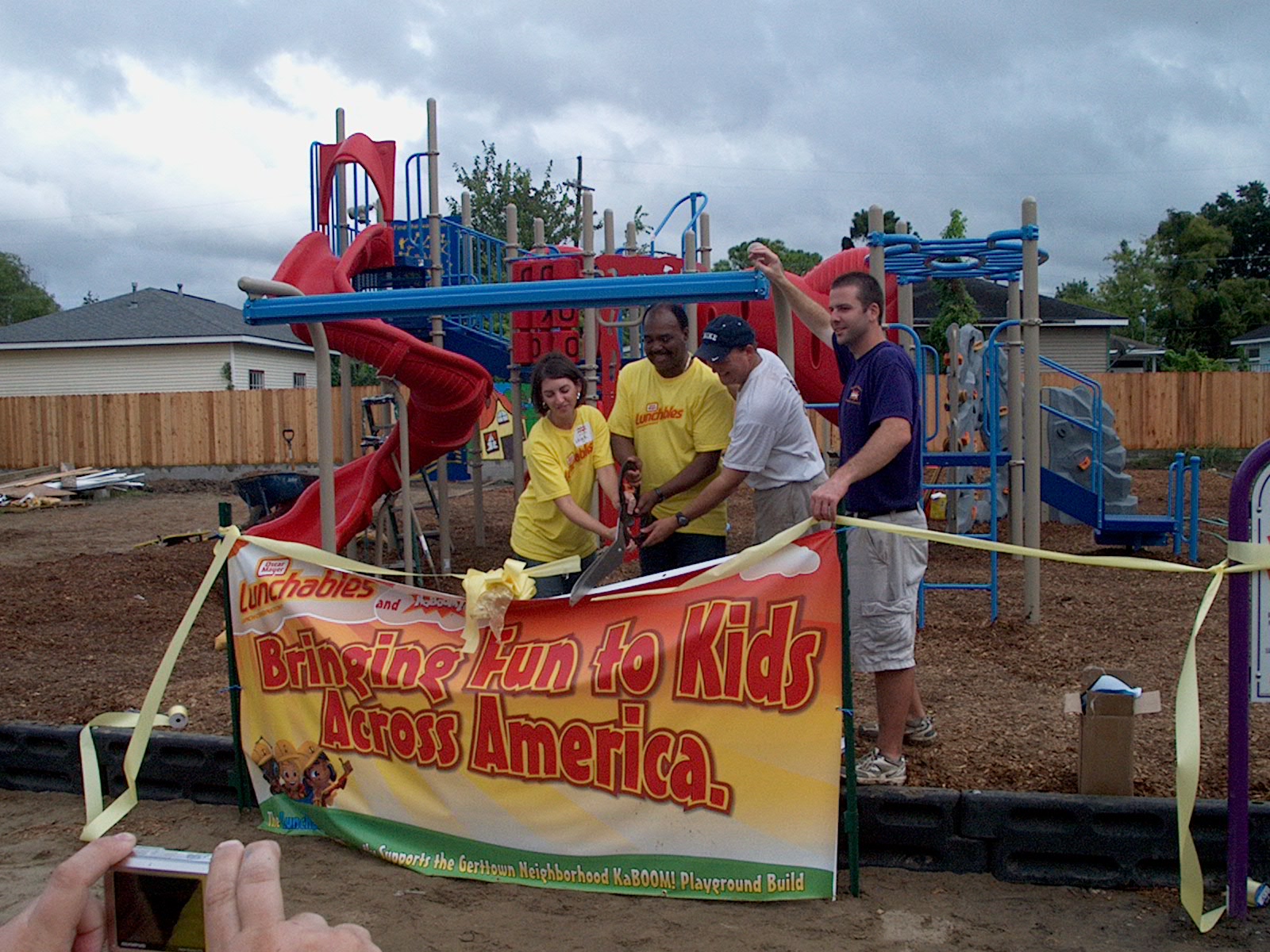
Today was KaBOOM day! Almost all of the Pittsburgh Unitarian Universalist volunteers and friends went to a nearby neighborhood to build a playground (a couple of other folks worked with Greenlight New Orleans, changing light bulbs in homes to bulbs that are more efficient and environmentally sound). We were joined by other volunteers in town and a number of Americorps young adults for a total of 75-100 folks. After breaking up into work groups, we built a wide range of playground apparatus (apparati?), built picnic tables and benches, painted a mural, and moved 180 cubic yards of mulch into the playground area.

KaBOOM is an interesting organization, whose goal is to build great places to play within walking distance of every child. They have built more than 1,300 to date and ours was the 64th built in the Gulf Coast region post-Katrina. The Louisiana Freedmen Develeopment Corporation and Lunchables (which is interesting because we did not receive a lunchables snack for lunch). Coordinating this wide range of activities without any sense of the skill levels of the volunteers is enormously challenging. The process was definitely aided by the pre-training of team leaders (which took place on Monday), who coordinated the many assignments.

It threatened rain all day, and held off until just near the end of the build. But, it lasted only 15 minutes or so, allowing much of the rest of the work to be finished and the ribbon cutting ceremony to take place around 3:15. There were a number of little ones anxious to start playing, but they had to be kept off until the concrete footers dry. The final project included two slides, swings, a rock climbing wall and several hanging bars.

The setting was very logical, with about one dozen new duplexes sharing a back lot in which the playground was located. It is an excellent model for creating neighborhoods and safe places for kids to play.

This heat and humidity are starting to wear my Northerner body down. A couple of times, we have had short rains followed by sun that turned the area into a sauna. I’m not sure I would ever get used to this climate. They are calling for a high of 89 tomorrow (yikes) with more chance of rain.

You Are a New Orleanian

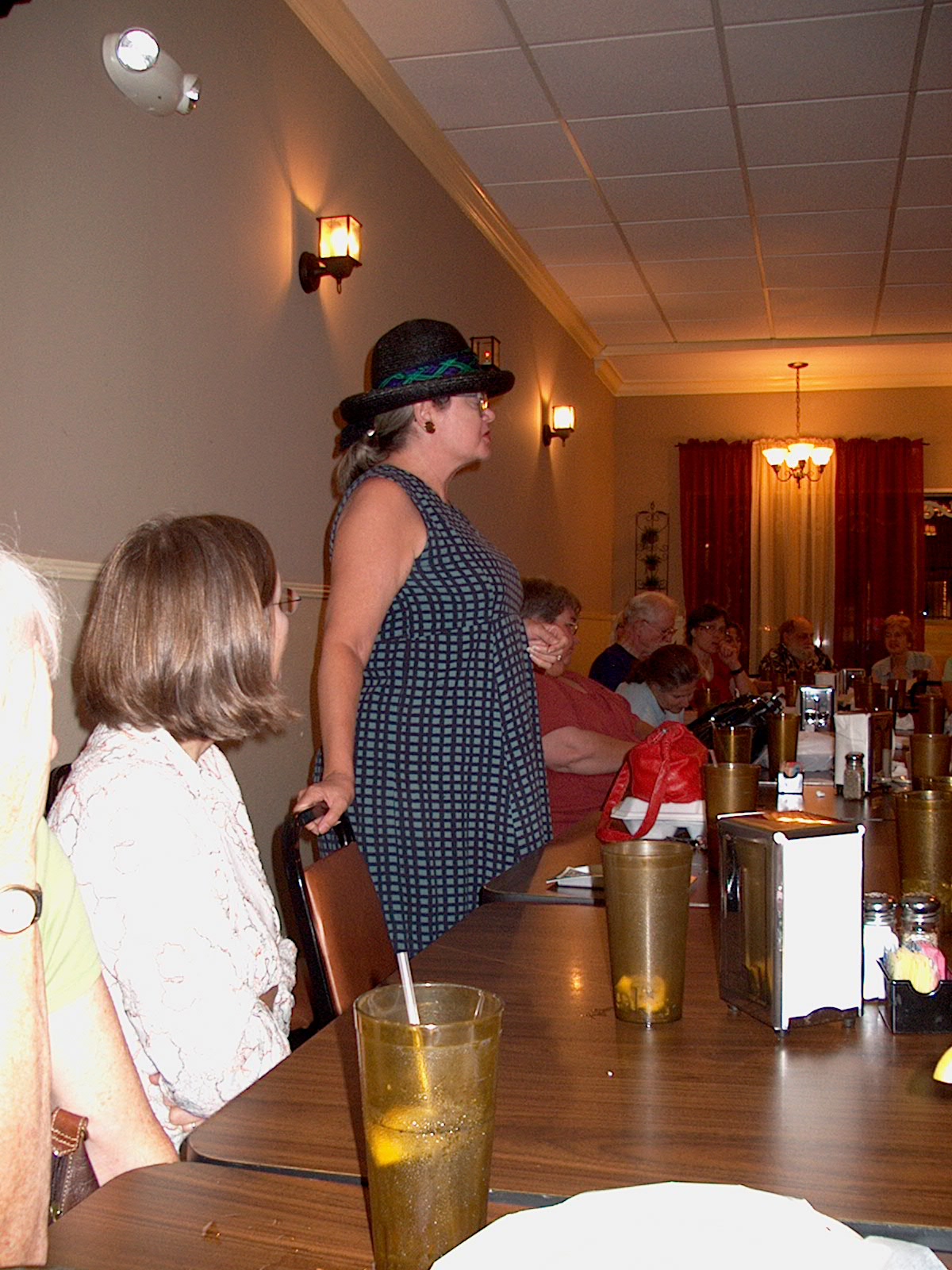
Tonight, many of the volunteers from Pittsburgh met some of the members of the First Unitarian Universalist Church of New Orleans for dinner. In addition to the fellowship and sharing, we had a presentation by one of the church members on race and class issues and Katrina. Of course, race and class remain (unfortunately) significant factors in the lives and well-being of Americans, which is perhaps no were more apparent than in aftermath of the Katrina tragedy. For instance, the Gulf Coast Housing Recovery Act currently in Congress lays out the deliberate racist and classist actions of people in authority at the time to shut down quality public housing sites and evict existing tenants after the disaster largely to replace public housing with higher cost housing. Ironically, one of the chief opponents of the bill is Louisiana senator David Vitter. We were urged to join the campaign contacting Senator Vitter’s office to ask that he stop his efforts to block the bill.

Reverend Melanie Morel-Ensminger of First UU Church also spoke in response to a question of how we should respond when people ask why New Orleans should be rebuilt given its geographical location and the danger of another devastating storm in the future. Reverend Morel-Ensminger replied that people would not ask this question if San Francisco needed rebuilding, even though it lies on a fault line. She said that people did not ask whether the cities on the Mississippi River flood plain should be rebuilt, even though the flooding of several years ago may well occur again. These questions would not be asked because, in this case, the vast majority of victims were people of color, the poor, and often both.

“You are a New Orleanian,” she told us, if you love jazz music, red beans and rice, and the other cultural contributions of New Orleans. You are a New Orleanian if the federal government controls a dam, or bridge, or other piece of critical infrastructure whose failure could cost you your home. She expressed the hope that no one ever experience the displacement and discrimination that many New Orleanians have faced, especially now that in just weeks, FEMA will be shutting down trailer camps, yet again putting low income people on the streets.

You are a New Orleanian if you believe in justice and that our government should protect our rights as home owners and citizens against the legions of the greedy, the narrow minded, and the uncaring. “We don’t want your pity,” she said. What New Orleanians want is for us to join with them in the fight for justice for all and in recognition of our common desire to live lives of freedom and dignity.

New Orleans Trip: Tuesday

Today, most of the volunteers went to the New Orleans Food Bank. A few returned to the Animal Shelter and some returned to the Lazarus Project working with AIDS patients. Also, the two construction crews at Ms. Evelyn’s and Ms. Severe’s houses returned to their sites.

I went back to Ms. Evelyn’s house today. Some of us helped jack up a corner of the house that was sinking. I worked on exploring the possibility of stripping the paint from the baseboards and doors, in order to restore them to their original condition. This is a long-term job, since there is a huge amount of woodwork to be repaired in the home. Once we can set up the best techniques, then the crew leader can direct future volunteers more effectively.

This brings up an interesting situation with this organization. All of the staff and leaders are young adults, many working through Americorps, and probably all in their 20’s. Few of them have extensive construction experience, but they have an unbridled passion to do a good job restoring these homes.

Dallas, our crew chief, is from Portland, Maine. He has a fiction writing degree from Colorado and is an energetic and idealistic young man. He badly wants to not just return Ms. Evelyn to a house, but restore her home to as close to its original condition as possible. Of course, we are doing this with little money, but a lot of labor. So, there are times when we volunteers have suggested want seem to be logical ideas and shortcuts. But, Dallas is undeterred.

The point is that, whoever is right is not important. What matters is that this young man and the dozen or so other young people leading these projects are learning vital skills while performing valuable public services. This experience will make them even more amazing people who I am sure will contribute immensely to society. So, whether they make the decision we older and perhaps more experienced adults would make is less important than the fact that we respect their authority and give our best efforts to help them achieve their goals for their projects.

So, coming to New Orleans is about directly helping victims of Hurricane Katrina and its aftermath. It is also about training the next generation of citizens in leadership and giving them the confidence to strive for their dreams.

Another important aspect of our trip to New Orleans is infusing our energy and our financial resources into the community. Several of us have reported conversations with local residents thanking us just for being here. Today, our crew ate lunch at Cafe Reconcile, an absolutely fascinating organization in Center City. This five-story building currently is a restaurant where young people learn all of the skills of the hospitality business. In time, the upper floors will be developed into a banquet hall, classrooms, space for entrepreneurial enterprises, and short-term housing for students. The food was amazing – collards, okra, pork chops, crawfish bisque, among other things.

Tomorrow, everyone will be going to the Ka-Boom playground site.

Lower Ninth

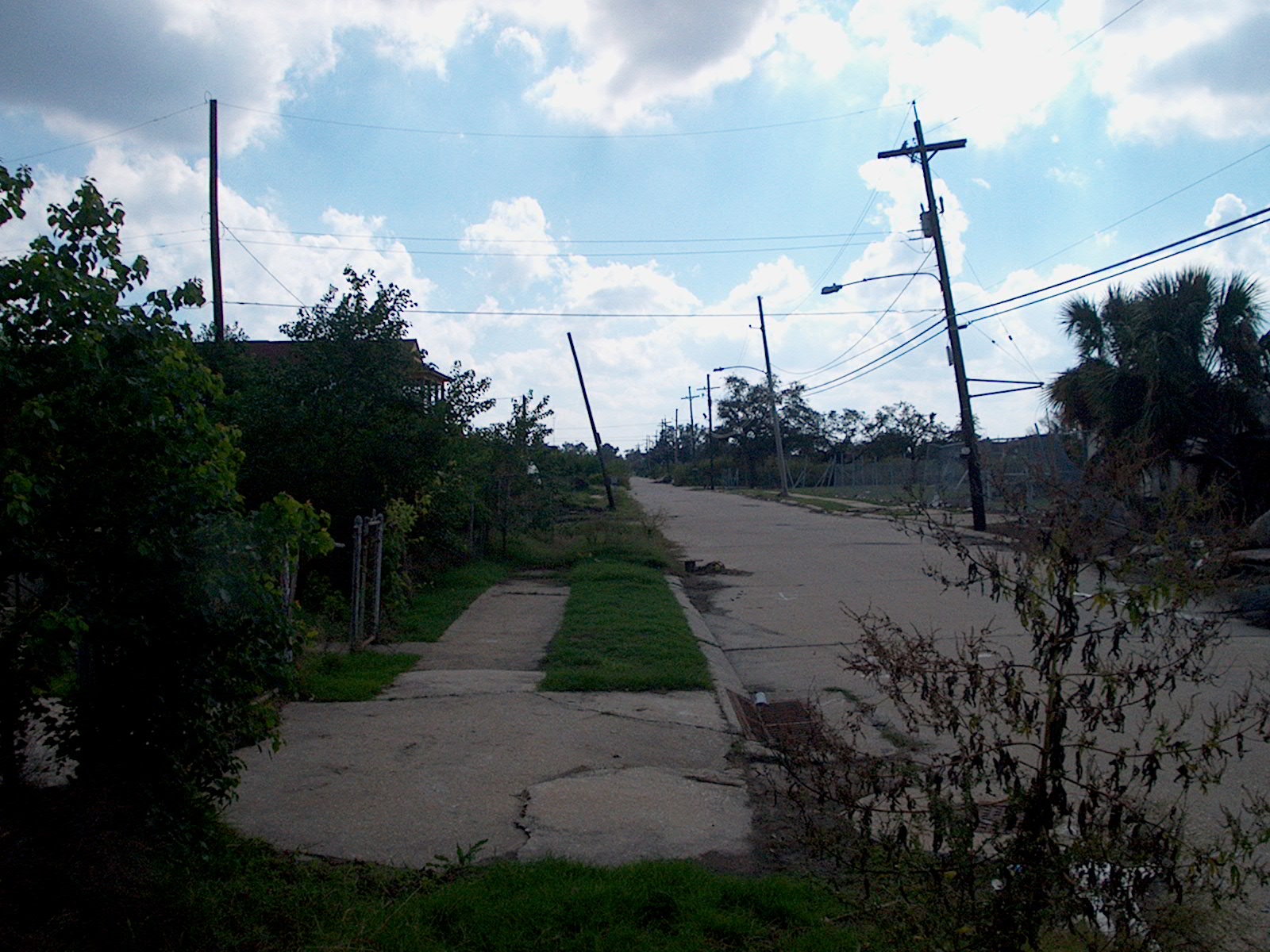
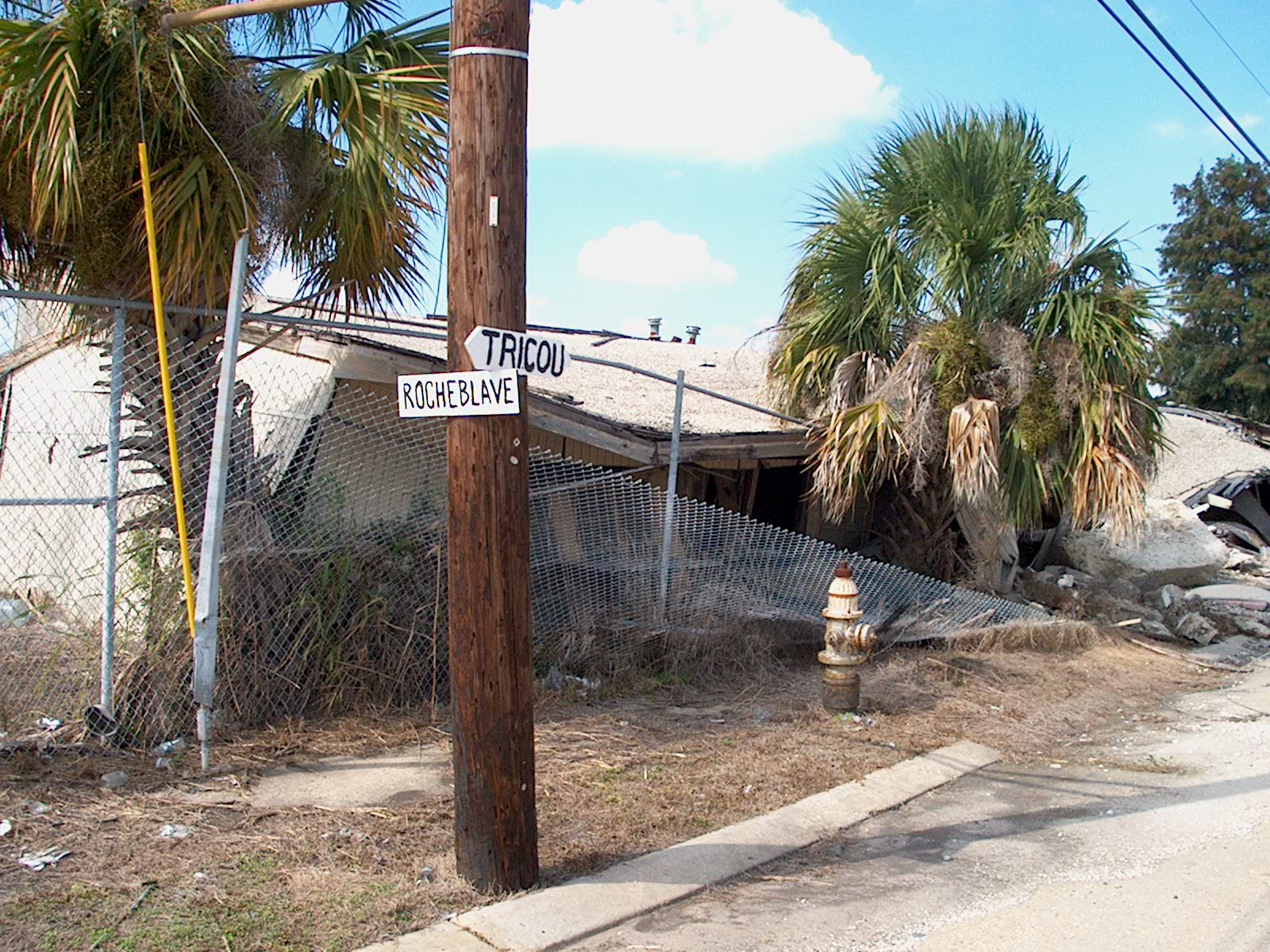
The experience of driving through the Lower Ninth Ward in New Orleans yesterday was a sobering one, and many of those in our group were deeply moved. To see what was left of a thriving neighborhood two years after Hurricane Katrina leaves one little hope that this community will ever be reborn again. With their apparent lack of power, and the interests that would like to see the Lower Ninth become an oil refinery or some developer’s tax shelter, these people seem to have few advocates to regain the home they once had.

Ironically, the Sunday Times-Picayune carried a New York Times article titled, “Black women face tough choice in Demo primary.” If you are a member of a privileged class in America, the article makes for interesting reading. The reporter interviewed African American women in a South Carolina beauty parlor on their views toward Barack Obama and Hillary Clinton.

“I’ve got enough black in me to want somebody black to be our president…but I want to be real, too…I fear that they just would kill him, that he wouldn’t even have a chance,” said Miss Clara, owner of the shop. One way to protect him, she suggested, would be not to vote for him. Black voters have noted that Obama was given Secret Service protection earlier than any presidential candidate except Hillary Clinton, who already had protection as a former president’s wife. After seeing the desolation of the Lower Ninth, and countless other examples in American history when the rights of African Americans have been pummeled into the ground, I can easily imagine why Miss Clara might feel protective of Obama.

One can hope that such fears are unfounded and we can all do more to work to improve our society so that the best candidate is elected to the presidency. After all, as one customer of Carries’ Magic Touch said, she would probably vote for Obama despite her fears for his safety. “Things happened with presidents in the past, and they weren’t African Americans.” Maybe if our nation honored this kind of bravery as much as that displayed on the battle field, then the people of the Lower Ninth and similar communities across the country might have one more small reason for hope in the future

New Orleans Trip: Sunday


Today is our first full day at Hands On New Orleans. It is a rest day, so after breakfast we all headed over to the First Unitarian Universalist Church of New Orleans. FUUNO is a beautiful facility that suffered from four feet of flooding during Hurricane Katrina and sustained substantial damage. But, the church has bounced back and is now beginning a major capital campaign in concert with two other area UU churches. I had one amusing moment. During the service, I noticed that my hymnal had a large circular imprint on the front cover. Later, I saw the following inscription on the inside front cover. “This hymnal was used to put out an ‘out of control’ chalice flame Easter Sunday, April 16, 2006.” No deep meaning, but it seems somehow appropriate.

After church we returned to “base camp” for lunch and our first community meeting led by the Hands On coordinator Stefanie. There are several jobs we will be working on this week including: construction on two houses; building a community playground through an organization called Ka Boom; helping the Animal Rescue Shelter of New Orleans (the only ‘no-kill’ shelter in the city); Project Lazarus, which helps AIDS patients; and doing outdoor cleanup and planting work with Groundwork: New Orleans.

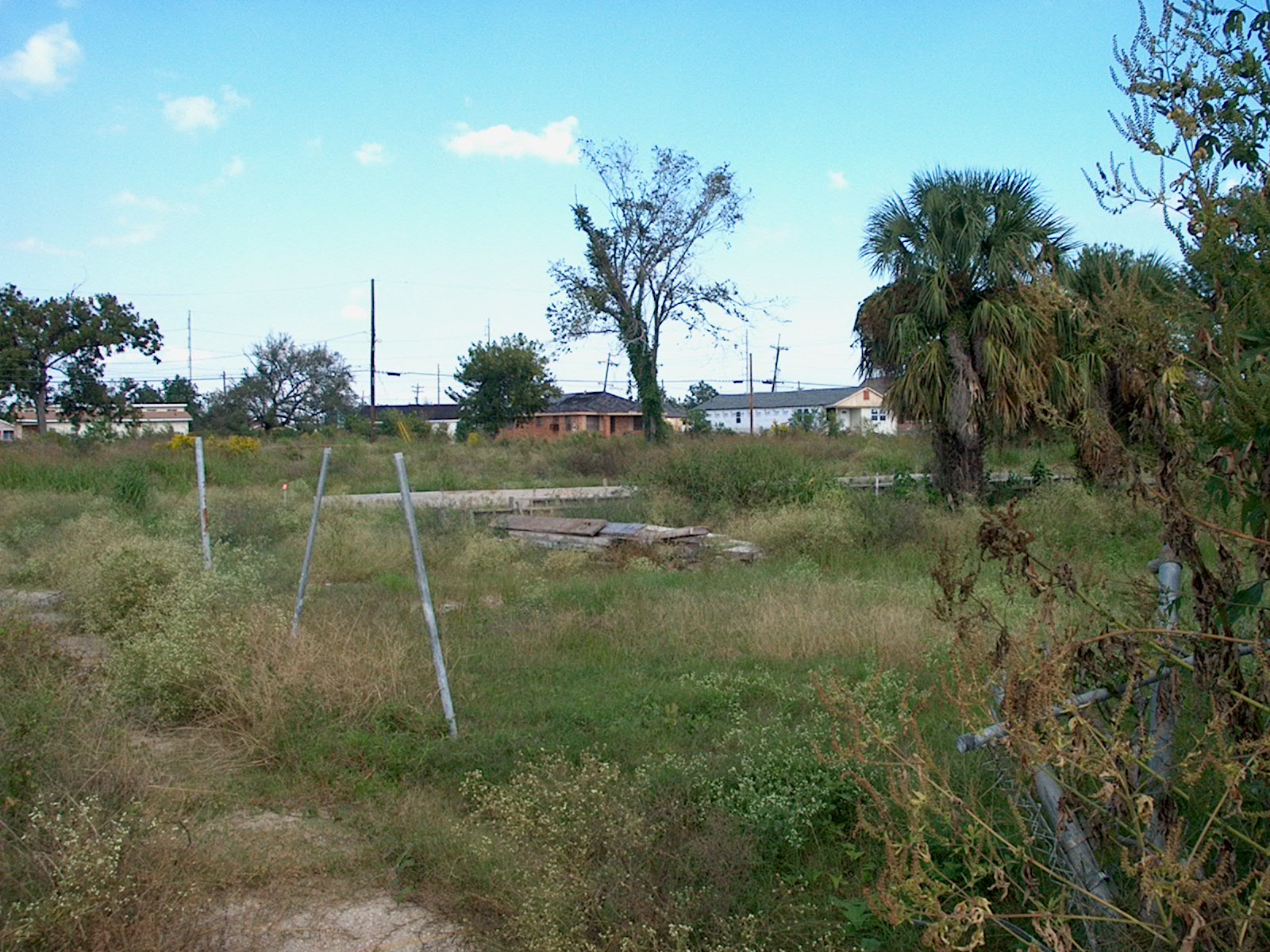
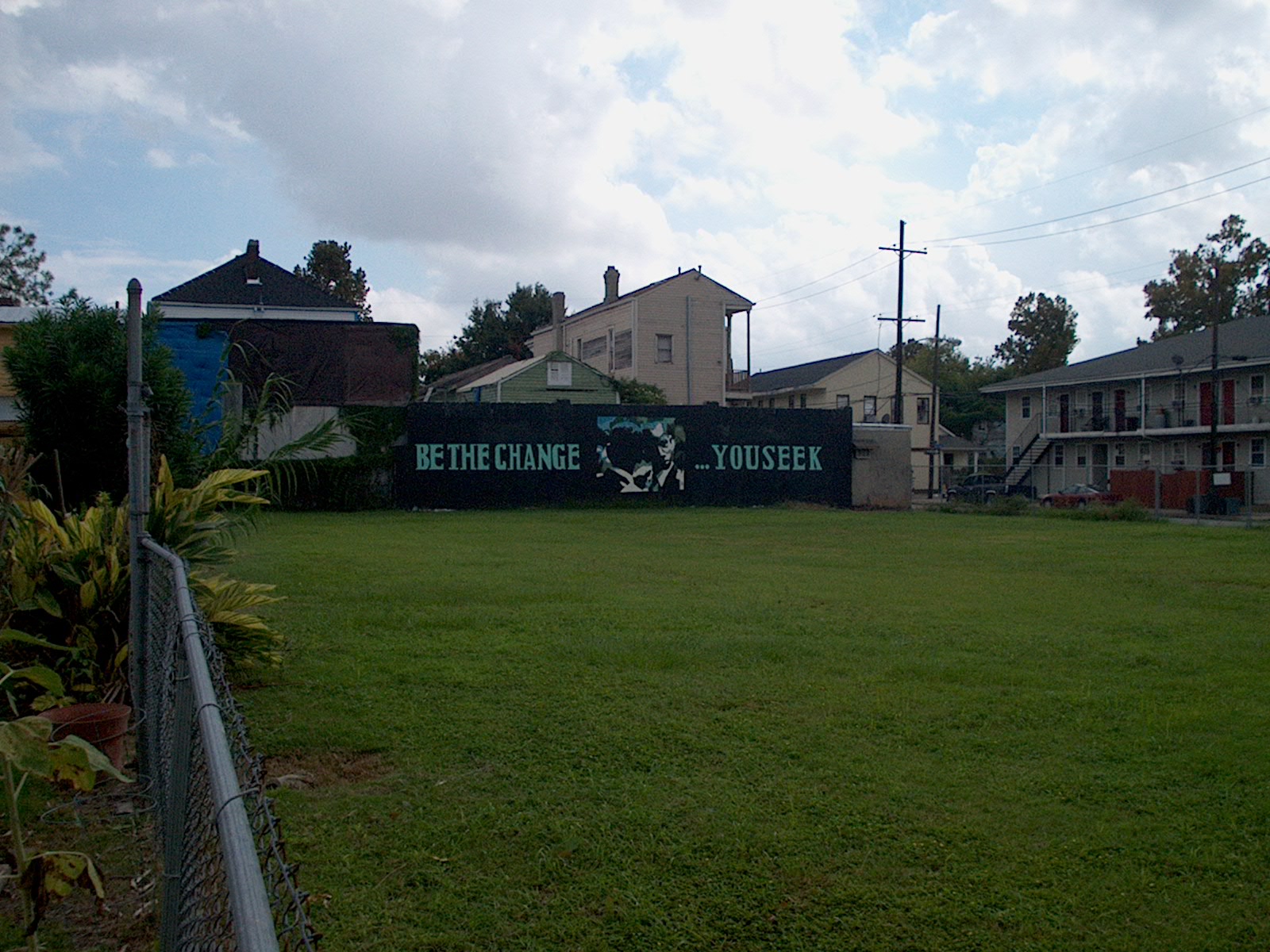
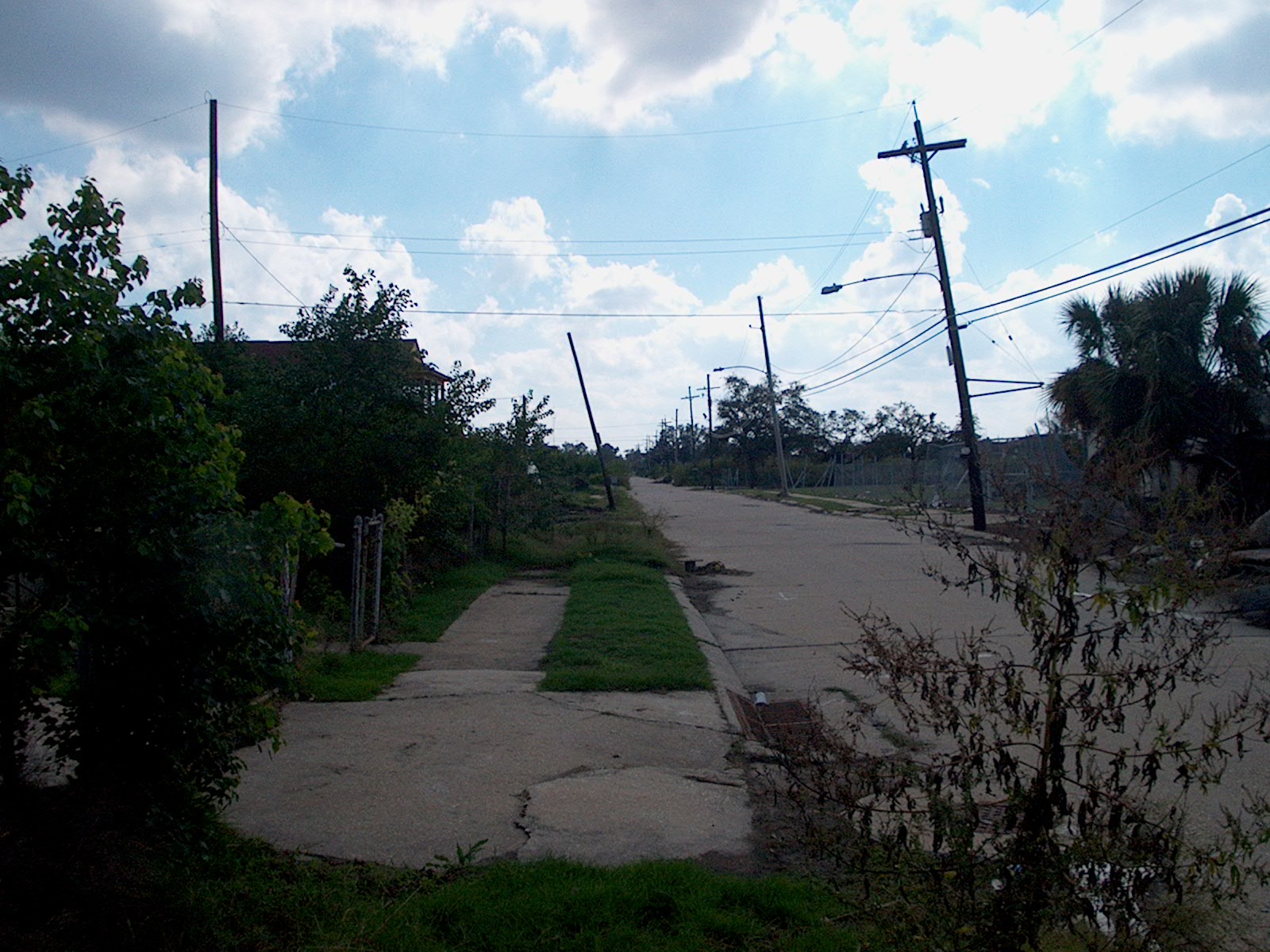
After lunch, we piled in the vans to take a tour of the city, especially the most affected areas. The tour consisted of many pages of text carefully prepared by First Church. Eventually, we drove into the Lower Ninth Ward. Watching all of the documentaries did not really prepare me for the desolation. Street after street of what used to be home-lined and tree-lined bustling communities is now just one empty, scrub-filled lot after another. One can literally count on a couple of hands the number of homes that seem to have been repaired completely. Most of the structures still remaining are in various states of disrepair, often with “Do not demolish” spray painted on their sides.

According to the tour, the former residents are besieged on all sides by bureaucracy and a society that has abandoned them. Many home owners (and 68% of the homes in the area were owned by their residents) inherited their houses from parents and never filed official papers regarding the transfers. As a result, home owners unable to prove ownership have been denied compensation or assistance. Also, people whose homes were destroyed and lack the money to rebuild, are being fined by the city if they fail to keep their unusable properties clear of overgrown plants. It doesn’t matter that the population of the area probably numbers in the dozens. No matter how one slices it, the injustice looms massive. It was a sobering experience.

As we looked at the infamous levy, we learned that some people have alleged that the levies were blown up. Apparently, many decades ago, the city blew up the levy in the poorer district in order to spare the richer district from flooding. So, the legacy of this colossal act of public ill lives on. It is not hard to imagine why a local resident would believe stories of government corruption and conspiracy, especially as contractors bilk property owners out of money and developers pressure the city to take over via eminent domain.

The rest of the evening, we spent in the world-renowned French Quarter. Anyone who asks why New Orleans should be rebuilt simply needs to go to this one-of-a-kind site.

Tomorrow, the work begins!

Pilgrimage to New Orleans

The weekend has finally arrived for our trip to New Orleans! A group of 30 Unitarian Universalists from Pittsburgh is flying down on Saturday to work for a week with an organization called Hands On New Orleans doing Katrina-related work. We have been planning this trip for almost six months and I can’t wait.

The site where we will be staying apparently has a small computer lab, so I will try to post daily site reports with a smattering of my own editorial comments as the week progresses. I am anxious to do my small share to help rebuild the lives and the city of New Orleans. I also welcome the experience of working side by side with my fellow Unitarian Universalists in the frontline of social justice activism.

We certainly owe a debt of gratitude to everyone who helped fund this trip from the churches in the Pittsburgh cluster. I want to thank everyone who attended our Brunch on the Bayou event in August and the Jim Scott benefit concert in September. I also want to thank everyone who donated directly to this fund raising effort. And, a special thanks goes to Michael Miller from the Unitarian Universalist Church of the South Hills for his magnificent and tireless administration of this trip.

Stay tuned!

The Jena 6 Case and Evolution

As I follow the Jena 6 case, I have come to the conclusion that our news media have displayed ineptitude above and beyond their normal limits. At this point, a reasonable reviewer of the reports of the events that went on in that town has little chance of possessing a complete and factual account. Regardless of the various arguments to the contrary, I am convinced that the malignancy that is our criminal justice system has once again reared its ugly head, displaying its overt racism and classism.

What disturbs me even more, however, is what I perceive to be a growing sentiment – that in time, our justice system with its various appeals and retrials will sort everything out and justice will eventually be served. Perhaps, in my childhood, I might have believed such a fantasy. But, the hard reality is that there still exist too many factions vested in a racist system of law enforcement and in a society that fails to invest in the future of our children regardless of their social status, family background, or ability.

I do not believe we can wait for the laborious process of evolution to eventually produce in this country a legal system that is color blind, or a school funding formula that does not favor the rich. The reality is that evolution consists not only of gradual change and adaptation, but also radical change and mutation. And, since we face forces with powerful resources invested in the status quo. We must be willing to be change agents.

The young men charged in the Jena 6 case are not angels. So what? Neither were their white counterparts who walked away with no charges and no potential for massive prison sentences. This community failed these young people and they should not be held liable. They and their families should not have to sacrifice years of their lives and all of their financial and emotional resources fighting unjust charges. This nation is failing another generation of young people and we should be held liable if we do not advocate for radical change in our legal system, our schools, our taxation practices, and our government funding policies.