Inspiration

Safe to say, I’ve had a miserable week.  Fortunately, I got some inspiration in the mail today from my friend Annie, who makes the most amazing dolls ever.  I commissioned this piece months ago and she arrived at just the right time.

Katarzyna Zalasowska was born in Poland around 1460 and raised Roman Catholic. She married Melchior Weigel, a merchant and councilman of Kraków, who died and left Katarzyna a widow.

At the age of 70, Katarzyna (her name often appears Westernized as Katherine Vogel) appeared several times before an episcopal court in Kraków for professing nontrinitarianism, likely influenced by the book De operibus Dei. Published by Martin Borrhaus in 1527, De operibus Dei (which roughly translates as “Concerning God‟s Works”) was the first document to openly question the doctrine of the Trinity in print anywhere in Europe, and predated Servetus’s On the Errors of the Trinity by four years.

Katarzyna was imprisoned for 10 years for confessing heresy. She tried to promote her view of the unity of God and opposition to the notion of the Holy Trinity in the biannual debates of the Polish Parliament in 1538-39. Shortly thereafter, the Bishop of Kraków charged her with apostasy (the crime of renouncing one‟s religion and criticizing its assertions) before the Queen, and Katarzyna was sentenced to be burned alive.

A white-haired woman of 80, Katarzyna was led to the center of the Little Market place of Kraków. According to written testimonies, even on the stake she refused to renounce her beliefs, which she confessed loudly until the end. Her last words paraphrased Socrates: “Neither in this life or the next can anything evil befall the soul of one who stands loyal to the truth as one is given to know it.”
When I have a setback, and feel like I’ve just come in fourth at the Olympics yet again, I imagine walking to the stake.  I wonder if I would face that fate with even a fraction of the bravery of Katarzyna Weigel.  I hope so.

Wonderful Resource for Victims of Abuse

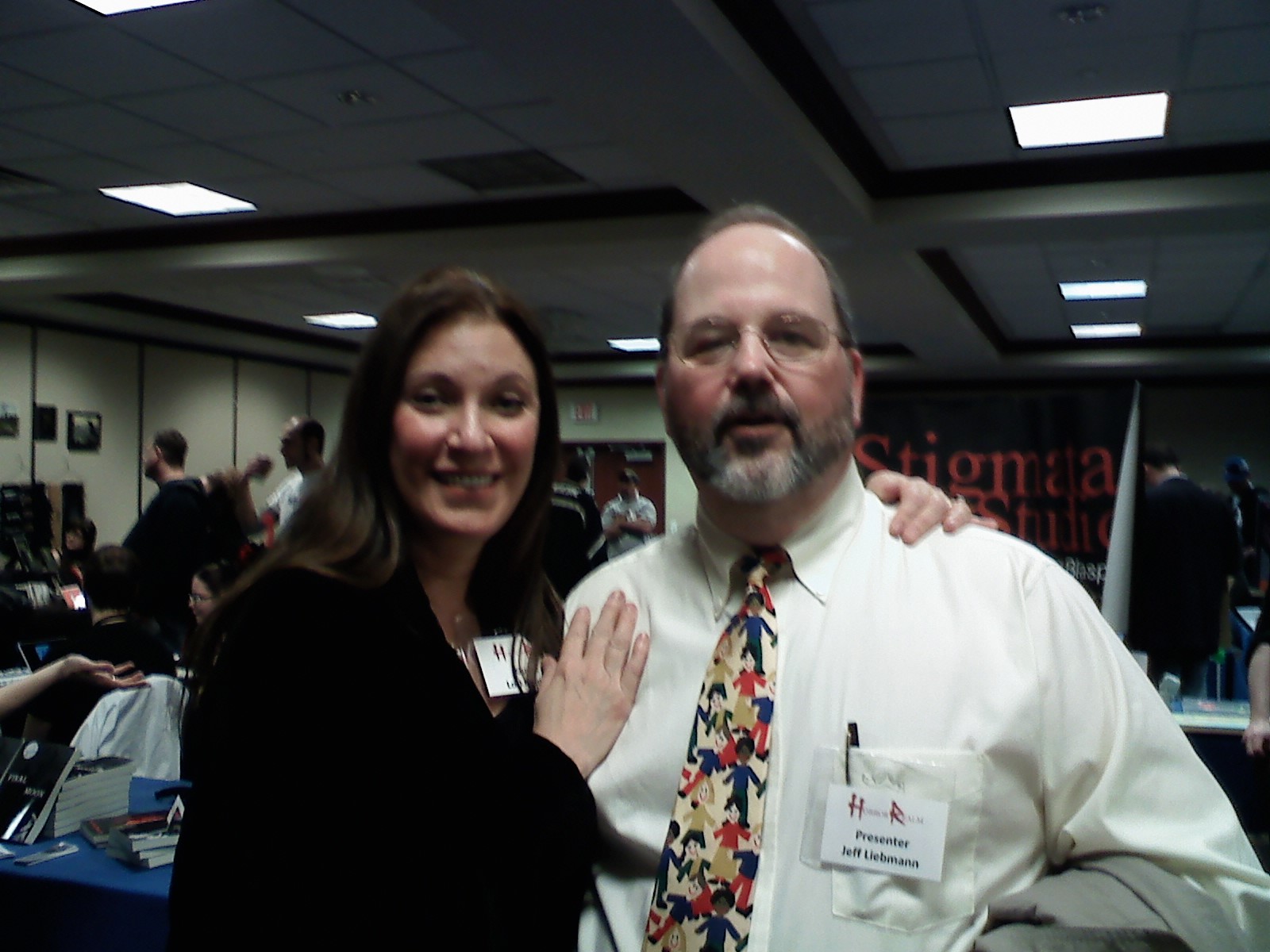
Regular readers of the muse kennel and pizzatorium know that I love zombies.  I watch zombie movies, read zombie books, and have on occasion dressed up like a zombie and shambled with hundreds of other similarly afflicted fans of this genre.

I can speak at great length about the relevance of “zombie theology.”  In fact, I recently spoke at a horror convention, delivering a session titled “Sermon of the Living Dead.”  Afterwards, I bought more some movies, picked up a couple more books, and examined zombie artists and news of upcoming zombie media events.

But, the highlight of my day was the opportunity to meet Lori Cardille. Lori is the daughter of Bill Cardille, known to many Pittsburghers as Chilly Billy Cardilly, host of Chiller Theatre for many years and one of the first horror movie hosts in the country. Lori starred in the lead role of George A. Romero’s third installment of his Living Dead series, Day of the Dead (the 1985 original and not the awful 2008 remake). I remain a huge fan of this film and particularly of Lori’s portrayal of Sarah, a scientist engaged in the hopeless search for a cure to the plague destroying humankind.

After waiting in line for 20 minutes or so, I introduced myself to this lovely and charming woman. We chatted and she signed my DVD of the movie (she donated the proceeds from her appearance to Pittsburgh Action Against Rape). And, I learned something fascinating about her.  She had written a short biographical account of her life, called I’m Gonna Tell.  Always on the lookout for pastoral care resources, I bought a copy and read it that night.

Lori’s account is frank, visceral, and incredibly informative.  For me, her story provided me with incredibly valuable insight into an experience I can only begin to comprehend.  She explores her journey and pain, relationships with relatives and friends, and her eventual confrontation with her abuser.  I would imagine that for a victim of abuse, her book would be healing and wonderfully supportive.

All Handguns Must Go – "Logic and Lawn Darts" (2/6/11 sermon)

Sometimes when I recall with romantic nostalgia my childhood, I wonder how we made it out of our formative years alive. My friends and I routinely played with toys that no company would consider manufacturing today. We romped on steel playgrounds anchored into crushed stone yards. And, we generally roamed the neighborhood unsupervised for hours at a time without fear of predators, abductors, molesters, or stray bullets.

Enough accidents and tragic occurrences raised the safety consciousness of a generation of Americans, so that now we can hardly avoid warnings of the mayhem possible from even the most innocent products. A few years ago, an online publication called Radar Magazine published a list of the most dangerous toys of all time. Obviously one can hardly expect such a list to be terribly scientific, but apparently the choices were made according to the ability of these toys to kill, maim, or generally be hazardous to the well being of children receiving them as gifts. I credit the authors of the list with spanning the last few generations of ingenious toy craft. I have no doubt that each of you will identify with at least one of these deliverers of destruction.

In tenth place was the Fisher-Price Harley Davidson Power Wheels Motorcycle. The throttle of this motorized vehicle apparently got stuck in full acceleration mode on occasion, sending the rider on an uncontrolled journey toward collision. In ninth place landed several 1979 Battlestar Galactica Missile Launchers, which propelled projectiles small enough to fit into unsuspecting throats.

Now, for the older children among us, we have our eighth place finisher, the Johnny Reb Cannon. While people apparently had no problems with its glorification of the Confederacy upon its release in 1961 (the centennial of the start of the Civil War), the Reb fired small, hard, plastic cannonballs up to 35 feet. Apparently, our toy makers don’t learn their lesson about small projectiles from one generation to another. At number seven, we have Creepy Crawlers. Of course, one could take one’s pick here from Easy-Bake Ovens to my personal favorite from my childhood, the Vacuuform. Nothing says safety like an open hot plate and exposed 100-watt light bulbs.

Another toy for the older generation comes in at number six. The Bat Masterson Derringer Belt Gun combined the cap-firing fun of a gun with a belt buckle. Number five brings us Sky Dancers – a toy of which I was blissfully ignorant before writing this sermon. Sold in the late 1990’s, one apparently stuck their little fairie feet into a launcher, pulled a string, and sent the twirling toys into the air.

We probably all remember those hideous (in my personal opinion) Cabbage Patch Dolls and number four brings us the 1996 Snacktime Kids Doll, which apparently had no shut off switch for its ravenous, munching jaws. At number three, Mini-Hammocks from EZ Sales. Unfortunately, children often found themselves emulating a chrysalis with no chance of emerging as a butterfly.

My personal favorite chimes in at number two. Gilbert, the company that gave us the infamous Erector Set, in 1951 produced the U-238 Atomic Energy Lab. For a mere $49.50, the kit came complete with four actual samples of Uranium-bearing ores, a Geiger counter, and a Spinthariscope (to see “live” radioactive disintegration). Lucky kids also received a comic book (Dagwood Splits the Atom) and a government manual titled, “Prospecting for Uranium.”

And now – drum roll please – the number one most dangerous toy of all time. Lawn Darts! Sort of a javelin-version of horseshoes (my set was known as Jarts), one lobbed the metal tipped arrows underhand toward a plastic hoop lying on the grass. The large spear impaled itself in the dirt, hopefully scoring points for the thrower.

Now, lest you think this particular survey unfairly castigates the dignity of these fine products, let’s review the known findings of reputable analysts. According to the Consumer Product Safety Commission, Fisher-Price recalled more than 200,000 of the Power Wheels Motorcycles in 2000 after receiving nine reports of the foot pedal on these mechanized deathtraps sticking. One 3-year-old boy suffered cuts and bruises when his out-of-control bike ran into a home. Mattel offered a “Missile Mail-in” to replace the small, red plastic bullets launched from the Battlestar Gallactica toys. Even though the product met or exceeded all existing and proposed safety standards at the time, there were instances of accidental swallowing of missiles, including one reported death of a four-year-old child.

One can imagine similar reports from the Johnny Reb Cannon, and the danger from Creepy Crawler burns were probably only exceeded by the nauseating taste of the toxic chemicals comprising them. One product safety organization reportedly claimed that the Bat Masterson belt gun’s caps “can be ignited by friction and cause serious burns.” I won’t speculate what kind of friction they thought a 10-year old boy would experience on his belt.

Injuries from Galoob’s Sky Dancers reportedly included scratched corneas and temporary blindness, mild concussions, broken ribs and teeth, and facial lacerations that required stitches. Nearly nine million Sky Dancers were eventually recalled by 2000 and the company fined $400,000. After 35 fingers and ponytails fell victim to Snacktime Kids’ appetites, Mattel removed them from shelves forever, and offered 500,000 customers a full $40 refund.

Between 1984 and 1995, twelve children between the ages of five and seventeen years old became entangled and died when using the Mini-Hammocks. A seven-year-old girl suffered permanent brain damage from a near-strangulation. A mother found her five-year-old boy entangled, but was able to resuscitate him. As a result, three million of the devices were recalled.

I won’t even hazard to speculate about the impact of the Atomic Energy Lab.

After deciding that voluntary agreements on stricter labeling and marketing were not having the desired effect, in 1987 the Consumer Product Safety Commission voted to ban lawn darts. The Commission had records of three deaths associated with lawn darts since 1970. Lawn darts were linked with an estimated 700 emergency room visits each year. Commission Chair Ann Brown went so far as to recommend that “Parents should destroy these banned lawn darts immediately.” Commissioner Anne Graham added, “What limited recreational value lawn darts may have is far outweighed by the number of serious injuries and unnecessary deaths…There are numerous alternatives to lawn darts, and I would urge adults who have lawn darts to throw them away now.”

Created in 1972 (sadly too late for some of our examples), the Consumer Product Safety Commission is a federal agency charged with protecting the public from unreasonable risks of serious injury or death from thousands of types of consumer products under the agency’s jurisdiction. The Commission’s work to ensure the safety of consumer products is believed to have contributed to the 30% decline in the rate of deaths and injuries linked to such products.

The Commission has jurisdiction “over more than 15,000 kinds of consumer products used in and around the home, in sports, recreation and schools.” But, the Commission does not claim jurisdiction over all categories of products. For example, food, drugs, cosmetics, and medical devices fall under the purview of the Food and Drug Administration; automobiles, trucks, motorcycles, and tires are the responsibility of the National Highway Traffic Safety Administration. Pesticides are included as part of the sphere of activity of the Environmental Protection Agency, and boats lie under the authority of the Coast Guard.

But, let’s move away from kid’s stuff (literally) and jump to the big three. Alcohol and tobacco are regulated by the Alcohol and Tobacco Tax and Trade Bureau, whose primary function is to “ensure that only qualified persons engage in the alcohol beverage industry… [and] enforcing the laws relating to tobacco products advertising.” And firearms fall under the Bureau of Alcohol, Tobacco and Firearms. BATF’s mission statement describes it as a law enforcement agency “that protects our communities from violent criminals, criminal organizations, the illegal use and trafficking of firearms, the illegal use and storage of explosives, acts of arson and bombings, acts of terrorism, and the illegal diversion of alcohol and tobacco products.”

You may note a subtle distinction between the roles of these various entities. The Consumer Product Safety Commission regulates the distribution and the design and manufacture of consumer products. The Alcohol and Tobacco Tax and Trade Bureau and the BATF, on the other hand, only regulate the distribution of the products within their sphere of operation, as well as the improper use of them by consumers. So, while the government empowers the Consumer Product Safety Commission to prevent companies from producing a dangerous product, the other agencies can only penalize those who abuse the laws regarding the sale, distribution, and use of alcohol, tobacco, and firearms once they have already been manufactured. One agency recaptures the cow after leaving the barn. The other keeps the calf from being born at all.

I am sure that critiquing the operations or the relative success of any of these important government bodies provides ample employment to various watchdog groups and analysts. Given their particular notoriety, one could certainly spend significant time examining the merits (or lack thereof) of certain historic BATF actions. Instead, I offer a suggestion that will simplify the work of every BATF agent by removing any ambiguities from their mission to protect this nation’s communities.

I call for a total ban on privately-owned handguns and for the confiscation and destruction of all such weapons in existence. I call for the elimination of all private ownership of handguns in this country and a ban on the production of handguns for the use of anyone but authorized law enforcement agents forever.

I understand that efforts to control handguns in this country have met with one failure after another. Since the shooting of James Brady in 1981 during John Hinckley’s attempted assassination of President Ronald Reagan, gun control advocates have run into one roadblock after another, largely due to the furious lobbying efforts of the National Rifle Association.

But, I do not call for gun control. I do not advocate for expanded background checks, or increased regulations on vendors. I do not care what the founders wrote 200 years ago or how even the most impartial jurist might interpret their meanings today. The time is long overdue for us as a nation to completely and forever cut our ties with all handguns as being inimical to human life, liberty, and the pursuit of happiness.

Now, I suspect even the most peace-loving among you might contemplate certain questions that arise from this call:

  • What’s wrong with owning a handgun for target shooting?
  • What’s wrong with carrying a handgun for my personal protection?
  • How will we get handguns away from criminals?

Legitimate questions – let’s address each one.
 
Some people own handguns merely for the enjoyment of target shooting. I myself have fired pistols at a shooting range and understand the pleasure of the sport. Let’s recall our list of infamous toys. All 10 combined resulted in fewer than 20 deaths. Obviously, the preventable and unnecessary death of even one child should deeply sadden us. But, lawn dawns caused only three reported deaths over 16 years, and were banned by the federal government.
 
In contrast, even the most ardent supporter of handgun ownership must agree that many hundreds of thousands of people have died from handgun homicides, accidents, and suicides during my lifetime. If we can ban businesses from even manufacturing a toy with only the potential of personal injury, why can we not ban a product with a long-proven track record of far more death and destruction?
 
But, criminals still have guns and I need to protect myself. Yes, you do. Let’s examine our actions in response to other similar circumstances. The federal government began establishing standards to phase out the use of lead additives to gasoline when the harmful effects to human health and the environment became apparent. Environmental protection regulations caused the automobile industry to turn itself on its collective ear to alter vehicle design and assembly, and the oil industry was forced to change its gasoline production and distribution processes. And, aside from the reported deaths of original research team members early on of lead poisoning, leaded gas was not likely linked directly to any deaths. From January 1, 1996, the Clean Air Act banned the sale of leaded fuel for use in on-road vehicles. Possession and use of leaded gasoline in a regular on-road vehicle now carries a maximum $10,000 fine.
 
The point is that we identified an inherent danger. We found a usable alternative – unleaded gas – and we banned the dangerous product. So the obvious question arises. Does an alternative exist to handguns for personal safety purposes? Of course it does. And one alternative – the taser – works just as effectively, is much less prone to accidental misuse, and results in death only in rare cases. Tasers can already be legally carried (concealed or open) without a permit in 43 states.
 
What about handguns already being used by criminals? As gun ownership advocates fondly say, when we criminalize guns, only criminals will have guns. Baloney. I know that I should be more theological and intellectual about my response to this argument. But, if we banned handgun manufacture and importation, then only time and the enforcement of laws stand between us and a relatively handgun-free America. Handguns are not marijuana – people can’t grow pistols in their backyards.
 
Will a handgun ban stop violent crime? Of course not. Kids will find ways to injure themselves no matter how many sharp edges and toxic substances you remove from their environment. Likewise, criminals may well use rifles, knives, clubs, hand grenades, or just their fists to commit acts of violence. That argument, however, offers no reason to oppose efforts to attempt to reduce and even eliminate deaths directly associated with private handgun ownership.
 
What solutions do I offer if we attempt this transition? Given our government’s propensity for throwing money at solutions, I ask for a relatively modest sum to fund the following initiatives:
  • For one year, offer every recreational owner who turns in a handgun $100 in cash, or an appraised trade-in on a bow and arrow, rifle, shotgun, or other legal firearm of their choice – after that, all handguns will be confiscated and destroyed;
  • Provide every collector of historic handguns free conversion of their weapon, making it incapable of firing to avoid confiscation;
  • Offer every registered owner who turns in a protective handgun a free taser;
  • Provide research and development funding to Colt Manufacturing and the New Jersey Institute of Technology, who are working to perfect “smart guns,” and then convert every handgun used by law enforcement agents to incorporate biometirc recognition; and
  • Make mandatory sentencing associated with handgun-related crime so onerous, that no sane criminal will consider their use.

What would these initiatives cost? Estimates place the number of handguns in America at 200 to 300 million. We could partially offset the cost of the handgun buy-back program with modest taxes on the huge expected increase in taser sales and permit fees. Given our history of industry bailouts, and our exorbitant military expenditures over the years, the remaining costs far outweigh the direct potential gain in human life and reduction of human misery.
 
Now, I am no lawyer and have no interest in haggling over budgetary priorities and implications. But, as a clergyman, I must address certain recent decisions in our halls of government. A 5-4 Supreme Court decision in June 2010 on McDonald v. the City of Chicago, cited the Second Amendment’s right to bear arms – and specifically the right to possess a handgun – as “fundamental to the Nation’s scheme of ordered liberty” in trumping the ability of local governments to protect their residents by creating common-sense regulations on handguns. Also, in July 2010, Louisiana Governor Bobby Jindal signed into law a bill authorizing persons who qualify to carry concealed weapons, and having passed necessary training and background checks, to bring them to churches, mosques, synagogues, or other houses of worship.
 
After Columbine, Virginia Tech, and now the senseless murders recently in Tucson, I say, “enough.” I don’t care if you are a bodyguard, a state policeman, or a secret service agent charged with protecting the President, I welcome you into this house of worship. But, I do not welcome your weapons and I specifically do not welcome your handguns. Arrest me, sue me, fine me. But, I will never knowingly allow anyone to bring a handgun into any congregation I serve. If we take a stand against handguns, then let it start here in our houses of worship. Here, where we dedicate ourselves to loving our neighbors and to bringing about a better life on earth – here is where we say “no” now and forever to handguns.
 
Our government routinely bans products with only the potential to cause harm. Drugs that may well cure diseases face rejection after years of development and study. Foods that may only cause illness are regularly ordered destroyed. And companies that manufacture toys that perhaps may harm a child face fines, lawsuits, and bans. Saving just one nine-year-old like Christina Taylor Green would make a handgun ban worth any price.
 
So, where is our equivalent collective outrage against this far-greater ill plaguing our populace? I say it should reside here, here in our churches, mosques, synagogues, and other houses of worship. Here, as children of a higher purpose and universal laws of humanity and love, we should demand the protection from these threats to our well-being and to our lives.

Oscar’s Back in the House

Yo, cousin Phil!  What’s up with this crazy weather?  All this ice and snow is cramping my style, you know?  Jeff doesn’t like to drive in bad weather, so I’m stuck here while he works on sermons…booooring!

And don’t give me that “I can’t control my shadow” stuff.  Haven’t you heard about the interdependent web and all that?  We are one with nature!  Empower yourself to take control of the situation and let’s have an early spring this year.

Oscar

(editor’s note — sorry, folks.  Oscar got hold of my cell phone while I was in the shower)

Giving Thanks

I give thanks for every day of life.  May we all be granted the awareness to never take that gift for granted.

I give thanks for men and women who have moved me to tears and mountaintops of emotion through their acts of commitment and the fire of their devotion to what is right.  May we all be granted such inspiration.

I give thanks for those unique attributes that make us human — the ability to reason beyond base needs for sustenance and survival; the capacity to act courageously, especially when logic tells us not to; and the power to love with every fiber of our souls.  May we all proudly own our humanity.

I give thanks for the wondrous engine of the universe and every accidental collision of molecules that created stars, rivers and mountains, and every form of life from the moss to the sequoia and the whale to bacteria.  May we learn to be better stewards of our planet.

I give thanks for the opportunity to forgive those who have wronged me; I especially give thanks for the chance to, despite my best efforts, forgive myself for my mistakes.  May each of us be granted the gift of such forgiveness.

I give thanks that every day life provides me the chance to be a better person and to help others to do good.  May we never rest until all slaves are set free, all hungry are fed, and all lost find a path.

I am thankful for young people, who through their innocence and fearless curiosity have been my best teachers.  May everyone have children like my own who every day show us the reality of eternal life.

So, to dear friends and caring relatives; to Gandhi, Martin Luther King, Jr., Michael Servetus, Norbert Capek, and Theodore Parker; to past, present, and future congregants; to Mom and Dad; to Ashley and Tyler…Thank you and Happy Thanksgiving.

Chalica Readings

Chalica was originally conceived in 2005 as a way to celebrate and put into intentional practice the seven principles of the Unitarian Universalist tradition – one a night – for seven nights.  Chalica begins on the first Monday of December, and is marked by the lighting of a chalice each day.  Gifts that reflect the principle for that particular day may be given, or you can choose to focus more on mindfulness and action.

I have prepared daily readings for Chalica this year, which individuals and families can use in their home celebrations.  I encourage you to read this draft and offer any suggestions or comments you may have to improve it.  I plan to record these readings and post them to the Unitarian Universalist Congregation of Smithton web site for all to use this year.

Day One (Monday)
Chalice Lighting
Within us all burns the fire of life.
We share this common flame,
     symbol of our precious being.
Each flame burns with a unique glow,
     signifying the inherent worth and dignity
     of every person.

Reading
Hymn 131, Love Will Guide Us, has the following lyric:
If you cannot sing like angels,
     if you cannot speak before thousands,
     you can give from deep within you.
You can change the world with your love.

Message
Each of you is one of billions of humans inhabiting this planet. Billions – a scary number. But, a billion represents just a tiny fraction of the grains of sand here on earth, or snowflakes that fall every winter. And yet, each grain of sand, each snowflake is different. In every case, perhaps microscopic variations make every grain, every flake unique.

But, sand does not think. The snow crystal has no capacity to reason. The desert feels no emotion. And the blizzard cannot love.

On the other hand, each and every person thinks and has the capacity to reason. Each and every person feels and has within them the seeds of love. So, while sand has usefulness when melted into glass and the snow melts to provide life sustaining water, one would not miss a single grain, a stray flake.

Each and every person, however, has worth. Regardless of our status or our accomplishments, we impact the lives of others. In addition, each and every person possesses dignity – the right to self-determination, the right to pursue noble deeds, and the right to grant and earn respect inherent in the human soul.

On this first day of Chalica, we affirm and promote the inherent worth and dignity of every person. Amen.

Discussion
So, today, exchange gifts that honor people in your life. Ask yourself these questions:

  • Are there people I don’t understand, and what can I do to bridge the divide between us?
  • Are there people with whom I have disagreements, and can I work to find a common path for us to walk together?
  • Is there someone I have disrespected to whom I can make amends?
  • Is there someone who has helped me that deserves my special thanks?
  • Is there someone in need of assistance that I can help and what can I do to help them?

Day Two (Tuesday)

Chalice Lighting
Fire cannot be grasped,
     or held within the hand.
Fire is transparent,
     giving light and warmth to all.
May this chalice represent justice,
     fairness and compassion.
 
Reading
Hymn 140, Hail the Glorious Golden City, begins with the following lyric:
Hail the glorious golden city,
     pictured by the seers of old:
Everlasting light shines o’er it,
     wondrous things of it are told.
Wise and righteous men and women
     dwell within its gleaming wall;
Wrong is banished from it borders,
     justice reigns supreme o’er all.
 
Message
A glorious golden city where wrong is banished and justice reigns supreme. If such a place existed, wouldn’t you move there in a second? You might be willing to do whatever it took to relocate to that city, because the benefits would be worth any cost, any sacrifice.
 
Well, the gleaming walls don’t reflect the sun. There is no off ramp from the highway of life to this place. You won’t find a dot on any map, or a link on Google or Wikipedia.
 
But, the glorious golden city exists. It exists here in your heart, and here in your mind. Every brick is laid by each act of justice you commit. The mortar mixes each time you demand fairness from friends and family, employers, government, and businesses. And, the everlasting light shines brightest when you love others with that purest unconditional compassion that guarantees that we are all equal in the eyes of whatever forces power our universe.
 
So, put away your boxes and cancel the moving van. For you already own a plot in the glorious golden city. On this second day of Chalica, we affirm and promote justice, equity, and compassion in human relations. Amen.
 
Discussion
So, today, exchange gifts that honor those in your local community that are less fortunate. Ask yourself these questions: 
  • Are there local charities to which I can offer time or talents?
  • Can I donate food, clothes, whatever I can afford to others in need?
  • Are the people near me to whom a simple kindness would make a world of difference?
  • How can I learn or participate in ways that promote justice and equity in my community?

Day Three (Wednesday)

Chalice Lighting
This chalice is a lighthouse,
     a beacon reaching across the vast spaces.
This flame beckons all travelers,
     come, enter, and be welcome.
Join us on our mutual quest.
 
Reading
Hymn 402, From You I Receive, has only this one simple lyric:
From you I receive,
     to you I give,
     together we share,
     and from this we live.
 
Message
Our chalice is a lighthouse, a beacon showing people a way to religious being, safe from the rocks and
currents of despair and hopelessness. But, lighthouses often reside in solitary locations, far apart from the bustle of home and business. In our search for individual spiritual growth, we might find so much comfort in a newfound belief, that we isolate ourselves from others. We might feel our beliefs too fragile to subject them to the scrutiny of others.
 
Perhaps a better metaphor is a steeple, whose bell peels out a welcome to all searchers, wherever they come from and whatever questions they bring with them. For our congregations are about community building and reaching out a warm hand of friendship to the stranger.
 
Many truths span national boundaries and cultural distinctions. One such truth particularly relevant to our congregations is this. A joy shared is twice a joy, while a burden shared is half a burden. Let us share our joys and our burdens gladly.
 
On this third day of Chalica, we affirm and promote acceptance of one another and encouragement to spiritual growth in our congregations. Amen.
 
Discussion
So, today, exchange gifts that honor our fellow Unitarian Universalists and their spiritual journeys. Ask yourself these questions: 
  • Can I take some time to look through a hymnal or book of reflections in order to better appreciate different points of view in our movement?
  • Are there words of peace or forgiveness I can extend to a fellow Unitarian Universalist?
  • Is there a unique gift or leadership role I can offer to my congregation?
  • Are there events I can attend more often to show my support for our religious community?

Day Four (Thursday)

Chalice Lighting
Our chalice is a lamp,
     lighting dark corners of ignorance;
     illuminating falsehoods.
We hold this sacred lamp,
     applying knowledge with care
     and abiding purpose.
 
Reading

Hymn 145, As Tranquil Streams, has the following lyrics:
Prophetic church, the future waits your liberating ministry;
Go forward in the power of love, proclaim the truth that makes us free.
A freedom that reveres the past, but trusts the dawning future more;
And bids the soul, in search of truth, adventure boldly and explore.

Message
The list of famous Unitarian Universalist thinkers runs long and deep in every field of human inquiry. But, thought without reflection breeds vanity and false pride. And ideas without the wisdom of application allow tyrants to run unchecked and the immoral to prey on the innocent.

Unitarian Universalism stands not just for unfettered research and learning; we stand for careful consideration of consequences. The hands that splice genes can unleash monstrous outcomes and the mind capable of splitting atoms can also lay waste to cities.

Education has the power to level all inequalities in life, but only if pursued with good intent and abiding will. Only the search for knowledge and wisdom will yield the fruits of meaning. And that harvest can soothe the greatest hurt and heal the deepest wound.

On this fourth day of Chalica, we affirm and promote the free and responsible search for truth and meaning. Amen.

Discussion
So, today, exchange gifts that honor another tradition, or to honor education. Ask yourself these questions:

  • Can you take time to read about, or participate in an event that celebrates another religion or tradition?
  • What do you know or love that you can teach others
  • What knowledge or talent have you wanted to learn and what is stopping you from doing so?
  • Can you give the gift of a favorite book to someone?

Day Five (Friday)

Chalice Lighting
This gentle flame is the roaring inferno of transformation,
     for only through freedom of belief
     may we become what we will
May our chalice melt the shackles of superstition and creed,
     lighting our way on the path
     of spiritual growth and freedom.
 
Reading
Hymn 135, How Happy Are They, begins with the following lyric:
How happy are they, born or taught,
     who do not serve another’s will;
Whose armor is their honest thought,
      and simple truth their highest skill.
 
Message
One of the ironies of language involves the word “religion.” Derived from the same root word “ligio” that gives us the word “ligament,” religion actually translates to “that which binds us together again and again.” And yet, the professed point of many religions is to liberate us from suffering and evil.

So, how do we find liberation by binding ourselves repeatedly? For some, the bond is dogmatic acceptance of a common creed. For others, it is the relinquishing of certain choices and responsibilities to divine Providence.

But, Unitarian Universalists viewed themselves as working hands of Providence in the world. We seek and achieve liberation through democratic community; by finding and celebrating our common commitments with souls engaged on the same spiritual journey. In our congregations, we give voice to our beliefs, and we amplify those voices through free discourse and a pulpit that inspires without dictating.

On this fifth day of Chalica, we affirm and promote the right of conscience and the use of the democratic process within our congregations and in society at large. Amen.

Discussion
So, today, exchange gifts that honor democracy. Ask yourself these questions:

  • What can you do to be of public service, or help those willing to serve in office?
  • Can you write a letter to an elected official on a matter of importance?
  • How can you help a committee in your congregation?
  • Would you be willing to host a dinner or gathering to discuss an important issue, or perhaps lead a class to study a significant ethical issue? 
Day Six (Saturday)

Chalice Lighting
As we light this chalice,
     may its flame consume the forces of violence in the world;
     may its heat warm the chill of misunderstanding and hate; and
     may its light brighten the lives of the sick of heart and mind.
Chalice, burn with the fire of peace and liberty.
 
Reading

Hymn 159, This Is My Song, has the following lyric:
My country’s skies are bluer than the ocean,
     and sunlight beams on cloverleaf and pine;
But other lands have sunlight, too, and clover,
     and skies are everywhere as blue as mine.
O hear my song, thou God of all the nations,
     a song of peace for their land and for mine.

Message
Nearly every religion preaches peace. And yet, our world still labors under the wraith of war, omnipresent poverty, and persistent harbingers of hate. We will never achieve peace in the world until each and every one of us finds peace within our own hearts; a peace that cannot be attained while the body hungers, limbs are shackled, and free will lies imprisoned.

 
As Unitarian Universalists, we can appreciate the sentiments of prophets of peace throughout history. We can also aspire to live lives in pursuit of peace for ourselves, our communities, our societies, and our world. As our love is unconditional, so must our struggle for liberty for others be unqualified. Every human being has the inherent right to live free, to love unrestricted, and to seek enlightenment via the path of their choice. We are all only as free as the most fettered among us.
 
On this sixth day of Chalica, we affirm and promote the goal of world community, with peace, liberty, and justice for all. Amen.
 
Discussion
So, today, exchange gifts that honor our global community. Ask yourself these questions: 
  • Can I find a way to volunteer with, or donate to an organization that has global influence, such as UNICEF, or Doctors Without Borders?
  • Can I write a letter for Amnesty International?
  • How can I help the social justice committee in my congregation to hold a fundraiser, or run an alternative gift market?
  • Have I looked at the Unitarian Universalist Service Committee web site recently, and updated my membership?

Day Seven (Sunday)
Chalice Lighting
We ignite this elemental flame,
     core of our earth and of our very being.
We call upon the foundation of molten rock.
We call upon the electricity of lightning.
We call upon the light of celestial stars.
Fire within, transform us with your power.
 
Reading
Hymn 298, Wake, Now, My Senses, closes with the following lyric:
Wake, now, my vision of ministry clear;
Brighten my pathway with radiance here;
Mingle my calling will all who will share;
Work toward a planet transformed by our care.
 
Message
Primitive humans understood and respected the power of the natural world. While humankind takes well-deserved pride in its modern engines and harvesting of resources, we would do equally well to hone our humility, remembering that we are insignificant creatures next to the might of a sun.
 
The temptation to succumb to the short-term benefits of our modern way of life is not sustainable. We know this well, and yet we continue to avail ourselves of our world’s bounty with little care for its maintenance.
 
As Unitarian Universalists, we must fight for the rights of our planet with no less diligence that we do for our own freedom and liberty. As congregants, we are stewards of our houses of worship; as citizens, we are stewards of our nation; and as human beings, we are stewards of our home, the earth.
 
On this seventh day of Chalica, we affirm and promote the interdependent web of all existence of which we are a part. Amen.
 
Discussion
So, today, exchange gifts that honor our earth and its creatures. Ask yourself these questions: 
  • How can I do more to recycle bottles, cans, and more? If I can sell my recyclables, what environmental/animal aid society would I support?
  • Could I rescue an animal from a shelter?
  • How can I help plan and conduct an outdoor worship service in my congregation, weather permitting?


 

Remembering Veterans, Family and Friends

Today we remember and honor the service of men and women throughout the years in dedication to the principles of freedom and democracy that are the cornerstones of this great nation.  We also celebrate the  ideal that the seeds of greatness and accomplishment lie within each and every person.

This holiday began life in 1919 as Armistice Day, in recognition of the ending of World War I, with these words by President Woodrow Wilson: “To us in America, the reflections of Armistice Day will be filled with solemn pride in the heroism of those who died in the country’s service and with gratitude for the victory, both because of the thing from which it has freed us and because of the opportunity it has given America to show her sympathy with peace and justice in the councils of the nations.”

But, it was a shoe store owner in Emporia, Kansas who turned this day into one honoring the service of all veterans to their country. Even though he never officially served in uniform, Al King always had a great respect for the military. He promoted his notion so much that the Chamber of Commerce of Emporia (a town not all that much larger than West Newton) decided to get involved, and businesses closed their doors that November 11, 1953, to celebrate the first-ever all-inclusive Veterans Day.

Today, many conflicts later, we recognize that those brave souls in uniform are not alone in their dedication and commitment to the ideals of this country. Spouses and family, friends and neighbors, teachers and colleagues stand behind each soldier wherever and however they serve. This holiday celebrates all of the sacrifices, large and small, of every veteran and everyone who has loved and supported a veteran.

We look forward to the day when there will be no war. We imagine, someday, children may ask their parents, “What was Veterans Day all about?” because the circumstances that cause nations to take up arms against each other with become passé, an anachronism in a world without hunger, disease, or want.

But, until that day, tyrants will arise to suck the will from the common person, and threaten our lives, our liberty, and our pursuit of happiness. Until that time, each and every one of us has a role to play defending our universal belief in human worth against those who would desecrate our humanity and defile our spirit. Whether we wear the uniform, or provide support for those that do – whether motivated by divine sources, words of inspiration, or real life heroes – our task as citizens is to remember, to honor, and to live lives of service.

UUA Blogger Survey

The Best Practices for Unitarian Universalist Blogging report, originally published in August of 2008, is being updated and bloggers who promote Unitarian Universalism are being surveyed. We are being asked to post the questions and our answers to our blogs…so here goes.

1. Why do you blog? What goals do you have for your blog?
Well, that’s a really good question.  The main reason I blog is that I believe that all ministers should be blogging, offering our opinions, feelings, and insights in this important venue for modern seekers.  For me, it is a form of Unitarian Universalist evangelism — a chance for people to connect to our movement in one more way beyond the Sunday morning worship service or the weeknight committee/program meeting.

My goals are many: to continue my process of reflection and discernment as I prepare to enter into fellowship with other ministers; to interact with others in a public forum on relevant issues; and to let my muse run wild on occasion.

2.  Who is your intended audience?
Anyone interested in the free and responsible search for truth and meaning; anyone who wants to sit across the table from me and share a pizza.

3.  Who owns your blog? Does it belong to you as individual or to your congregation or other organization?
The muse kennel and pizzatorium is all me.  I will certainly refer to my congregation on occasion, and post sermons, but my blog is my side of this virtual conversation.

4. How frequently do you post?
Not nearly often enough!  I am one of the world’s worst journalists.  And, I guess that I feel that the only time I want to blog is when I really have something important to say.  Needless to say, I don’t “get” Twitter.

5.  What is the tone of your blog?
I suppose the tone is essentially professional with an important touch of the personal.  I really just go where my muse takes me in regards to tone.

6.  What steps do you take to make sure that your blog is a safe space, both for you and for other participants? Do you have a code of conduct?
I filter comments (most of which are spam anyway) and will not post comments that are snarky or combative to the point of killing dialogue.  As for me, anything I post is fair game and I assume is public.  If I feel unsafe posting it, then I simply won’t.

7.  What kinds of boundaries do you observe around confidentiality?
I generally don’t name people I discuss, but my stories are mostly about me anyway.  I would endeavor never to discuss someone else in a way that they could be identified without asking their permission first.  But, generally, if I do mention someone else, it is to praise them or give them props for helping me in some way.

8.  How do you respond to comments and email from readers?
I will always post and respond to comments and emails that are respectful and that contribute to the ongoing dialogue.  Sarcastic and excessively argumentative (those that in my opinion shut down discourse) comments are generally ignored.

9.  What are the most challenging aspects of blogging in your experience?
Inertia is the biggest problem and I am my own worst critic.  If I don’t feel particularly qualified to comment on a topic, or feel that my opinion is not all that unique, then I tend to not post.  I suppose that I just need to grant myself the permission to let others make that call.

10.  What are the most rewarding aspects of blogging in your experience?
I feel the most reward when I can give voice to an idea or experience that would not likely have been expressed via other avenues open to me.  I guess I feel that if my posts affect just one other person in some way, then the effort is worthwhile. 

11.  What advice would you give to Unitarian Universalists who are new to blogging and want to get started?
Stop worrying about it and let your muse off its leash!  You will never please anyone, and you can never please anyone unless you give yourself the chance.  So, just run off that diving board and cannonball into the pool!

12.  How do you evaluate the success of your blog? What have been your most successful blog posts or series?
I don’t.  I’ll admit to a twinge of pride when The World mentions my blog in its weekly summary.  But, my blog simply is what it is.  It is successful if I let it be what it is.

I believe that my best series was the one I did on my trip to New Orleans.

13.  What do you wish you had done differently in your blogging?
Hmmm, nothing that I can think of.

14.  What other online tools do you use to promote your blog? (i.e. social networking sites, Twitter, social bookmarking tools, etc.)
I set up my blog to automatically post to my Facebook account.  I tell people about my blog on various web pages and other avenues.

15.  Do you use an Really Simple Syndication (RSS) feed? How many subscribers do you have?
I honestly have never even looked at that to figure it out.

16.  Do you track site traffic? How many unique visitors do you have per day (on average)?
No, I think I would only find that depressing!  And, I’m way too obsessive-compulsive, so I would waste too much time analyzing numbers.  Frankly, I am always pleasantly surprised when I find that anyone has spent any of their valuable time reading my ramblings.

17.  Do you find Unitarian Universalist Association resources helpful to you as a blogger? What additional resources could we provide to Unitarian Universalist bloggers?
Not really, although I use UUA resources for lots of other things.  I’m not really sure how the UUA could contribute to my blogging.  One possible idea might be for someone to come up with a weekly suggestion on a topic for UU bloggers to address.  Then the posts could be assembled, or even summarized in some way.  Such a resource might be really useful to somebody researching that topic.

18.  Please write any additional comments or suggestions.
Peter Bowden is the man, and has been enormously helpful to me on a number of occasions regarding all things technical.  And, if you read me blog, then please write/comment and let me know what you like, don’t like, want to see more of, whatever!

One More Immigration Story

The United States is keeping two young members of my congregation from living in their home and being with their friends in worship. You see, one happened to be born in Italy, so when her visa ran out, she was forced to return and seek a new visa. Exile to a foreign land is costing this couple many thousands of dollars, months of separation from jobs and loved ones, and untold anxiety. And, in the end, their fate remains up in the air.

America has an immigration problem. The good news is that so many people willing to work and especially perform some of the toughest, menial tasks gladly sacrifice everything to come here. They face a frightening unknown, often toil under intolerable conditions, and suffer great deprivation. The bad news is that the terrible state of our administration of immigration leaves states like Arizona little choice but to pass absurd and unconstitutional laws in a misguided attempt to solve their own local problems.

Ancestors of every citizen of this nation were at one time immigrants. Whether your people migrated across the Bering Strait thousands of years ago, sailed across the Atlantic on the Mayflower, a slave ship, or a crowded passenger liner, every American has roots from other lands. They came here for the same reason people cross our borders today – for opportunities, for a chance to better themselves, for the hope that this country stands for.

I am no immigration attorney. But, a better way must exist to extend a welcoming hand to those willing to become contributing citizens and to expanding the legacy of the fantastic ethnic and cultural diversity of this land. And, there certainly must be a way to prevent the breaking up of families over bureaucratic details.

By the way, one more detail about this couple. They are both women. Although married (in Canada), our federal government refuses to grant the rights to same-sex married couples given to heterosexual couples. There is a word for this. Discrimination.

And there is another word for this. Wrong.

Behind the Clouds – A Flower Communion Service

Opening Words
from “The Rainy Day” by Henry Wadsworth Longfellow

The day is cold, and dark, and dreary;
It rains, and the wind is never weary;
The vine still clings to the moldering wall,
But at every gust the dead leaves fall…

Be still, sad heart! and cease repining;
Behind the clouds is the sun still shining;
Thy fate is the common fate of all,
Into each life some rain must fall,
Some days must be dark and dreary.

Time for All Ages

Following World War I and the establishment of an independent Czechoslovakia, Norbert Ĉapek founded a Unitarian congregation in Prague called the Liberal Religious Fellowship. He introduced the Flower Festival service on June 4, 1923 as a symbolic ritual to unite people in the new congregation. The traditional Christian communion service was unacceptable to many who had joined the new fellowship after leaving the Catholic church. Ĉapek decided to utilize the native beauty of the land to create a ritual unique to the new religious body.

People were asked to bring a flower of their choice to church and to place them in large vases at the entrance. During the worship service, Ĉapek consecrated the collected flowers. Afterwards, people returned to the vases and took a different flower home with them. It was such a success that it was held yearly just before the summer recess of the church. His fellowship grew into the largest Unitarian congregation in the world, with a membership of almost 3,400 by 1932.

With the outbreak of World War II, Ĉapek chose to remain in Europe, despite invitations to come to America. He delivered a series of sermons on the topic of freedom and justice that got the attention of Nazi authorities. In March 1941, the Gestapo broke into Ĉapek’s apartment, confiscated his books and sermons, and arrested him and his 29-year-old daughter, Zora. Ĉapek was charged with listening to BBC broadcasts (a capital offense) and with treason. The Nazis cited several of his sermons as evidence. A year later, he and his daughter were found guilty.

The court found Ĉapek innocent of the treason charge and recommended that, given his age, the year served in prison be counted toward his jail time. The Gestapo, however, ignored the court’s recommendation, sending Ĉapek to Dachau and Zora to forced labor in Germany. Ĉapek’s name appears among a list of prisoners sent on an invalid transport on October 12, 1942 to Hartheim Castle, near Linz, Austria, where he died from poison gas.

Reflection Reading
from Norbert Ĉapek’s 1927 sermon “Salvation”

This relying on help from outside instead of upon ourselves flows from the doctrine of salvation which various churches still impose on us…The Catholic Church…and many varieties of…evangelical churches teach us to look for salvation from some supernatural source and think it blasphemous when someone feels he must seek salvation through his own moral effort.

Jesus did not have the superstitious belief that an angry God required a sacrifice to reconcile himself with mankind because of Adam’s sin. We owe [that belief] to the apostle Paul, whereas Jesus’ teaching about salvation is expressed in the parable of the prodigal son…

Christian people were much harmed by the notion of the necessity of pacifying God’s anger through the blood sacrifice of Jesus…Jesus’ gospel was meant for the poor, the oppressed, the unjustly handicapped, and all other unfortunate people.

The German reformers, Luther and Calvin, tore the heart out of Jesus’ gospel and instead inserted the dogma about Jesus’ sacrifice for the atonement of sins…The[ir] religion…was suitable for a feudal social system, but how much did it do for the oppressed, the poor, and the enslaved people?

Salvation cannot come from something or someone outside ourselves… Salvation comes only through what a person achieves through his own effort and ability.

Sermon – Behind the Clouds

Once upon a time, in a not-so-magical kingdom, there was an ogre who owned a factory. Now, as befitted his natural demeanor, the ogre was very cruel to the factory workers. He would beat them regularly, and if a worker ever gave him cause for displeasure, the ogre would cast him out of the factory forever. In fact, it sometimes seemed that the ogre enjoyed mistreating his workers more than actually running the factory effectively.

There was a man who worked for the ogre. The man worked behind a tiny desk helping the ogre keep track of production in the factory and utilizing resources most efficiently. The ogre was terrible at counting, and so needed the man’s skills. But, that did not stop the ogre from tormenting him mercilessly. And the man could not complain because he needed the work to support his family. Over time, the man learned ways to please the ogre and to keep the ogre from getting too mad at him.

The workers in the factory toiled for years under the cloud of the ogre’s wrath. The workers were talented and committed to their craft, but the ogre took any joy they might have felt out of the work. It seemed that the factory always lay in darkness – not the black of night, but the murkiness of a sunless day.

Sadly, this all-too-real fairy tale is one with which each of us can likely identify. In school, at work, even at home, it sometimes seems that there are people whose sole purpose in life is to cause others suffering. We endure this suffering out of love, or duty, or obligation, or simply out of habit. And we pay a toll for our efforts, whether we realize it or not.

Thankfully, few of us will ever know the hardship possible under the fist of a tyrant. Oh, we may complain about our taxes, incompetent legislators, or soulless government bureaucracies. If you are non-White, a woman, gay, or a member of other oppressed minorities in our country, you probably have experienced abridgements of your rights, or prejudice at the hands and from the lips of bigots with the ability to affect your life and livelihood.

But, few Americans can even begin to comprehend genocide – police and soldiers dragging our neighbors into trucks and trains. Most of us will never experience living under the cloud of a dictator, where the sun is blocked not only by repressive rule, but by the ashes of people targeted as threats to those in control.

And yet, that is what Norbert Ĉapek faced when his beloved Czechoslovakia was consumed by Hitler’s power play with the Allies. At the global poker table, we blinked and in September 1938, the Nazis raked in the pot – more than one-third of Czechoslovakia. Seven months later, the Nazis occupied the remainder of the country.

As a Unitarian minister, Ĉapek would have been unquestionably suspect in their eyes. The Gestapo regularly attended his Sunday morning and Tuesday evening worship services. But, Ĉapek carefully measured his message and tone to one that might irritate, but not inflame the German authorities. In June 1940, Ĉapek was summoned to Gestapo headquarters, interviewed, and released. Like the man in our fairy tale, Ĉapek learned the craft of survival under the ogre.

In the ensuing months, Nazi rule over Czechoslovakia worsened. Jews were spirited away; school children were photographed and their racial characteristics measured. Ĉapek maintained his ministry and his church continued to grow.

Then, on March 28, 1941, five men in plain clothes burst into his apartment. Over four hours, they ransacked his belongings, taking hundreds of sermons and lectures, manuscripts and letters, his typewriter, and the radio given to him on his 70th birthday by his congregation. They arrested Ĉapek and his youngest daughter, and led them away from the home they would never see again.

Now, often in stories like the one I told earlier, a shining knight comes along. He slays the ogre, brings light to the factory, and frees the workers. But, in our all-too-real world, ogres are much too smart and cunning to fall victim of the knight’s lance. They convince the knight that fighting will entail a terrible cost and that the outcome may be worse than allowing the status quo to continue.

Even more often, the ogre persuades the knight that keeping his armor shiny requires lots of money and that new weapons are constantly needed to maintain the knight’s power. In time, the knight comes to rely on the ogre and ceases to hear the cries of the workers in the factory. The armor tarnishes and the clouds thicken.

Other times in our stories of fantasy, a fairy godmother flits down, wand in hand, to grant us our fondest desires by taking us from the drudgery of the factory to the magnificent castle. With a simple wave of her hand, she promises immediate gratification. With no effort on our part, she offers us the winning lottery ticket of life. But, in the world of non-fiction, the person promising to fulfill your wishes is a con artist at best, and at worst a predator poised to rob you of your very soul.

Am I recommending that we banish fairy tales from our children’s bedside? Would I relegate Cinderella to her ash heap and leave Camelot unimagined? No. Dreams are healthy things and the sign of an imaginative and optimistic mind. Envisioning a better future beyond today and tomorrow, or even beyond our own lives sets us apart from other species on this planet. Dreaming may sometimes lead us down frivolous paths, but dreams plant the seeds of great accomplishment and happiness.

There exist many people out there, however, who prey on our dreams to turn a profit without any real concern for our well being. Others pollute the air with their clouds of fear and despair to keep us sedated and inactive. The clouds we live under obscure from us the worlds of the possible, the lands of growth and change, the vistas of our dreams.

So, what happened to the man in the factory? Over the years, he learned not just survival under the ogre’s reign, but how to find joy in other parts of his life beyond the factory. He found love in his children and family. He found fulfillment serving his community and causes that helped other workers. And, he found peace and even moments of ecstasy in his house of worship. He began to realize that the factory, while a significant part of his life, did not define him as a person. Most important, he began to imagine what lie behind the clouds surrounding the factory.

These were not the passive dreams of one waiting to be rescued, or the unfulfilled wishes of one wiling away free time on idle pursuits. His dreams were not the wispy stuff of sleep or the intangible unreality of wonder. His dreams were solid things, built brick-by-brick through hard work and commitment. His dreams became a stairway of sacrifice, cutting through the clouds of the factory and extending beyond the reach of the ogre’s fickle anger.

And when the man ascended the structure he had built and climbed through the clouds, what did he find? He found what Norbert Ĉapek found. He saw in the bright light of day countless flowers of every conceivable color decorating the countryside. He saw the marvelous diversity of living things and the remarkable individuality we share that makes life interesting.

He felt an enormous burden lifted from his body. Gone was the pressure of the constant criticism and deriding doubt. But, also missing were the shame and the guilt from within; the resentment and even hatred that had festered and grown against the ogre. Vanished were those debilitating emotions that had distracted the man with their false hopes of self-satisfaction and their sugar-coated rationalizations of self-righteousness.

Behind the clouds, the man heard the calling of his life. Gone were the allure of salary and financial security. Banished were the accolades of double talk and the bromides of bureaucracy. He heard clearly his calling to become the person life had prepared him to be.
Twelve years before his arrest and imprisonment, Capek had prepared himself spiritually, oddly predicting the hardships he now faced, when he wrote:

How can a person be ready to undergo difficult trials? He must ask himself: “What is mine and what is not mine?” Suppose I am to be imprisoned; must I also then lament and be discouraged? Suppose I am to be exiled; is there anyone able to prevent my going peacefully with a smile, good humor, and my head held high? “We will put you in chains!” “Ah, dear friends, the chains you mean to put upon my legs may restrain me but no chains can restrain my will or my spirit.”…The result is a will that is very disciplined; no force on earth can make it do what it doesn’t want to do. Cleanse your own heart and put out of your mind pain and envy, ill will and passions you can’t control; then no one will be able to force you to do their will. You will be free as the west wind.

Throughout Ĉapek’s incarceration, he continued writing hymns. In Dachau, he was assigned to the “clergy hut” and ministered to other prisoners. A Catholic priest wrote to Ĉapek’s daughter: “Your papa…always was in a good mood and was able to encourage all the people around him, to bring them out of their bad situations…I cannot understand it in any other way than there was in it a higher power. “ Another prisoner told Ĉapek’s biographer, “If it hadn’t been for Ĉapek, I probably wouldn’t be alive now, nor would others who survived.”

No, thankfully we are unlikely to face the experience of Norbert Ĉapek. But, we can learn from his life and find inspiration in his work. The flowers we celebrate today represent not simply life, but the life that lifts us behind the clouds to the land of light. We can pull from his example the energy to strive, the commitment to sacrifice, and the courage to endure. Ĉapek saw these fragile representatives of nature as the heart of his congregation’s communion. And, while flowers may sometimes be crushed by the ogres of the world, flowers will always endure; flowers will always reach through the clouds until they find the light; the light of dreams, the light of love.

Closing Words

Norbert Ĉapek wrote these words just before his death:

It is worthwhile to live and fight courageously for sacred ideals. Oh, blow, you evil winds, into my body’s fire. My soul, you’ll never unravel. Even though disappointed a thousand times or fallen in the fight, and everything worthless seem, I have lived amidst eternity. Be grateful, my soul. My life was worth living. The one who was pressed from all sides but remained victorious in spirit is welcomed into the choir of heroes.