New Orleans Trip: Tuesday

Today, most of the volunteers went to the New Orleans Food Bank. A few returned to the Animal Shelter and some returned to the Lazarus Project working with AIDS patients. Also, the two construction crews at Ms. Evelyn’s and Ms. Severe’s houses returned to their sites.

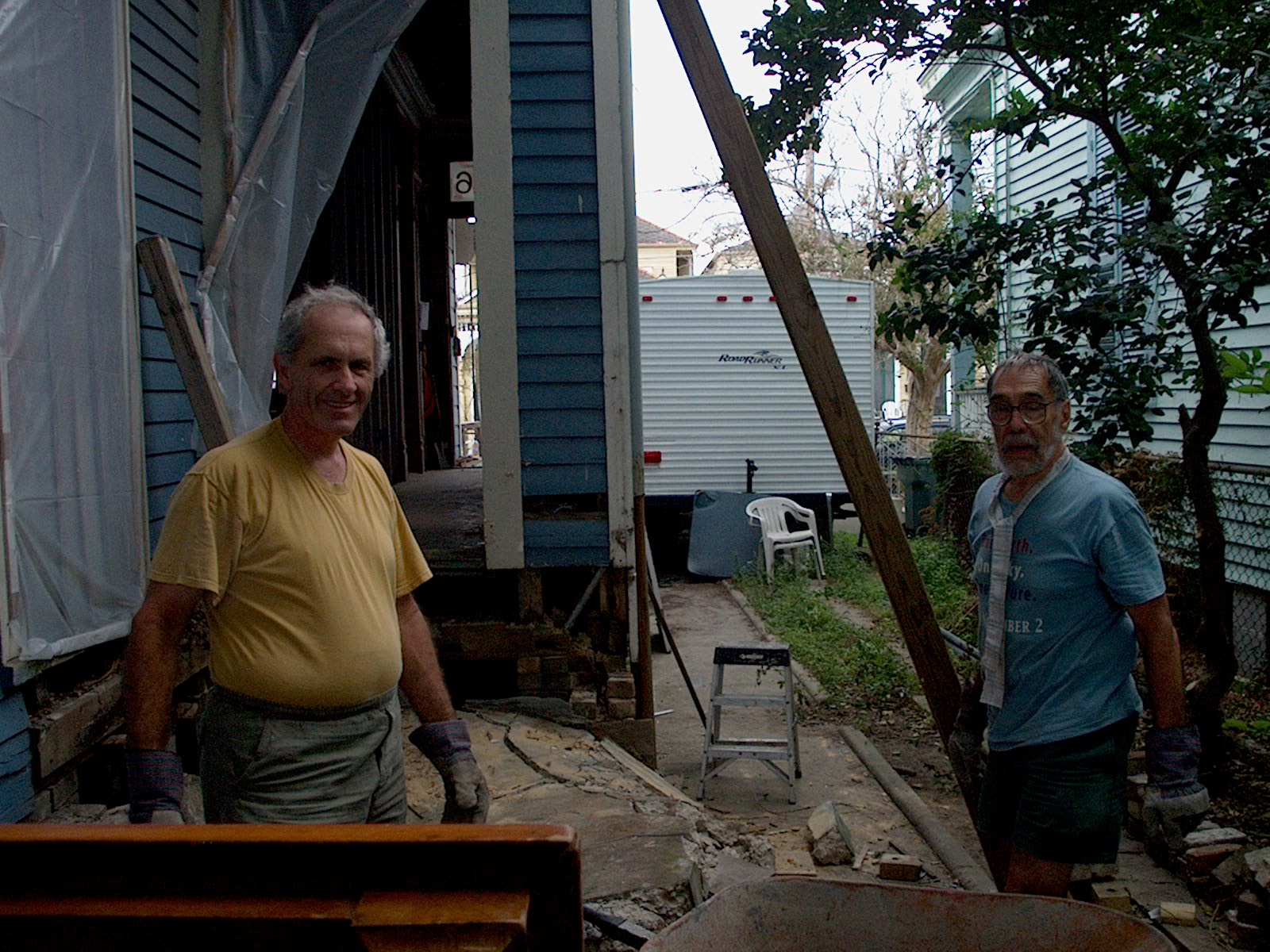
I went back to Ms. Evelyn’s house today. Some of us helped jack up a corner of the house that was sinking. I worked on exploring the possibility of stripping the paint from the baseboards and doors, in order to restore them to their original condition. This is a long-term job, since there is a huge amount of woodwork to be repaired in the home. Once we can set up the best techniques, then the crew leader can direct future volunteers more effectively.

This brings up an interesting situation with this organization. All of the staff and leaders are young adults, many working through Americorps, and probably all in their 20’s. Few of them have extensive construction experience, but they have an unbridled passion to do a good job restoring these homes.

Dallas, our crew chief, is from Portland, Maine. He has a fiction writing degree from Colorado and is an energetic and idealistic young man. He badly wants to not just return Ms. Evelyn to a house, but restore her home to as close to its original condition as possible. Of course, we are doing this with little money, but a lot of labor. So, there are times when we volunteers have suggested want seem to be logical ideas and shortcuts. But, Dallas is undeterred.

The point is that, whoever is right is not important. What matters is that this young man and the dozen or so other young people leading these projects are learning vital skills while performing valuable public services. This experience will make them even more amazing people who I am sure will contribute immensely to society. So, whether they make the decision we older and perhaps more experienced adults would make is less important than the fact that we respect their authority and give our best efforts to help them achieve their goals for their projects.

So, coming to New Orleans is about directly helping victims of Hurricane Katrina and its aftermath. It is also about training the next generation of citizens in leadership and giving them the confidence to strive for their dreams.

Another important aspect of our trip to New Orleans is infusing our energy and our financial resources into the community. Several of us have reported conversations with local residents thanking us just for being here. Today, our crew ate lunch at Cafe Reconcile, an absolutely fascinating organization in Center City. This five-story building currently is a restaurant where young people learn all of the skills of the hospitality business. In time, the upper floors will be developed into a banquet hall, classrooms, space for entrepreneurial enterprises, and short-term housing for students. The food was amazing – collards, okra, pork chops, crawfish bisque, among other things.

Tomorrow, everyone will be going to the Ka-Boom playground site.

New Orleans Trip: Monday

After breakfast, everyone broke into their work groups. I was part of a group of seven folks working on Ms. Evelyn Green’s house in Center City. Ms. Green is a widow and I understand a very prominent person in her neighborhood. During Hurricane Katrina, her roof was damaged and the house sustained a great deal of water damage. By the time she could move back in, water had seeped everywhere and mold was growing.

After hooking up with Hands On New Orleans, crews went into the house and gutted it. All plaster was removed, down to the rafters and joists. Everything was then power washed and treated with mold remover. Now, the crews are working on restoring the inside of this interesting old house, built in the 1890’s.

Today, a few of the volunteers worked on creating a window repair space and cataloging all the window parts in the house. Another group demolished a back porch ruined by the storm. We left two of the crew back at based camp to scout out the best prices on specialized equipment that will be needed to finish the outside siding and to research how some of the architectural details can be saved. I worked with one of the crew chiefs building temporary racks to how moldings and trim boards over the next few months.

About midway through the day, a very sharply dressed gentleman approached the house with a photographer. He toured the house and spoke to the workers. As he was leaving, I introduced myself and found out that he was the minister of the nearby church that used to house Hands On New Orleans. The photographer was from the New York Times! When he heard that I was a student minister, he asked if that meant I was a Reverend yet. I said, “Not quite,” but I had a feeling that I may wind up in the article as Reverend Liebmann (I hope I don’t get in trouble with the powers that be!)

Arriving back at base camp, we joined in the Race for the Showers – a thoroughly primitive display in less than ideal circumstances. Oh, well, what’s the point of experience like this if you don’t rough it a little? Dinner and the community meeting are in a few minutes. We have heard that a film crew is arriving from the U.K. for some reason. I didn’t bargain on becoming world famous for one little week of volunteer work!

Lower Ninth

The experience of driving through the Lower Ninth Ward in New Orleans yesterday was a sobering one, and many of those in our group were deeply moved. To see what was left of a thriving neighborhood two years after Hurricane Katrina leaves one little hope that this community will ever be reborn again. With their apparent lack of power, and the interests that would like to see the Lower Ninth become an oil refinery or some developer’s tax shelter, these people seem to have few advocates to regain the home they once had.

Ironically, the Sunday Times-Picayune carried a New York Times article titled, “Black women face tough choice in Demo primary.” If you are a member of a privileged class in America, the article makes for interesting reading. The reporter interviewed African American women in a South Carolina beauty parlor on their views toward Barack Obama and Hillary Clinton.

“I’ve got enough black in me to want somebody black to be our president…but I want to be real, too…I fear that they just would kill him, that he wouldn’t even have a chance,” said Miss Clara, owner of the shop. One way to protect him, she suggested, would be not to vote for him. Black voters have noted that Obama was given Secret Service protection earlier than any presidential candidate except Hillary Clinton, who already had protection as a former president’s wife. After seeing the desolation of the Lower Ninth, and countless other examples in American history when the rights of African Americans have been pummeled into the ground, I can easily imagine why Miss Clara might feel protective of Obama.

One can hope that such fears are unfounded and we can all do more to work to improve our society so that the best candidate is elected to the presidency. After all, as one customer of Carries’ Magic Touch said, she would probably vote for Obama despite her fears for his safety. “Things happened with presidents in the past, and they weren’t African Americans.” Maybe if our nation honored this kind of bravery as much as that displayed on the battle field, then the people of the Lower Ninth and similar communities across the country might have one more small reason for hope in the future

New Orleans Trip: Sunday


Today is our first full day at Hands On New Orleans. It is a rest day, so after breakfast we all headed over to the First Unitarian Universalist Church of New Orleans. FUUNO is a beautiful facility that suffered from four feet of flooding during Hurricane Katrina and sustained substantial damage. But, the church has bounced back and is now beginning a major capital campaign in concert with two other area UU churches. I had one amusing moment. During the service, I noticed that my hymnal had a large circular imprint on the front cover. Later, I saw the following inscription on the inside front cover. “This hymnal was used to put out an ‘out of control’ chalice flame Easter Sunday, April 16, 2006.” No deep meaning, but it seems somehow appropriate.

After church we returned to “base camp” for lunch and our first community meeting led by the Hands On coordinator Stefanie. There are several jobs we will be working on this week including: construction on two houses; building a community playground through an organization called Ka Boom; helping the Animal Rescue Shelter of New Orleans (the only ‘no-kill’ shelter in the city); Project Lazarus, which helps AIDS patients; and doing outdoor cleanup and planting work with Groundwork: New Orleans.

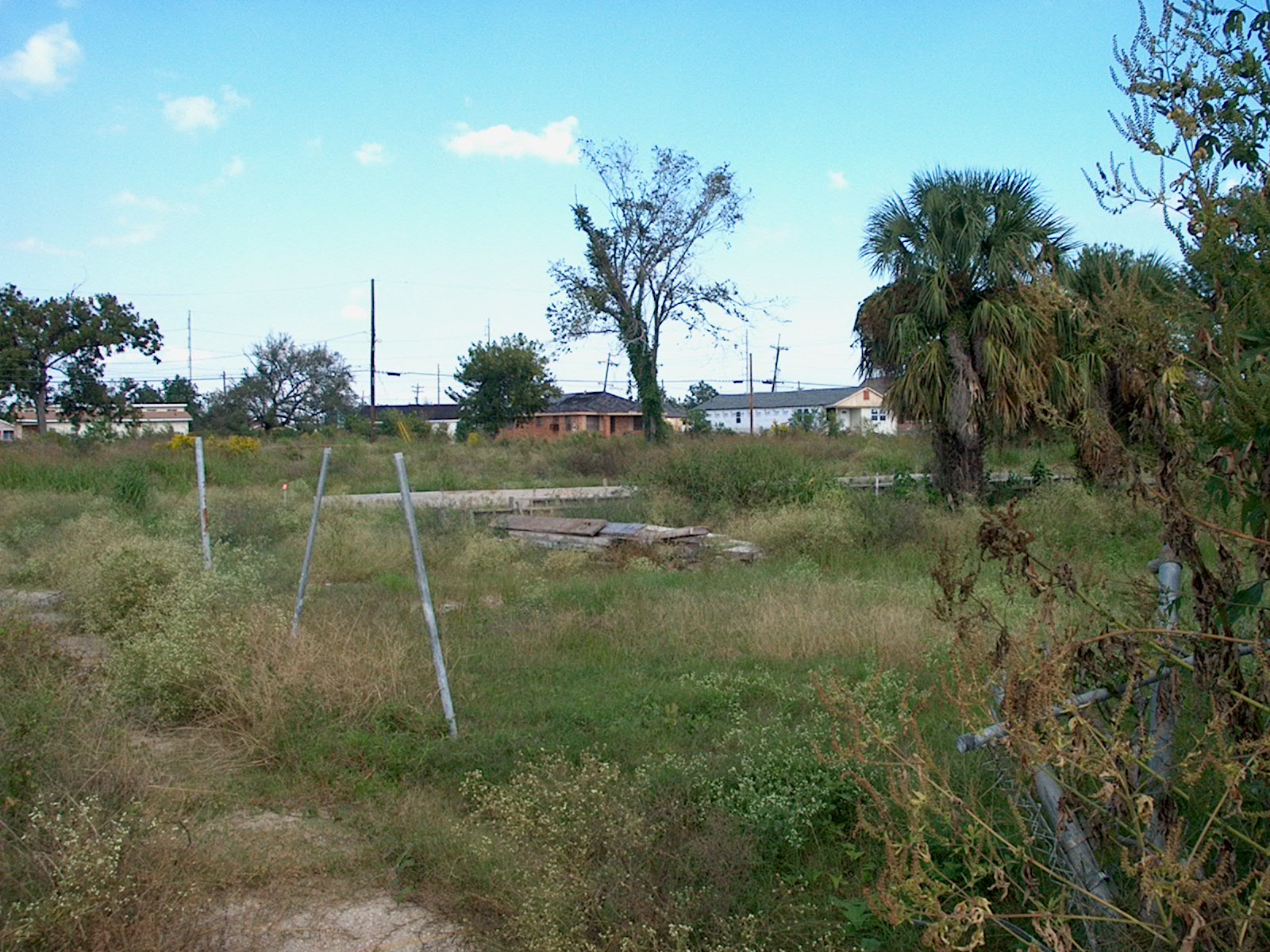
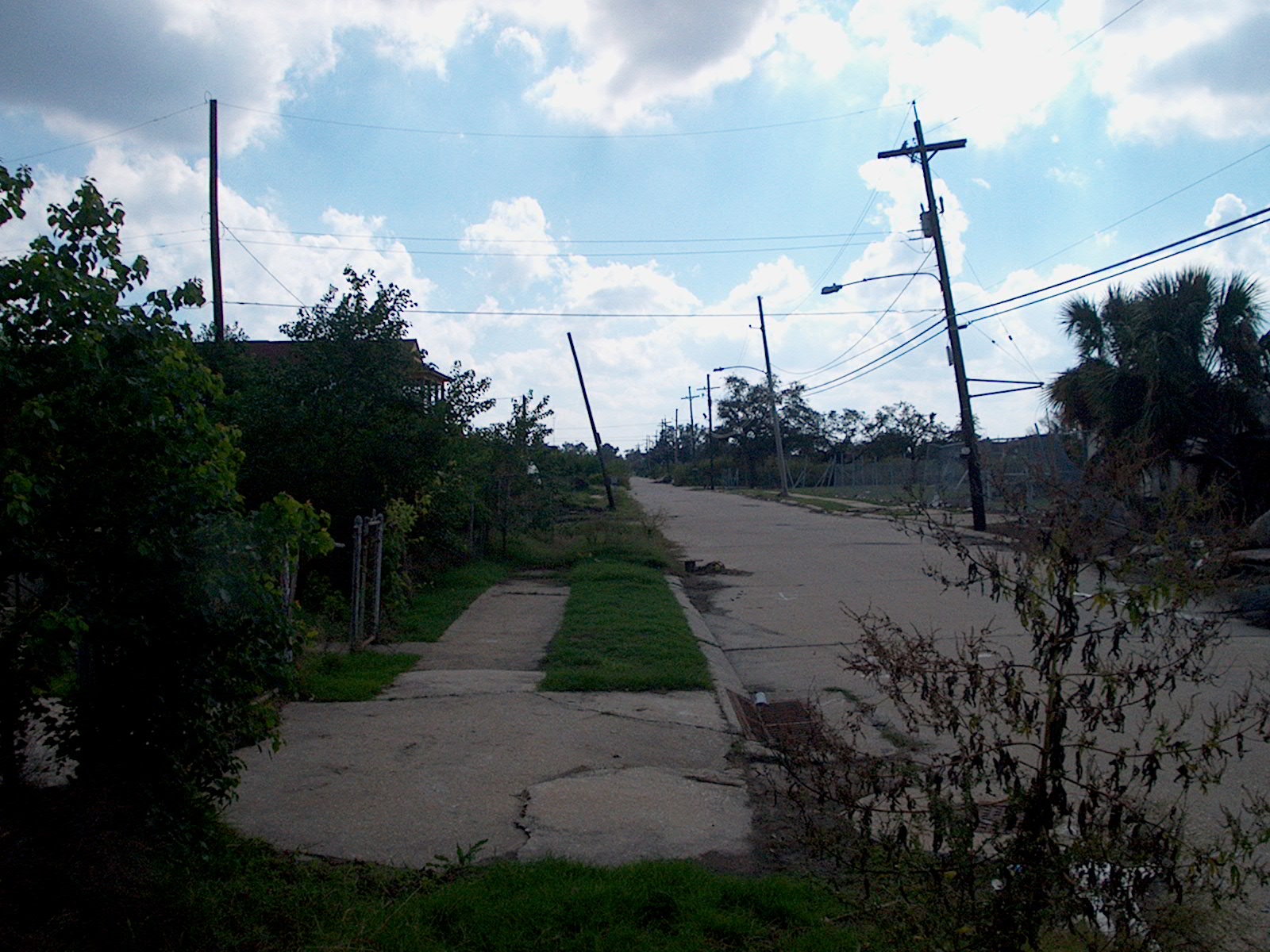
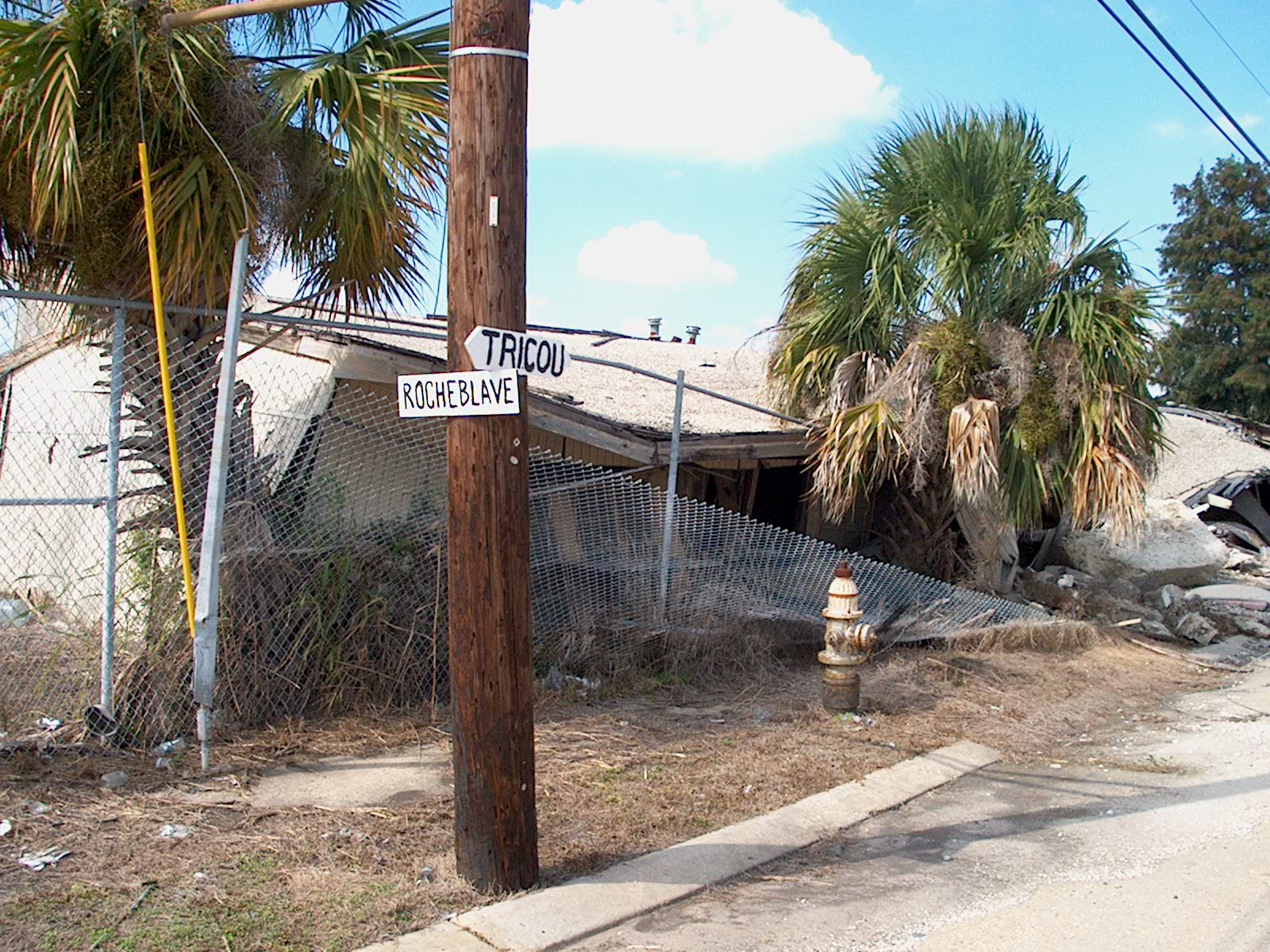
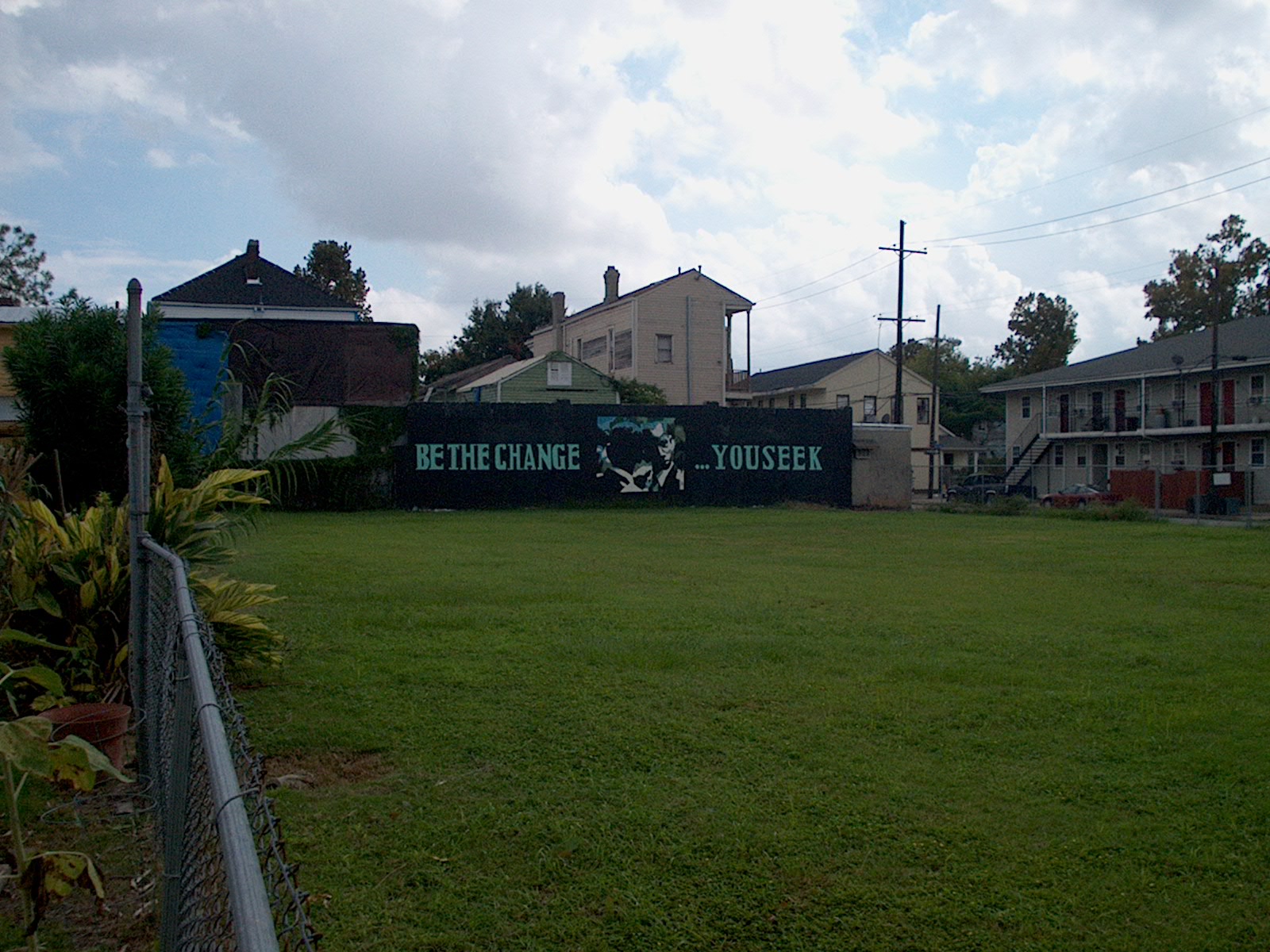
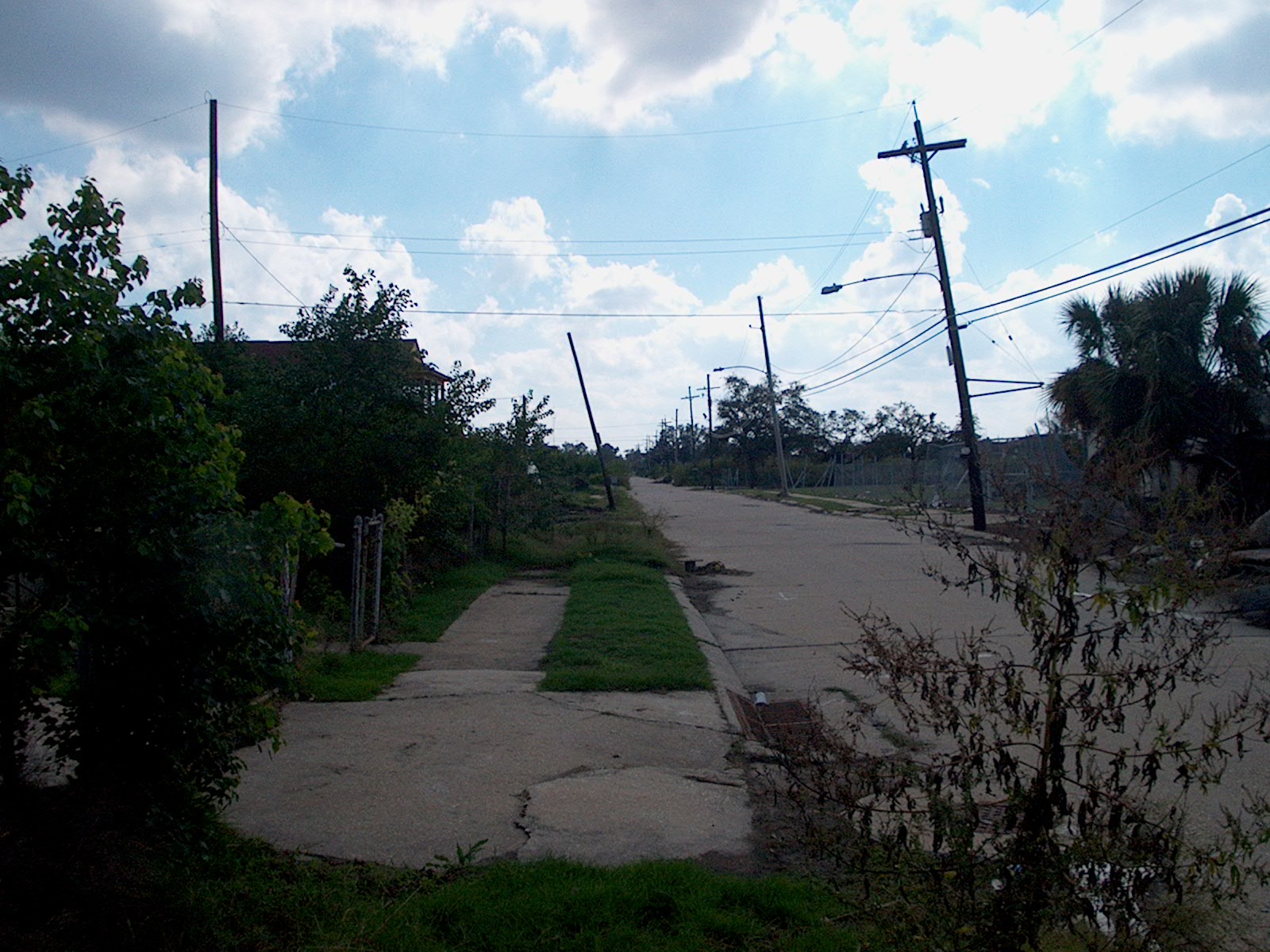
After lunch, we piled in the vans to take a tour of the city, especially the most affected areas. The tour consisted of many pages of text carefully prepared by First Church. Eventually, we drove into the Lower Ninth Ward. Watching all of the documentaries did not really prepare me for the desolation. Street after street of what used to be home-lined and tree-lined bustling communities is now just one empty, scrub-filled lot after another. One can literally count on a couple of hands the number of homes that seem to have been repaired completely. Most of the structures still remaining are in various states of disrepair, often with “Do not demolish” spray painted on their sides.

According to the tour, the former residents are besieged on all sides by bureaucracy and a society that has abandoned them. Many home owners (and 68% of the homes in the area were owned by their residents) inherited their houses from parents and never filed official papers regarding the transfers. As a result, home owners unable to prove ownership have been denied compensation or assistance. Also, people whose homes were destroyed and lack the money to rebuild, are being fined by the city if they fail to keep their unusable properties clear of overgrown plants. It doesn’t matter that the population of the area probably numbers in the dozens. No matter how one slices it, the injustice looms massive. It was a sobering experience.

As we looked at the infamous levy, we learned that some people have alleged that the levies were blown up. Apparently, many decades ago, the city blew up the levy in the poorer district in order to spare the richer district from flooding. So, the legacy of this colossal act of public ill lives on. It is not hard to imagine why a local resident would believe stories of government corruption and conspiracy, especially as contractors bilk property owners out of money and developers pressure the city to take over via eminent domain.

The rest of the evening, we spent in the world-renowned French Quarter. Anyone who asks why New Orleans should be rebuilt simply needs to go to this one-of-a-kind site.

Tomorrow, the work begins!

Flying to New Orleans

I arrived at the Pittsburgh International Airport two hours early to find it nearly deserted. Saturday night is a great time to fly out. The check-in area was virtually empty of people (except of course for the person ahead of me in line with three boxes of human blood!).

This gives me the opportunity to exercise my right of free speech and express my opinion that the insanity that is airport security should make us ashamed to call ourselves civilized [rank mode on]. I challenge someone to prove that the time and resources expended in this colossally stupid enterprise has actually succeeded in apprehending any credible threat to the public welfare. I accepted this absurdity until the removal of shoes began a few years ago. This endeavor is, in my opinion, the result of unbridled fearmongering…sigh [rant mode off].

Anyway, I arrived at the terminal in time to watch most of the restaurants close their gates; all but McDonald’s and TGIFriday’s. Not wanting to raise my cholesterol 20 points, I headed for the acronym. Just a word of warning – a half order of potato skins is still HUGE. Ron was a very friendly waiter and extremely attentive. He was disappointed when I told him that I do not fly often. So, if you find yourself eating at Friday’s at the airport, ask for Ron.

So, there are 14 of us waiting for the connecting flight to Washington D.C.: 11 men, two women (one wearing sunglasses at night), and a baby of indeterminant gender. The plane is a puddle jumper that seats about 50. Mercedes, the flight attendant, is hilarious. Her’s was the first safety speech I have listened to in years.

Dulles International was much busier. I strolled through a couple of shops (Border’s carried Newsweek, but not Time – I wonder if that has anything to do with the UUA’s national ad campaign? Just kidding). The toy store had one of those bins with annoying wind up toys. One was a chicken that did that inane birdie dance song that is so prevalent at weddings. I told the clerk that if I had to endure that cacophony for an eight-hour day, I would end up on the six o’clock news.

On the flight to New Orleans, I sat next to a nice lady from Myrtle Beach. When she saw me reading The Pipe and Christ, a book about a Jesuit priest and the Lakota Indians, we got to talking about religion. She had heard of Unitarian Universalism, having read a biography of Christopher Reeve. She could not quite understand, though, why anyone would not want to accept the joy of a personal relationship with the Christian God. I suppose I need to get used to those conversations.

We arrived in New Orleans 25 minutes ahead of schedule – amazing! On the cab ride to the Hands On New Orleans site, we passed the Superdome. It immediately brought back memories of the thousands of people stranded there with no facilities and of people dying on the sidewalks outside. It’s midnight now and everyone is asleep. So, I’m in an empty room at the end of the hall until tomorrow, when I will move to the men’s bunk room.

The UUA and Madison Avenue

The Unitarian Universalist Association’s national advertising campaign has begun. Advertising in Time Magazine began with the October 15, 2007 issue and will continue over the next several months with placements such as this UUA print ad (also shown to the left).

According to the UUA’s press release, the Time.com Religion Pages will offer links to articles and essays authored by Unitarian Universalists on topics including: the relationship between religion and science; the role of religion in American democracy; and religion, morality, and sexuality.

I certainly applaud the goals of the campaign and believe such an effort is long overdue. Our denomination will always debate issues of the relative merits of any continental efforts and their impacts on congregational polity. But, I personally feel that the relative benefits far outweigh the potential harm.

That said, this first print ad even made me cringe just a little. “Is God keeping you from going to church?” I do understand the desire to be catchy, even controversial, in getting the reader’s attention. The ad certainly appeals to the atheistic, yet religious person within me. But, I have no doubt that many Unitarian Universalists will see this ad and explode in anger over what they will perceive as an anti-theist tone and the heavy reliance on the term “church.”

I will not be one of those criticizing the ad (do not, however, ask me what I think of the new UUA web site, grrrrr). For while I deeply respect those who might find the ad objectionable (and I have no doubt that conversations will continue for many weeks), I will suggest that nearly any attempt to attract broad public interest in Unitarian Universalism in eight words will displease many dedicated UU’s. The reality, however, is that we certainly will never get the millions of readers of Time magazine to read Channing’s Baltimore Sermon or Ballou’s “Treatise on Atonement.” Even the text of the seven principles is too long for the average modern attention span. I do not see this as sufficient reason not to produce such a campaign.

We are a tiny denomination – a soft voice amidst a cacophony of shrill shouts. And yet, we have evidence that many people share our religious philosophy, but are simply unaware that we exist. I see no harm in helping people learn that we are here and that we welcome them with open arms; in fact I believe we have a duty to make our presence known. I see no way to make this omelet without breaking eggs.

The key, in my opinion, is to assess the materials and calmly reflect before reacting one way or the other. Then, encourage discussion in your church, congregation, fellowship, society about the issues. Most importantly, now is the time that we should all pay extremely close attention to our visitors. For while we may take issue with this campaign or its specific contents, the result may be to bring people through our doors asking that question that so many of us have asked — “Where have you people been all my life?”

Guilty Pleasures

As you know from the title of this erudite journal, pizza is one of my guilty pleasures. You’ve seen that bumper sticker that says, “A bad day of fishing is better than a good day at work.” Well, for me, even a bad pizza is better than good food that is healthy and nutritious. Well, not always, but work with me here.

Anyway, I have an idea for a book that I offer up to anyone who wants to run with it. Just send me an autographed copy or two when it hits the New York Times bestseller list. The title would be simply “Guilty Pleasures,” and it would consist of an encyclopedic collection of the guilty pleasures of famous people throughout history. I know I would read it.

Now, we have to be careful about our definitions. A pleasure isn’t truly guilty unless it is really bad or potentially harmful for you. So, no altruistic pursuits and no quaint but harmless hobbies. Wouldn’t it be awesome to learn that Michaelangelo had tattoos and body piercings; or that Lincoln loved to skinny dip in the Potomac River; or that Confucius slipped risque limericks into the Analects? Of course, the Roman Emperors would have an entire chapter.

None of us are saints. Given that we are human, we will make mistakes and we will engage in behaviors that are risky, possibly harmful, and even potentially dangerous. I think the point is that, since we must engage in these behaviors by our nature, then we should do so with intent and in a way that maximizes our own pleasure and the pleasure of those people important to us. So, when you engage in your guilty pleasure, be creative about it and do it shamelessly. Drink responsibly, laugh heartily, and love relentlessly. Never be ashamed about your passion.

Apatheism

Browsing the latest issue of the Humanist Network News, I found myself browsing an article by Warren Allen Smith. His online encyclopedia of freethinkers, Philosopedia, defines apatheism (a portmanteau of atheism and apathy), as a subset of atheism, when atheism is defined as lack of belief in deities, rather than specific disbelief in deities. “An apatheist (AP-uh-thee-ist) is someone who is not interested in accepting or denying any claims that God, or any other supernatural being, exists or does not exist. In other words, an apatheist is someone who considers the question of the existence of God as neither meaningful nor relevant to human affairs.”

I came to atheism after years of reflection and by what seems to me, appropriately, to be a quite evolutionary process. I certainly would say that I possess a lack of belief in deities. I suppose I have yet to consider whether I also possess a specific disbelief in deities. But, just because I do not believe deities exist, nor that any proof of their existence could be offered, I think it would be slightly presumptuous of me to profess a disbelief in deities.

So, the question now is whether or not I consider the existence of God as a meaningful notion or as relevant to human affairs. Let me start simply. The existence of God has no meaning to me. And, I certainly believe that peoples’ belief in the existence of God has led to some of the greatest miseries of humanity in the millennia since the inception of civilized society. On the other hand, belief in the existence of God has also created great beauty and motivate some people to incredible acts of generosity, kindness, and courage.

Therefore, I think the more relevant question is, should the existence of God continue to be a meaningful notion? I would answer that question categorically in the affirmative. I believe that humanity has outgrown its continued belief in the existence of God, just as children outgrow their need to believe in many myths and fairy tales to assuage their guilt or ease their fears of the unknown. I believe that a continued belief in the existence of God will eventually lead to more “just” wars with unjust underlying motives professed by preaching hypocrites with sacred texts in one hand and clubs and stock portfolios in the other hand.

Given that no one can wave a magic wand and excise the notion of God from human memory, one must surely admit that the existence of God has been, is today, and will likely continue to be relevant to human affairs. So the question of whether or not it should be relevant is, in my opinion, moot. The answer, therefore, lies in religious education and in the provision of effective affective worship experiences that do not require a believe in God. I have spent many years committed to the education of our youth in the ways of critical thinking and assessment of moral issues based on Unitarian Universalist principles. And, as a developing minister, I am now committing myself to the creation of worship experiences that are effective and that produce in participants an affect that is as powerful, if not more powerful, than that produced by the purveyors of the God myth.

So, am I an apatheist. Not yet and perhaps never. As a minister, I must care about the impact that peoples’ belief in the existence of God has on society, and I must respond by offering religious people an atheistic option to pursue their spiritual paths and to share worshipful experiences with others.

Pilgrimage to New Orleans

The weekend has finally arrived for our trip to New Orleans! A group of 30 Unitarian Universalists from Pittsburgh is flying down on Saturday to work for a week with an organization called Hands On New Orleans doing Katrina-related work. We have been planning this trip for almost six months and I can’t wait.

The site where we will be staying apparently has a small computer lab, so I will try to post daily site reports with a smattering of my own editorial comments as the week progresses. I am anxious to do my small share to help rebuild the lives and the city of New Orleans. I also welcome the experience of working side by side with my fellow Unitarian Universalists in the frontline of social justice activism.

We certainly owe a debt of gratitude to everyone who helped fund this trip from the churches in the Pittsburgh cluster. I want to thank everyone who attended our Brunch on the Bayou event in August and the Jim Scott benefit concert in September. I also want to thank everyone who donated directly to this fund raising effort. And, a special thanks goes to Michael Miller from the Unitarian Universalist Church of the South Hills for his magnificent and tireless administration of this trip.

Stay tuned!

The Jena 6 Case and Evolution

As I follow the Jena 6 case, I have come to the conclusion that our news media have displayed ineptitude above and beyond their normal limits. At this point, a reasonable reviewer of the reports of the events that went on in that town has little chance of possessing a complete and factual account. Regardless of the various arguments to the contrary, I am convinced that the malignancy that is our criminal justice system has once again reared its ugly head, displaying its overt racism and classism.

What disturbs me even more, however, is what I perceive to be a growing sentiment – that in time, our justice system with its various appeals and retrials will sort everything out and justice will eventually be served. Perhaps, in my childhood, I might have believed such a fantasy. But, the hard reality is that there still exist too many factions vested in a racist system of law enforcement and in a society that fails to invest in the future of our children regardless of their social status, family background, or ability.

I do not believe we can wait for the laborious process of evolution to eventually produce in this country a legal system that is color blind, or a school funding formula that does not favor the rich. The reality is that evolution consists not only of gradual change and adaptation, but also radical change and mutation. And, since we face forces with powerful resources invested in the status quo. We must be willing to be change agents.

The young men charged in the Jena 6 case are not angels. So what? Neither were their white counterparts who walked away with no charges and no potential for massive prison sentences. This community failed these young people and they should not be held liable. They and their families should not have to sacrifice years of their lives and all of their financial and emotional resources fighting unjust charges. This nation is failing another generation of young people and we should be held liable if we do not advocate for radical change in our legal system, our schools, our taxation practices, and our government funding policies.