Wiener Dogs and Polka

Another favorite word of mine is “entendre.” A cousin of the pun, another low brow figure of speech, the entendre relies on innuendo (yet another cool word) as a way to to express oneself in a playfully risque manner. Now, appealing to my base sense of humor, while immensely gratifying, is not enough to warrant entry in the pizzatorium. Oh, no. Pizzas are all about combinations of tastes and textures. So, the truly effective double entendre must be couched within a framework of aburdity to merit attention.

We have a radio show here in Pittsburgh every Friday on Carnegie Mellon University’s station (WRCT). DJ Zombo, tends to play bizarre and silly music from all eras. A recent favorite is a song called the Wiener Dog Polka. Not only is this a “roll on the floor laughing” piece, loaded with double entendres, but it is performed by a group called Polkacide. Here is where the surreality steps up a notch.

Polkacide (the band’s logo is a skull and crossed kielbasas) was originally organized to play a one-night stand for the Deaf Club in San Francisco in 1985. The Deaf Club (an actual club for deaf people) had been hiring punk bands to perform. When it was suggested that some did not want a punk band, founder Ward Abronski, along with his long term girlfriend and Polkacide’s first drummer, formed a “really loud polka band” to play. When the gig was cancelled (ironically for noise abatement), Ward realized it was too good of an idea with too many great musicians, to let it die. I love synchronicity.

The challenge, of course, for a minister, especially a somewhat irreverent reverend. Is to find some “appropriate” way to insert such wonderful snippets of human creativity into a sermon. I find such reflections entertaining, as well as challenging. And, no, doing a “Humor in Religion” service doesn’t count. That is low hanging fruit.

I have yet to think of a good spot for this little tidbit, yet. But, I firmly believe that every dog has its day (so to speak), so the opportunity will arise sometime. That is one way to get people to read their church newsletters.

Irreverent (but Respectful of Boundaries)

Certain words delight me. They find their way into my speech and writing, partly because they have deep meaning. But, they also usually possess something interesting as words in either a visual or auditory sense. For instance, I love the word “paradigm.” Ever since I read Joel Barker’s book on the subject years ago, the concept (and that silent ‘g’) have given me immense joy.

I was reminded of another delightful word recently. In closing an email, a friend signed off with “Yes at times irreverent, but respectful of boundaries.” What an absolutely wonderful expression! Of course, now that I travel the path toward a life of ministry, the word “irreverent” has new meaning. How exactly does a minister act irreverently? Can a “reverend” be irreverent?

Well, I certainly intend to explore irreverence as a “reverend” in my ministry. For one, I strongly encourage people to challenge assumptions in their lives and to facilitate paradigm shifts. My most commonly asked question is “Why?” Why do we follow certain rules and behave in certain ways? And, please, never expect me to accept as a valid answer, “Because we have always done it that way,” unless you are able to substantiate the tradition with detailed justification.

Another favorite form of irreverence is humor, particularly satire. My ministry is as informed by the “sermons” of George Carlin as it is by any theologian past or present. Humor gives us permission to lower our guard, so that we can examine ourselves safely and with an open spirit. The act of laughing relaxes our bodies and eases tensions that might make us less open to insight and sharing.

Perhaps my favorite form of irreverence is the use of popular culture as religious metaphor. I frequently infuse imagery from movies, television, and so-called “lower” art forms into my sermons. This summer, I delivered a sermon on the Gospel According to Ed Wood, and I am currently writing a paper on Themes of Religious Humanism in the films of George A. Romero. If someone had not already written them, I would have composed religious education curricula on the Simpsons, Star Trek, and Dr. Seuss.

Irreverence, however, should be wielded with a substantial degree of precision. Like any tool in the arsenal of the minister, irreverence can hammer a point home, or smash its intended target indiscriminately. Sometimes, paradigms exist for legitimate reasons. Sometimes, making light of a topic is simply not appropriate. And, sometimes, we need to appeal to a “higher” state of intellect, emotion, and being to achieve a desired affect. So, I shall strive to always maintain a healthy irreverence, while remaining mindful and respectful of boundaries.

New Orleans Trip: Afterword

The past week seemed to be immensely rewarding for each of the participants. It is hard to assess the impact one short week of effort by our little group had on this city still recovering two years later from the trauma of Katrina. In some ways, our presence alone appeared to have as significant an effect on the residents as did the weeds we pulled, the nails we hammered, or the food we sorted. And, even though we paid Hands On New Orleans for room and board for the week, we brought to the trip additional financial resources by purchasing a good deal of food, drink, and souvenirs, and through charitable donations.

For me, the experience was an interesting contrast of the close quarters and strenuous effort for six days among adults with my many past weekends spent at weekend district youth conferences. As the week progressed, we learned a good deal about each other and many friendships developed. We spent much time in the common lounge area at Hands On talking and sharing. At the same time, the living quarters presented unfamiliar challenges that created moments of modest tension. Living in bunk beds in a room with 8 to 16 people, and sleeping in the Southern heat and humidity, fosters forces that bind folks together in shared intimate exploit, but also produces strains that accentuate the differences that can separate us.


A lesson that this week strongly reinforced for me was the importance of assuming the good intention of others. Affirming and promotion the inherent worth and dignity of every person entails an appreciation of the very different personalities we all possess. When these personalities clash, we can avail ourselves of many tools to resolve conflicts and reunite in common purpose – a caring thought, humor, a gentle touch or a hug. But, most important, I believe, is the discipline of walking in another’s shoes just long enough to see the world from their perspective, and hopefully understanding the influences that produced the person as they are today. Just a moment of reflection can help all of us see the basic goodness that lies in each person.

Living in a human society, our lives intersect which each other on a daily basis. At school, at work, and at church, our interactions can create moments of shared joy and wonder. But, crossing paths can also generate friction. When that happens, before we look for the hurtful cause, or the evil in another, it helps to first assume the good intention of others. Finding the good in others may also help us intensify the good within ourselves.

New Orleans Trip: Friday

This was our last work day here in NOLA (New Orleans, La.). Most of the job sites were repeats, including the Live Oak School, Project Lazarus, and the various construction projects. I spent my last day back at Ms. Evelyn’s house pulling down plaster and lath. We got the huge timber installed under the sagging corner of the house, so our crew chief was excited.

I do not consider myself a gourmet by any means. In fact, I am really not all that discriminating an eater at all. But, there are some foods that turn me into that drooling vision of Homer Simpson. We ate lunch at Cafe Reconcile again, and today I had the Shrimp Creole, Crawfish Bisque, and chicory coffee. New Orleans deserves to be restored to its original condition if for absolutely no other reason, meals like this.

Tonight, I walked a few miles along St. Charles Avenue to the Camellia Grille. My daughter has been raving about this place for years on her visits. Again, my palate was delighted. They had a chocolate pecan pie. I told the man behind the counter that I do not order pecan pie north of the Mason-Dixon line, because we Northerners just don’t know how to make it. He assured me that I would be delighted.

I watched as he cut the slice of pie and inverted in onto the grill. Then he squirted a little butter on the grill and flipped the pie over. After placing it on the plate, he topped it with a huge scoop of vanilla ice cream. Words fail me in describing that experience.


I don’t exactly know what makes a memorable experience religious. Perhaps seeing a child’s precious stuffed animal atop moldy textbooks in a collapsed elementary school in the Lower Ninth Ward two years after Katrina is a religious experience. Perhaps every experience is religious to some small degree. I am not sure what the percentage must be in order for an experience to be truly described as religious. I think that I have reached a point where any moment in our lives that takes us beyond the normal and routine, and that stimulates our thoughts and emotions, is religious.

Because if God is the ultimate, or the combination of all experience, or the universe, or however one views the concept, then any experience that opens our senses, our hearts, or our minds to something beyond ourselves is placing us in the presence of God. Perhaps thinking of eating a chocolate pecan pie trivializes the nature of experiencing God. I certainly do not intend to do so. I am trying to say that a simple act – feeling a breeze, wading in the surf, watching the first golden rays of sunlight in the morning – can inspire awe, and put one in a state of self awareness and awareness of our connectedness with all of existence.

The potential for such an experience should exist every Sunday morning in worship services. But, we should be on the lookout for these moments all during our hectic lives. Perhaps a truly religious life is one filled with religious experience – some that are life changing epiphanies, and some that waft on the wind like a butterfly.

You Are a New Orleanian

Tonight, many of the volunteers from Pittsburgh met some of the members of the First Unitarian Universalist Church of New Orleans for dinner. In addition to the fellowship and sharing, we had a presentation by one of the church members on race and class issues and Katrina. Of course, race and class remain (unfortunately) significant factors in the lives and well-being of Americans, which is perhaps no were more apparent than in aftermath of the Katrina tragedy. For instance, the Gulf Coast Housing Recovery Act currently in Congress lays out the deliberate racist and classist actions of people in authority at the time to shut down quality public housing sites and evict existing tenants after the disaster largely to replace public housing with higher cost housing. Ironically, one of the chief opponents of the bill is Louisiana senator David Vitter. We were urged to join the campaign contacting Senator Vitter’s office to ask that he stop his efforts to block the bill.

Reverend Melanie Morel-Ensminger of First UU Church also spoke in response to a question of how we should respond when people ask why New Orleans should be rebuilt given its geographical location and the danger of another devastating storm in the future. Reverend Morel-Ensminger replied that people would not ask this question if San Francisco needed rebuilding, even though it lies on a fault line. She said that people did not ask whether the cities on the Mississippi River flood plain should be rebuilt, even though the flooding of several years ago may well occur again. These questions would not be asked because, in this case, the vast majority of victims were people of color, the poor, and often both.

“You are a New Orleanian,” she told us, if you love jazz music, red beans and rice, and the other cultural contributions of New Orleans. You are a New Orleanian if the federal government controls a dam, or bridge, or other piece of critical infrastructure whose failure could cost you your home. She expressed the hope that no one ever experience the displacement and discrimination that many New Orleanians have faced, especially now that in just weeks, FEMA will be shutting down trailer camps, yet again putting low income people on the streets.

You are a New Orleanian if you believe in justice and that our government should protect our rights as home owners and citizens against the legions of the greedy, the narrow minded, and the uncaring. “We don’t want your pity,” she said. What New Orleanians want is for us to join with them in the fight for justice for all and in recognition of our common desire to live lives of freedom and dignity.

New Orleans Trip: Tuesday

Today, most of the volunteers went to the New Orleans Food Bank. A few returned to the Animal Shelter and some returned to the Lazarus Project working with AIDS patients. Also, the two construction crews at Ms. Evelyn’s and Ms. Severe’s houses returned to their sites.

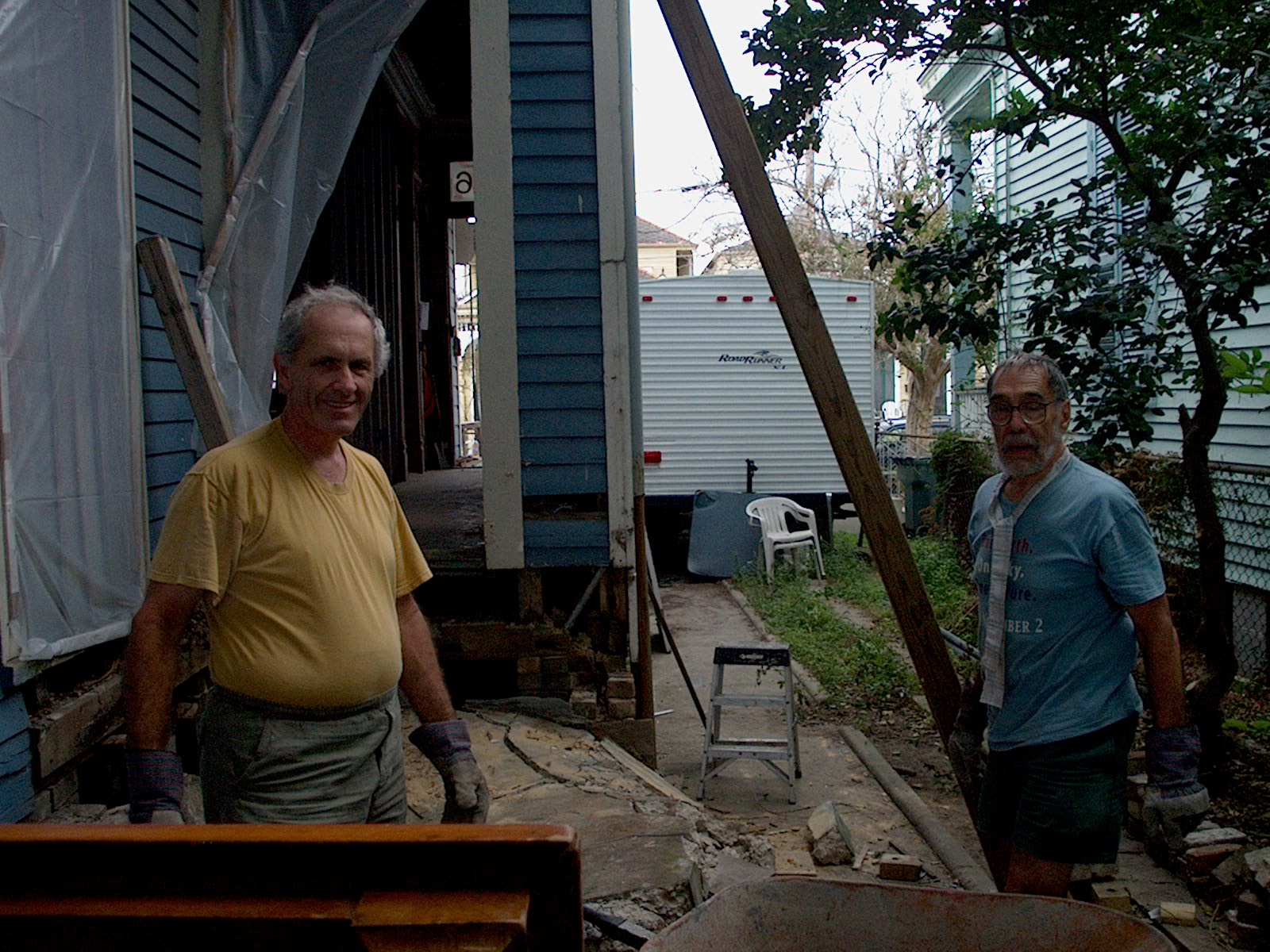
I went back to Ms. Evelyn’s house today. Some of us helped jack up a corner of the house that was sinking. I worked on exploring the possibility of stripping the paint from the baseboards and doors, in order to restore them to their original condition. This is a long-term job, since there is a huge amount of woodwork to be repaired in the home. Once we can set up the best techniques, then the crew leader can direct future volunteers more effectively.

This brings up an interesting situation with this organization. All of the staff and leaders are young adults, many working through Americorps, and probably all in their 20’s. Few of them have extensive construction experience, but they have an unbridled passion to do a good job restoring these homes.

Dallas, our crew chief, is from Portland, Maine. He has a fiction writing degree from Colorado and is an energetic and idealistic young man. He badly wants to not just return Ms. Evelyn to a house, but restore her home to as close to its original condition as possible. Of course, we are doing this with little money, but a lot of labor. So, there are times when we volunteers have suggested want seem to be logical ideas and shortcuts. But, Dallas is undeterred.

The point is that, whoever is right is not important. What matters is that this young man and the dozen or so other young people leading these projects are learning vital skills while performing valuable public services. This experience will make them even more amazing people who I am sure will contribute immensely to society. So, whether they make the decision we older and perhaps more experienced adults would make is less important than the fact that we respect their authority and give our best efforts to help them achieve their goals for their projects.

So, coming to New Orleans is about directly helping victims of Hurricane Katrina and its aftermath. It is also about training the next generation of citizens in leadership and giving them the confidence to strive for their dreams.

Another important aspect of our trip to New Orleans is infusing our energy and our financial resources into the community. Several of us have reported conversations with local residents thanking us just for being here. Today, our crew ate lunch at Cafe Reconcile, an absolutely fascinating organization in Center City. This five-story building currently is a restaurant where young people learn all of the skills of the hospitality business. In time, the upper floors will be developed into a banquet hall, classrooms, space for entrepreneurial enterprises, and short-term housing for students. The food was amazing – collards, okra, pork chops, crawfish bisque, among other things.

Tomorrow, everyone will be going to the Ka-Boom playground site.

New Orleans Trip: Monday

After breakfast, everyone broke into their work groups. I was part of a group of seven folks working on Ms. Evelyn Green’s house in Center City. Ms. Green is a widow and I understand a very prominent person in her neighborhood. During Hurricane Katrina, her roof was damaged and the house sustained a great deal of water damage. By the time she could move back in, water had seeped everywhere and mold was growing.

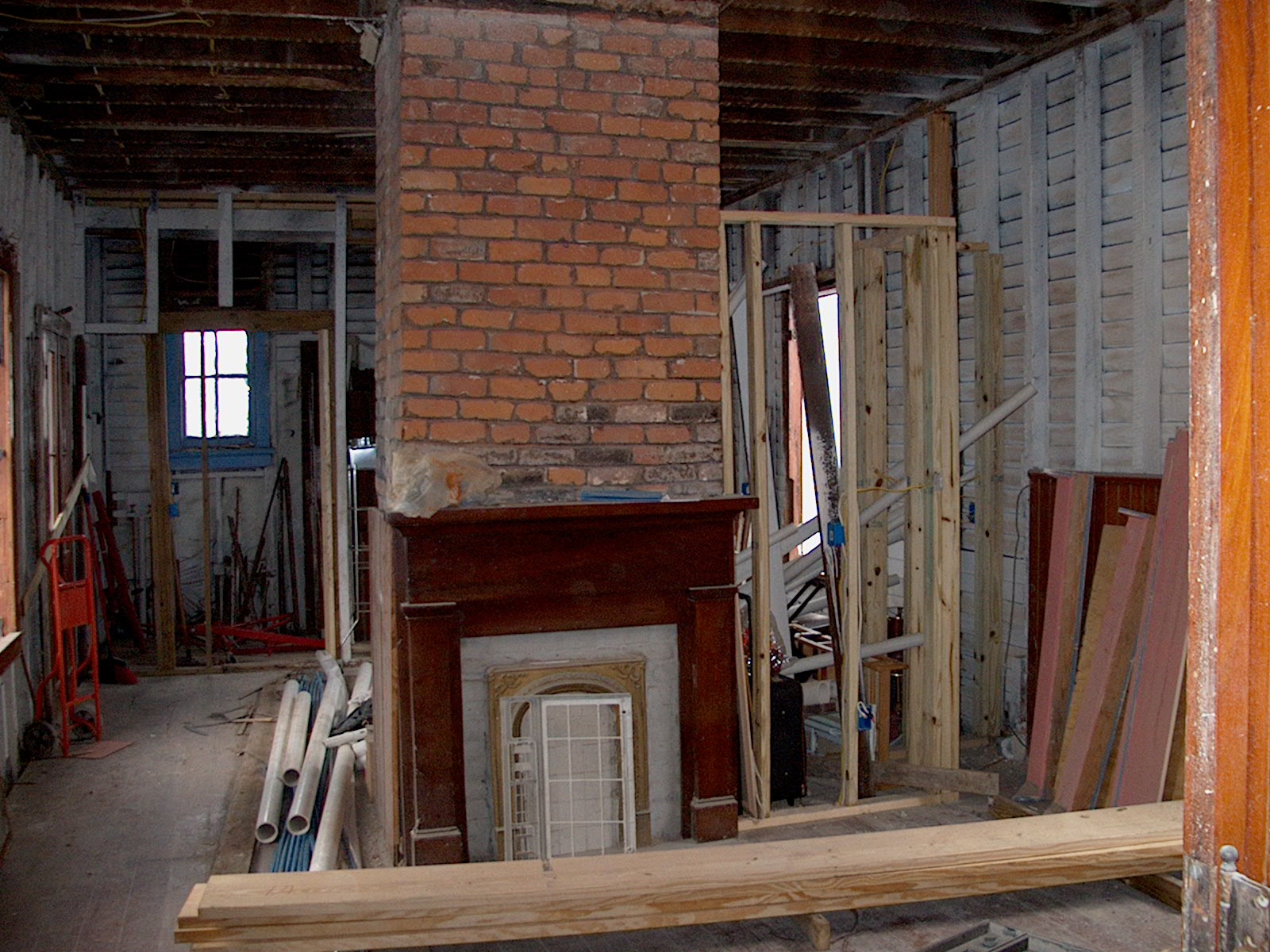
After hooking up with Hands On New Orleans, crews went into the house and gutted it. All plaster was removed, down to the rafters and joists. Everything was then power washed and treated with mold remover. Now, the crews are working on restoring the inside of this interesting old house, built in the 1890’s.

Today, a few of the volunteers worked on creating a window repair space and cataloging all the window parts in the house. Another group demolished a back porch ruined by the storm. We left two of the crew back at based camp to scout out the best prices on specialized equipment that will be needed to finish the outside siding and to research how some of the architectural details can be saved. I worked with one of the crew chiefs building temporary racks to how moldings and trim boards over the next few months.

About midway through the day, a very sharply dressed gentleman approached the house with a photographer. He toured the house and spoke to the workers. As he was leaving, I introduced myself and found out that he was the minister of the nearby church that used to house Hands On New Orleans. The photographer was from the New York Times! When he heard that I was a student minister, he asked if that meant I was a Reverend yet. I said, “Not quite,” but I had a feeling that I may wind up in the article as Reverend Liebmann (I hope I don’t get in trouble with the powers that be!)

Arriving back at base camp, we joined in the Race for the Showers – a thoroughly primitive display in less than ideal circumstances. Oh, well, what’s the point of experience like this if you don’t rough it a little? Dinner and the community meeting are in a few minutes. We have heard that a film crew is arriving from the U.K. for some reason. I didn’t bargain on becoming world famous for one little week of volunteer work!

New Orleans Trip: Sunday


Today is our first full day at Hands On New Orleans. It is a rest day, so after breakfast we all headed over to the First Unitarian Universalist Church of New Orleans. FUUNO is a beautiful facility that suffered from four feet of flooding during Hurricane Katrina and sustained substantial damage. But, the church has bounced back and is now beginning a major capital campaign in concert with two other area UU churches. I had one amusing moment. During the service, I noticed that my hymnal had a large circular imprint on the front cover. Later, I saw the following inscription on the inside front cover. “This hymnal was used to put out an ‘out of control’ chalice flame Easter Sunday, April 16, 2006.” No deep meaning, but it seems somehow appropriate.

After church we returned to “base camp” for lunch and our first community meeting led by the Hands On coordinator Stefanie. There are several jobs we will be working on this week including: construction on two houses; building a community playground through an organization called Ka Boom; helping the Animal Rescue Shelter of New Orleans (the only ‘no-kill’ shelter in the city); Project Lazarus, which helps AIDS patients; and doing outdoor cleanup and planting work with Groundwork: New Orleans.

After lunch, we piled in the vans to take a tour of the city, especially the most affected areas. The tour consisted of many pages of text carefully prepared by First Church. Eventually, we drove into the Lower Ninth Ward. Watching all of the documentaries did not really prepare me for the desolation. Street after street of what used to be home-lined and tree-lined bustling communities is now just one empty, scrub-filled lot after another. One can literally count on a couple of hands the number of homes that seem to have been repaired completely. Most of the structures still remaining are in various states of disrepair, often with “Do not demolish” spray painted on their sides.

According to the tour, the former residents are besieged on all sides by bureaucracy and a society that has abandoned them. Many home owners (and 68% of the homes in the area were owned by their residents) inherited their houses from parents and never filed official papers regarding the transfers. As a result, home owners unable to prove ownership have been denied compensation or assistance. Also, people whose homes were destroyed and lack the money to rebuild, are being fined by the city if they fail to keep their unusable properties clear of overgrown plants. It doesn’t matter that the population of the area probably numbers in the dozens. No matter how one slices it, the injustice looms massive. It was a sobering experience.

As we looked at the infamous levy, we learned that some people have alleged that the levies were blown up. Apparently, many decades ago, the city blew up the levy in the poorer district in order to spare the richer district from flooding. So, the legacy of this colossal act of public ill lives on. It is not hard to imagine why a local resident would believe stories of government corruption and conspiracy, especially as contractors bilk property owners out of money and developers pressure the city to take over via eminent domain.

The rest of the evening, we spent in the world-renowned French Quarter. Anyone who asks why New Orleans should be rebuilt simply needs to go to this one-of-a-kind site.

Tomorrow, the work begins!

Flying to New Orleans

I arrived at the Pittsburgh International Airport two hours early to find it nearly deserted. Saturday night is a great time to fly out. The check-in area was virtually empty of people (except of course for the person ahead of me in line with three boxes of human blood!).

This gives me the opportunity to exercise my right of free speech and express my opinion that the insanity that is airport security should make us ashamed to call ourselves civilized [rank mode on]. I challenge someone to prove that the time and resources expended in this colossally stupid enterprise has actually succeeded in apprehending any credible threat to the public welfare. I accepted this absurdity until the removal of shoes began a few years ago. This endeavor is, in my opinion, the result of unbridled fearmongering…sigh [rant mode off].

Anyway, I arrived at the terminal in time to watch most of the restaurants close their gates; all but McDonald’s and TGIFriday’s. Not wanting to raise my cholesterol 20 points, I headed for the acronym. Just a word of warning – a half order of potato skins is still HUGE. Ron was a very friendly waiter and extremely attentive. He was disappointed when I told him that I do not fly often. So, if you find yourself eating at Friday’s at the airport, ask for Ron.

So, there are 14 of us waiting for the connecting flight to Washington D.C.: 11 men, two women (one wearing sunglasses at night), and a baby of indeterminant gender. The plane is a puddle jumper that seats about 50. Mercedes, the flight attendant, is hilarious. Her’s was the first safety speech I have listened to in years.

Dulles International was much busier. I strolled through a couple of shops (Border’s carried Newsweek, but not Time – I wonder if that has anything to do with the UUA’s national ad campaign? Just kidding). The toy store had one of those bins with annoying wind up toys. One was a chicken that did that inane birdie dance song that is so prevalent at weddings. I told the clerk that if I had to endure that cacophony for an eight-hour day, I would end up on the six o’clock news.

On the flight to New Orleans, I sat next to a nice lady from Myrtle Beach. When she saw me reading The Pipe and Christ, a book about a Jesuit priest and the Lakota Indians, we got to talking about religion. She had heard of Unitarian Universalism, having read a biography of Christopher Reeve. She could not quite understand, though, why anyone would not want to accept the joy of a personal relationship with the Christian God. I suppose I need to get used to those conversations.

We arrived in New Orleans 25 minutes ahead of schedule – amazing! On the cab ride to the Hands On New Orleans site, we passed the Superdome. It immediately brought back memories of the thousands of people stranded there with no facilities and of people dying on the sidewalks outside. It’s midnight now and everyone is asleep. So, I’m in an empty room at the end of the hall until tomorrow, when I will move to the men’s bunk room.

The UUA and Madison Avenue

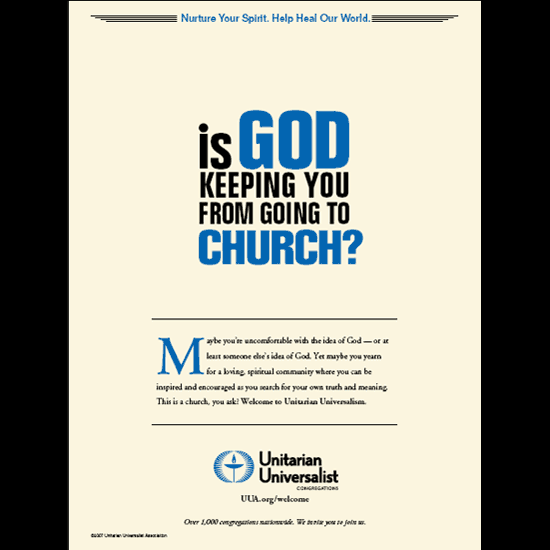
The Unitarian Universalist Association’s national advertising campaign has begun. Advertising in Time Magazine began with the October 15, 2007 issue and will continue over the next several months with placements such as this UUA print ad (also shown to the left).

According to the UUA’s press release, the Time.com Religion Pages will offer links to articles and essays authored by Unitarian Universalists on topics including: the relationship between religion and science; the role of religion in American democracy; and religion, morality, and sexuality.

I certainly applaud the goals of the campaign and believe such an effort is long overdue. Our denomination will always debate issues of the relative merits of any continental efforts and their impacts on congregational polity. But, I personally feel that the relative benefits far outweigh the potential harm.

That said, this first print ad even made me cringe just a little. “Is God keeping you from going to church?” I do understand the desire to be catchy, even controversial, in getting the reader’s attention. The ad certainly appeals to the atheistic, yet religious person within me. But, I have no doubt that many Unitarian Universalists will see this ad and explode in anger over what they will perceive as an anti-theist tone and the heavy reliance on the term “church.”

I will not be one of those criticizing the ad (do not, however, ask me what I think of the new UUA web site, grrrrr). For while I deeply respect those who might find the ad objectionable (and I have no doubt that conversations will continue for many weeks), I will suggest that nearly any attempt to attract broad public interest in Unitarian Universalism in eight words will displease many dedicated UU’s. The reality, however, is that we certainly will never get the millions of readers of Time magazine to read Channing’s Baltimore Sermon or Ballou’s “Treatise on Atonement.” Even the text of the seven principles is too long for the average modern attention span. I do not see this as sufficient reason not to produce such a campaign.

We are a tiny denomination – a soft voice amidst a cacophony of shrill shouts. And yet, we have evidence that many people share our religious philosophy, but are simply unaware that we exist. I see no harm in helping people learn that we are here and that we welcome them with open arms; in fact I believe we have a duty to make our presence known. I see no way to make this omelet without breaking eggs.

The key, in my opinion, is to assess the materials and calmly reflect before reacting one way or the other. Then, encourage discussion in your church, congregation, fellowship, society about the issues. Most importantly, now is the time that we should all pay extremely close attention to our visitors. For while we may take issue with this campaign or its specific contents, the result may be to bring people through our doors asking that question that so many of us have asked — “Where have you people been all my life?”